
Ryan Coogler explores hip-hop and exploitation in Sinners, his groundbreaking horror-action film that has rapidly become the second highest-grossing movie in the U.S. this year, just behind a popular family franchise. Set for digital release on June 3, Sinners has propelled Coogler onto the list of America’s fifty top-earning directors, cementing his place not just with blockbuster sagas like Black Panther and Creed, but with a story steeped deeply in cultural legacy and music history.
A Horror Story Rooted in Music and Echoes of the Past
Sinners draws from a unique intersection of vampire myth and delta blues, weaving together the Black American experience—past, present, and future—over the course of a single stifling day in 1932 Clarksdale, Mississippi. The film‘s foundation is inspired by Coogler’s own great uncle, James Edmonson, whose devotion to blues legends like Albert King and Buddy Guy influenced Coogler’s exploration of the genre, even though his own upbringing was more closely tied to hip-hop. Coogler immersed himself in blues, recognizing its power as a soundtrack of defiance, struggle, and community—parallels he found echoed in hip-hop’s evolution.
“It’s a story of echoes and those echoes colliding,”
—Ryan Coogler, Director and Writer
The blues served as Coogler’s gateway, but hip-hop remained his home language. As he recounted to Rolling Stone from his Oakland home, the town’s rich musical legacy—spanning MC Hammer’s rise, the gangsta rap movement, and Tupac’s influence—deeply shaped his sense of identity and artistic direction. Blues, he says, became key to understanding hip-hop’s own ancestral roots.
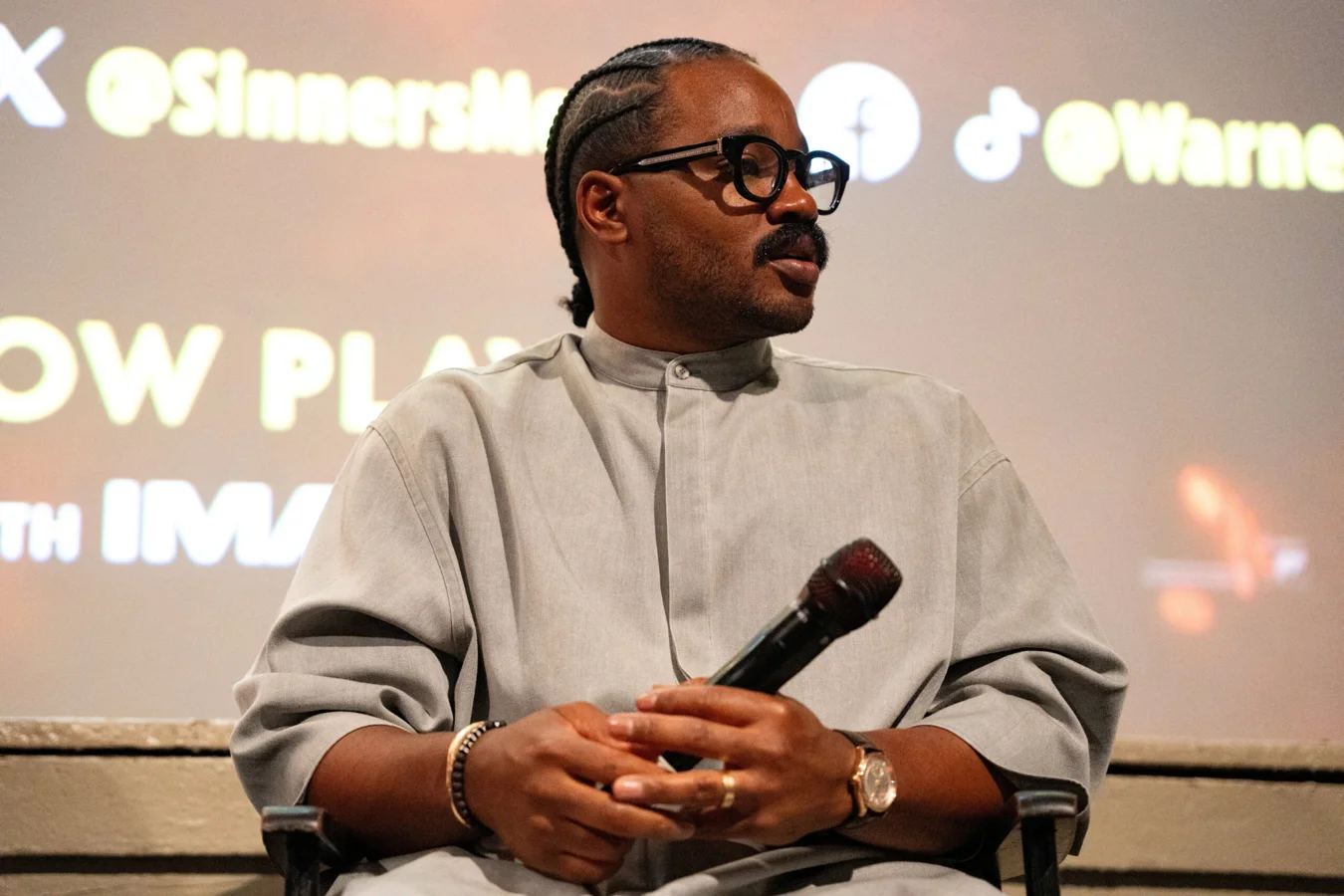
“Blues is the entry point to the movie for me, but if blues was the entry point, hip-hop was the car that I was driving in,”
—Ryan Coogler, Director and Writer
“For every music that I come across in my life experience, hip-hop is what I know as being mine. It’s my native language. And so for me to really feel like I could make this movie, I had to truly understand that blues was hip-hop’s ancestor.”
—Ryan Coogler, Director and Writer
Twins and Survival: Gangsta Rap and Blues Parallels
Coogler equates the hard-edged stories of blues with the grit found in gangsta rap, an ethos embedded in his protagonists: the twins Smoke and Stack, played by Michael B. Jordan. Survivors of World War I who navigated Chicago’s crime underworld alongside Al Capone, they return to Clarksdale to open a juke joint for local sharecroppers. Though not musicians, their pursuits are shaped by a relentless drive for wealth, depicted through scenes of negotiation, intimidation, and at times, violence—motifs mirroring both exploitation and aspiration central to American music history.
Dance Montage: Connecting Generations Through Ritual
The film’s core confrontation between blues, hip-hop, and traditional African music arrives in a supernatural dance montage, choreographed by Aakomon Jones. Here, protagonist Sammie “Preacher Boy” Moore—brought to life by Miles Caton—emerges as a gifted musician channeling the West African griot heritage. This spellbinding sequence unfolds as Sammie plays “I Lied to You,” conjuring ancestors and future generations onto a dancefloor crowded with characters from every era: from masqueraders and drummers to b-boys and California-style dancers. Parliament-Funkadelic-style guitars, trap beats, and the blues blend in a scene that erases boundaries between past, present, and future.
“A lot of us know blues because of hip-hop,”
—Aakomon Jones, Choreographer
“We know funk, jazz, rock & roll, and then you get to the origin of all of those things, it all stems from an African diaspora.”
—Aakomon Jones, Choreographer
Within this ancestral gathering, Delta Slim, a bluesman mentor, frames the juke joint ritual as a communal act of healing:
“With this here ritual, we heal our people, and we be free.”
—Delta Slim, Bluesman Mentor (narration in film)
Personal Connections: Family, Community, and Musical Inheritance
For Coogler, the supernatural elements resonate as much with family gatherings as they do with folkloric tradition. He shared moments from his wife Zinzi’s recent fortieth birthday—photos capturing three generations dancing, children snapping photos, and elders enjoying themselves—drawing a line between his personal life and the intergenerational energy at the heart of Sinners.
“For me, that scene is my life,”
—Ryan Coogler, Director and Writer
Coogler’s own family, having endured the upheaval of the post-slavery Jim Crow era and subsequent migration from the South, became a testament to resilience and togetherness—a narrative he saw as inseparable from Sinners’ depiction of Black life under brutal historic conditions. He explained his sense of responsibility in depicting both the suffering and the joy:
“There was a time in the ’90s when that was us every weekend, what happened at the Juke joint,”
—Ryan Coogler, Director and Writer
“This country made it its business to split my ancestors up, whenever it was financially beneficial for certain individuals,”
—Ryan Coogler, Director and Writer
“I got a family who was very intergenerational since slavery was abolished. They fled the Jim Crow South. We make it our business to stick around each other. I could not justify [making] a movie with vampires biting into people’s necks without showing this part of me; showing these people – that drew the straw of being born and dying in the height of sharecropping, miscegenation laws, and these back-breaking, dehumanizing, racist policies – with their descendants having a good time. Music is magical. That was the A side to the B side of everything else. Hip-hop has its place in that.”
—Ryan Coogler, Director and Writer
The Art and Science of Movement: Creating Visceral Reactions
Coogler and Jones designed the montage to traverse dances and styles across decades and continents, from West African griot and Zaouli traditions to Memphis jookin’ and West Coast street dance. It was a celebration, but also a provocation meant to spark conversation among audiences with different perspectives on Black culture and performance.
“I’m like, ‘the fuck?’ You had me at hello”
—Aakomon Jones, Choreographer
“I wanted to feel as close to a great blues record as it could,”
—Ryan Coogler, Director and Writer
“The thing about a great blues record that I found in studying, it’s like it fucking never gets old. Each time you hear it, you find new things.”
—Ryan Coogler, Director and Writer
He reflected on how the technical complexity of Black art is often dismissed, praising Jones and others whose mastery goes underappreciated. Referencing the famous “moonwalk,” Coogler noted the difficulty behind performances that might seem effortless but demand rigorous artistry and scientific understanding.
“That’s why I like rockin’ with Aakomon, seeing how he breaks down movement. When done properly, the moonwalk looks easy, but if you ever have tried, you realize, ‘Oh, this is incredibly scientific and artistic.’ To the eye that’s steeped in Western hierarchical observation, it can look very easy and dismissible.”
—Ryan Coogler, Director and Writer
Music, Morality, and Social Tension in the Juke Joint
Sinners places the cultural tension squarely within the plot as Sammie’s father, a stern pastor played by Saul Williams, decries the juke joint for drawing people away from church and family responsibilities. The club overflows with alcohol, gambling, and passion, embodying the classic points of friction between spiritual obligation and the pursuit of release through music and dance.
“drunkards and philanderers who shirk responsibility to their families so that they can sweat all over each other.”
—Sammie’s Father (Pastor), Character in Film
For many characters, the juke joint was less a place of moral decay and more an urgent space for fleeting freedom—a direct throughline from blues to hip-hop’s origins.
From the Blues to Hip-Hop: Repeating Patterns of Vilification
In Sinners, the juke joint’s reputation as a den of sin mirrors the historic demonization hip-hop faced as a creative outlet for marginalized communities. Emerging in the Bronx during the economic crises of the 1970s, hip-hop was both blamed for social problems and celebrated for fostering community when traditional avenues were closed. As Coogler notes, both blues and rap have sparked misgivings, policing, or outright bans—responses echoing fears of youth culture and Black innovation.
“It’s always demonized, man, whatever the youth is doing,”
—Ryan Coogler, Director and Writer
“That’s a human thing. It’s not just a Black thing.”
—Ryan Coogler, Director and Writer
“Look, you take the vampires away, everybody at that juke joint was doomed,”
—Ryan Coogler, Director and Writer
“Nobody in the movie is binarily wrong or right. It is a danger to all forms of music.”
—Ryan Coogler, Director and Writer
Exploitation and the Commodification of Feeling
The film resonates with the dangers of artistic exploitation that have haunted both the blues and hip-hop. Coogler points to Kendrick Lamar’s references to Faustian bargains in the music business and the legendary story of blues guitarist Robert Johnson, whose supposed deal with the devil underscores the costs of fame. In Sinners, this theme is depicted through antagonist Remmick’s offer of eternal security to Black musicians—if they surrender their humanity.
“No matter what, [if] you good enough at music, somebody’s coming to exploit you or worse,”
—Ryan Coogler, Director and Writer
“If you good enough at anything.”
—Ryan Coogler, Director and Writer
Coogler addressed the history of “race records”—how Black artists laid the foundation for genres like rock & roll, only to have the rewards diverted to white performers and corporate executives. He traced this form of exploitation from the music industry into film, pointing out that the structures behind both borrowed from the same systems of inequity.
“When you run a clock back far enough, you’ll learn that all the Black music used to be called race records. If a Black person sang a song and a white person sang a song, same lyrics, same music, same structure, same everything, they’ll take the Black song as a race record,”
—Ryan Coogler, Director and Writer
“Who gets paid what?” —Ryan Coogler, Director and Writer
“Who goes on what tour? What goes on what radio waves? The film industry is related to the music business. It’s a younger industry. When it was crafted, the crafters were looking at the music business and saying, okay, ‘Okay, well, what can we do that’s like that?’”
—Ryan Coogler, Director and Writer
Vampires as Metaphor: Power, Loss, and Connection
The vampiric elements—led by the white Irishman Remmick seeking to harvest Sammie’s magical gifts—symbolically evoke the persistent, systemic extraction of Black creativity by more powerful, often white-controlled interests. While the metaphor might appear clear, Coogler resists narrowing the film’s focus to a single allegory about racial exploitation, arguing for a broader meditation on the commodification of feeling and art itself.
“I told myself in this movie, I wouldn’t go so far into any specific allegories or anything like that,”
—Ryan Coogler, Director and Writer
“I was trying to communicate a feeling more than any specific allegory. The film is essentially about a feeling being commodified.”
—Ryan Coogler, Director and Writer
“It’s not the vampires doing that; the vampire is not charging anybody money for a feeling,”
—Ryan Coogler, Director and Writer
“I was very interested in the twins. If the vampires never showed up, who are the vampires in this movie? Who was the first person to recognize Sammie’s gifts and see some money? Who’s scary? Who’s everybody afraid of in this movie? It had to be a tapestry the vampires were a part of.”
—Ryan Coogler, Director and Writer
Shared Pursuits of Freedom and Belonging
The film ultimately presents the money-driven pursuits of twins Smoke and Stack not merely as greed but as a desperate search for self-determination—a motivation shared by antagonist Remmick, whose own struggles as an Irish immigrant bereft of roots echo those of the Black protagonists. The narrative reveals how repeated histories of exploitation ripple across communities and generations, shaping lives and creative expression long after the initial wound.
“He was looking for people who he could relate to,”
—Ryan Coogler, Director and Writer
“Music ain’t the only thing that echoes. Everything echoes. When people are systematically exploited, that exploitation echoes. You’re more likely to get swindled in a place where a lot of people exist who have been swindled. People know what it feels like to be on the other side of a deal.”
—Ryan Coogler, Director and Writer
What Sinners Means for Black Art and Film
Sinners is more than a haunting genre film; it stands as an intense meditation on music, ancestry, and the cycles of exploitation faced by Black artists across generations. Its interlocking themes resonate with the lives of its characters, its creators, and American history itself—an intricate pattern of echoes that continues to shape the present. With the film’s digital release, audiences nationwide will soon have the chance to reflect on how the past reverberates through new forms, and how Coogler’s creative vision pays tribute to the resilience, complexity, and ongoing evolution of Black culture within American cinema and music.
