
Nick Offerman delivers a haunting performance in Sovereign, a deeply unsettling crime drama premiering at the 2025 Tribeca Film Festival, examining the far-reaching consequences of extremist ideologies and the fraught relationships between fathers and sons. Set against the backdrop of true events from West Memphis, Arkansas, the film unspools the terrifying legacy passed from one generation to another through the story of Jerry Kane, a figure drawn directly from America’s dark corners.
Well known for his comedic and stoic turns as Ron Swanson in Parks and Recreation, as well as his acclaimed guest role as Bill in The Last of Us, Offerman’s portrayal of Jerry Kane marks the starkest shift yet in his career. In Sovereign, he brings to life a character warped by anti-government paranoia, obsessive beliefs, and desperate attempts to prepare his son for what he views as a war against authority. His performance diverges into uncharted emotional territory, probing the vulnerabilities and deeper tragedies beneath the hardened surface.
Exploring Twisted Patriotism and Extremism
Sovereign draws viewers into the insular, dangerous world of the sovereign citizen movement, inspired by acts of violent defiance that shook Arkansas in 2010. Offerman plays Jerry Kane, a widower and out-of-work roofer who supports himself by running debt relief seminars, targeting Americans at risk of losing their homes. He raises his 15-year-old son, Joe, portrayed by Jacob Tremblay, through a regimen of fringe homeschooling that isolates and indoctrinates the boy. As Jerry drags Joe to gatherings in church basements around the country, both appear in signature white suits, surrounded by camouflage-clad men eager for solutions and validation.
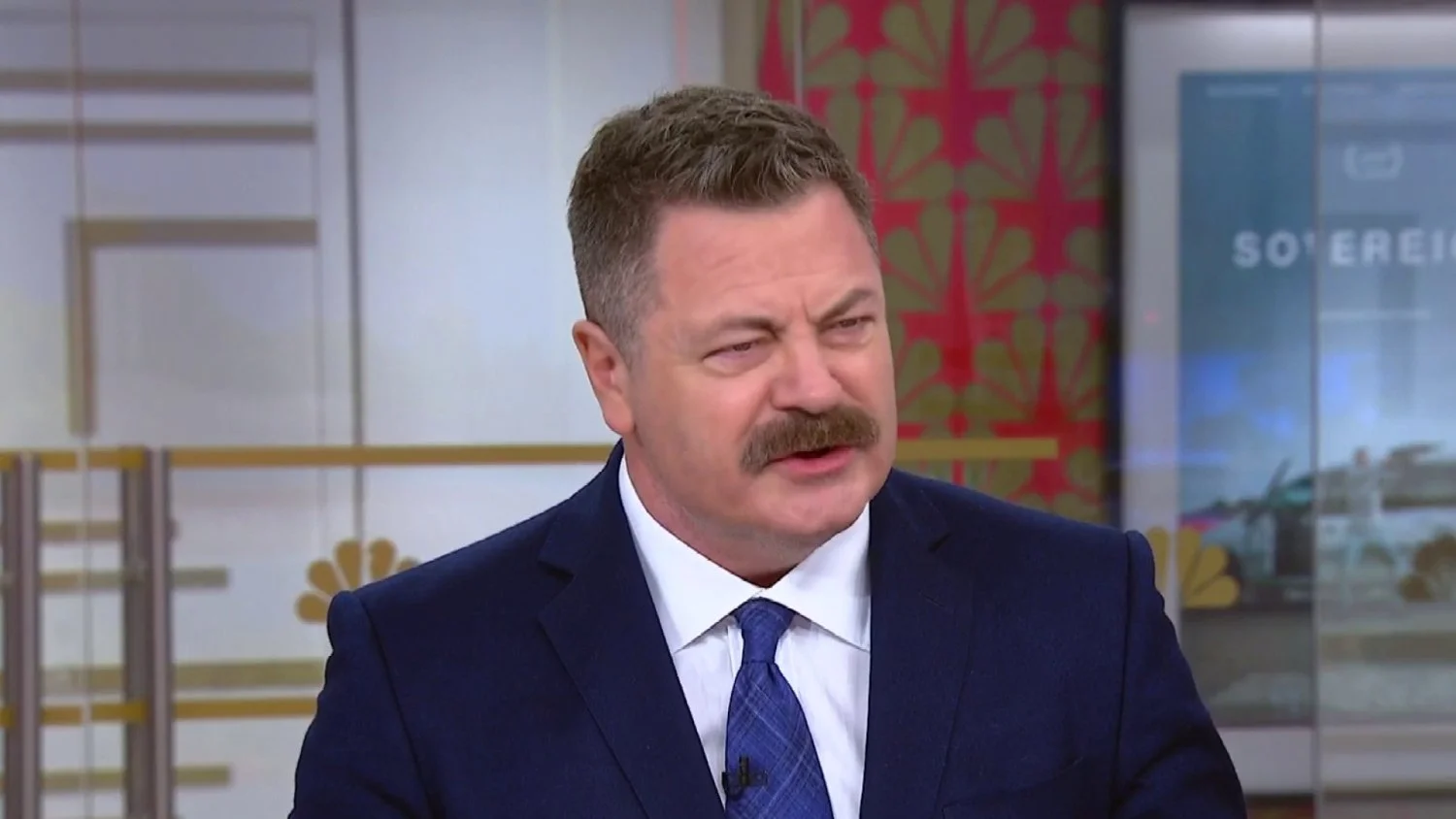
The film depicts how Jerry passes on warped lessons, using biased teaching and misinformation to transmute his own rage and disillusionment into his son’s developing worldview. This process, marked by unregulated homeschooling and isolation from peers, is central to how Sovereign explores its core themes—how extremist ideas take root, how father-son intimacy is shaped and twisted, and why some dangerous legacies persist across generations.
Main Characters and Their Complex Relationships
Nick Offerman embodies Jerry Kane, whose anti-authority convictions drive much of the film’s narrative intensity. Jacob Tremblay, as Joe Kane, delivers a nuanced performance, communicating the boy’s deepening inner conflict as he is pulled between loyalty to his father and glimmers of moral awareness. The cast also includes Dennis Quaid in the role of John Bouchart, a local police chief and father to Adam (played by Thomas Mann). Quaid’s character influences his adult son in different ways—training him for police work but also pushing a “tough love” approach as Adam begins his own journey into fatherhood with a newborn son.
The parallel between Jerry’s and John’s approaches to parenting highlights broader themes. Where Jerry’s method is overtly domineering and radical, John’s stern discipline carries its own risk of perpetuating generational cycles. These contrasting relationships serve as the backbone for the film’s meditation on fatherhood, aggression, and the dangers inherent in unchecked authority, both at home and in society at large. The empathy with which writer-director Christian Swegal navigates these patterns lends the film a sense of complexity, avoiding simple judgments.
Sovereign Citizens and Their Worldview
The Federal Bureau of Investigation describes sovereign citizens as
“anti-government extremists who believe that even though they physically reside in this country, they are separate or ‘sovereign’ from the United States.”
—Federal Bureau of Investigation
Within the film, Jerry Kane’s worldview exemplifies this ideology to its most extreme degree. The movie delves into beliefs rooted in the rejection of government authority—from law enforcement to tax collection—and presents the sovereign citizen movement as both delusional and dangerous, its members viewing all rules as artifices imposed by a manipulative state.
Jerry perpetuates claims that the monetary system is a fabrication and that
“rights are given to us by God,”
using religious rhetoric to justify his actions and refusal to adhere to societal norms. This radical belief system is revealed to stem in part from his own upbringing; a formative moment from Jerry’s childhood, when his father insisted that schools deliberately mislead students, illustrates how such distrust can be passed down and amplified across generations.
The Ripple Effect of Indoctrination and Toxic Masculinity
Sovereign sharply focuses on the cycle of indoctrination and the consequences of isolating a young person from broader society. Joe Kane grows up nearly alone—deprived of meaningful friendships, basic necessities, and the experience of social structures most children take for granted. His only respite is the distant affection he feels for Candace, portrayed by Kezia DaCosta, whom he observes longingly through her window and social media. The film refrains from reducing its topic to simple labels, such as “toxic masculinity,” but instead interrogates how radical ideas and emotional suppression flourish in the absence of support and oversight.
Joe’s struggle with his father’s teachings becomes a silent, constant battle. The film shows this conflict in moments where Joe, often behind a camcorder, watches Jerry’s rants and sees the disconnect between his father’s fear and the world outside. Jacob Tremblay’s performance conveys both apprehension and subtle resistance, making his journey profoundly affecting for viewers who remember his rise from Room to now.
The Dangers and Humanity Within Extremism
Some of Jerry’s pronouncements appear absurd—at one point, he compares government-issued social security numbers to “the mark of the beast.” But beneath these eccentricities lies a far more menacing reality. Jerry, whose patience is frayed by looming foreclosure and personal loss, arms himself and openly threatens violence. His rhetoric escalates:
“What we’re after here is not fighting, it’s conquering,”
he says.
“I mean, I don’t want to have to kill anybody, but if they keep messing with me, then I’m afraid that’s what it’s going to have to come down to.”
—Jerry Kane, as depicted in the film
This volatility, captured unflinchingly in Swegal’s direction and Offerman’s performance, makes Sovereign especially unnerving. The film is careful to show the impact on those who surround Jerry: the acolytes at his seminars, the vulnerable students, and above all, his son, whose inner turmoil becomes a quiet indictment.
Slices of Americana and Fleeting Moments of Compassion
Despite its grim subject, Sovereign does not paint all its characters with a single brush. Jerry, for all his flaws, is shown capable of tenderness—most notably in his relationship with Lesley Anne, played by Martha Plimpton, a regular attendee at his debt relief talks. Jerry encourages Lesley Anne to confront her childhood fears, offering rare glimpses of softness amongst the harshness.
The film uses animals—the Kanes’ dog, Adam’s baby—as symbols of hope and vulnerability, cutting through the bleakness with moments of sensitivity. Swegal employs dreary lighting and nostalgic visuals, from chain stores in the background of tense shootouts to shots of the dog racing through the suburbs of Arkansas, creating a powerful sense of place and loss.
Sovereign’s Place in American Cinema and Its Implications
With its neutral but intense depiction of law enforcement, complicated fathers, and corrupted sons, Sovereign stands as a significant feature debut for Christian Swegal. The film’s meticulously crafted visuals, supported by emotionally charged performances from Nick Offerman, Jacob Tremblay, and Dennis Quaid, resonate long after viewing, holding a mirror to patterns of pain and resilience in American families.
Sovereign had its world premiere at the 2025 Tribeca Film Festival and is scheduled for release in theaters on July 11 through Briarcliff Entertainment. Its focus on the mechanisms that drive extremism, the interplay of compassion and violence, and the inheritance of broken worldviews ensures it will spark intense discussion and reflection upon release. Through Offerman’s haunting portrayal and Swegal’s uncompromising vision, Sovereign illuminates the dangers lurking at the intersections of ideology and intimacy.
