
Wes Anderson’s new film, The Phoenician Scheme, offers his signature visual quirkiness but falters with a conflicted narrative, prompting both fascination and fatigue for fans and critics alike. This Wes Anderson The Phoenician Scheme review examines how Anderson’s meticulous artistry coexists with storytelling that is, at times, uneven and divisive.
Anderson’s Distinctive Cinematic Signature
Wes Anderson is no stranger to labels such as “auteur,” frequently cited in both academic and cinephile circles. Like the works of the late David Lynch, Anderson’s films are instantly recognizable for their carefully composed frames, consistent comedic undertones, and recurring ensemble cast. Bill Murray’s presence in almost every Anderson project is a familiar anchor, and in The Phoenician Scheme, he appears once again—though this time in an unexpectedly divine role.
As with Anderson’s previous films like The Life Aquatic and The Grand Budapest Hotel, The Phoenician Scheme demonstrates consistency in style, set design, and character eccentricities. The lush production, highly stylized environments, and symmetrical camera work once again illustrate his dedication to visual storytelling, invoking the influence of legendary directors such as Kubrick, Billy Wilder, and Francois Truffaut.
Plot Overview: Ambition in the Desert
At the heart of the story is Benicio Del Toro’s Anatole Zsa-Zsa Korda, a robber baron industrialist scheming to overhaul the infrastructure of the fictional desert country of Phoenicia. While Korda orchestrates grand plans for the nation, he faces relentless threats; enemies attempt assassination and sabotage, but he always slips away, though often without reliable transport or pilots.
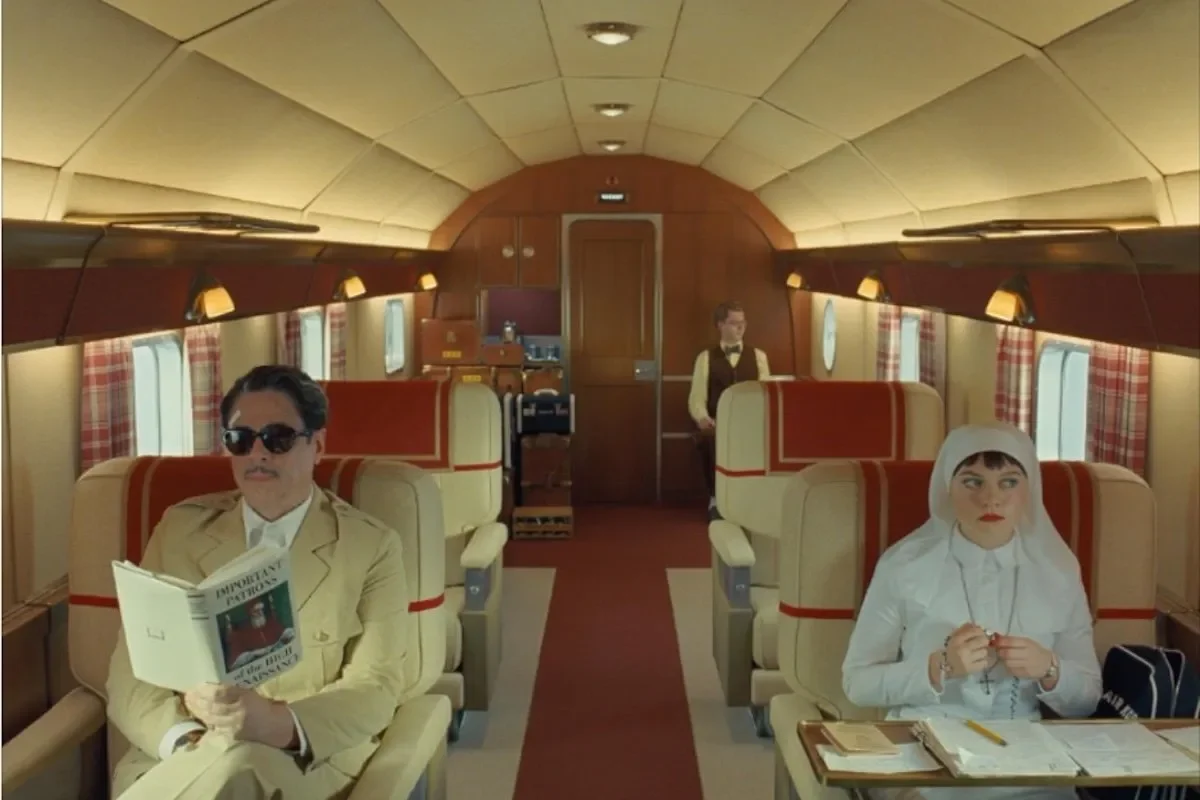
Korda’s future depends on appointing a successor, and among his ten children—nine sons in an Italian boarding school—he favors his daughter Liesl, portrayed by Mia Threapleton. Liesl’s suitability is complicated: she is training as a nun and lacks her father’s moral ambiguity. Doubts even linger about her true parentage, possibly linking her more closely to Korda’s enigmatic half-brother, Nubar—
“The son of my father, your uncle Nubar.”
—Nubar, half-brother
Character Dynamics and Thematic Layers
Korda’s secrets and ambitions are stashed in literal shoeboxes, which provide narrative guideposts for the film’s semi-episodic journey. Key sequences unfold, such as a tense meeting in a railroad tunnel where Korda and Liesl engage with new business partners, played by Tom Hanks and Bryan Cranston. A comic dispute is settled through a basketball game, humorously highlighting Korda’s lack of athletic prowess.
Liesl’s presence brings a moral lens to the proceedings. She often observes her father’s blunders from the sidelines while forming a tentative bond with Bjorn, an entomologist portrayed by Michael Cera. Her gradual transformation comes in small steps—a first taste of beer with Bjorn signals cracks in her façade of innocence, and her spiritual doubts suggest an internal struggle to maintain her convictions.
Throughout the film, Liesl’s journey raises questions about inherited character and the performance of virtue. Her actions, rituals, and even her moments of forgiveness often feel performative, suggesting that she may be more like her father than she realizes.
Stylistic Influences and Artistic Allusions
The Phoenician Scheme brims with tributes to mid-20th century cinema. Anderson’s admiration for films such as Dr. Strangelove, The Apartment, and the French New Wave (notably The 400 Blows) is keenly felt. The structural and thematic nods to these classics are unmistakable, whether through satirical narrative choices or deadpan performances reminiscent of Peter Sellers and Jack Lemmon.
This intricate layering of references elevates Anderson’s latest effort to something akin to cinematic high art, targeting audiences who enjoy parsing meaning and style from every frame. Yet, it is a sensibility not universally shared; some, including the academic and cinephile crowds, find this approach rewarding, while casual viewers may disengage.
Performance Highlights and Notable Contributions
Benicio Del Toro commands the film with his portrayal of Korda, lending depth to a character whose shameless ambition is matched by vulnerability. Mia Threapleton’s Liesl delivers a complex mix of innocence and calculation, though her subplot veers toward the satirical, sometimes diminishing its overall resonance. The film’s visual inventiveness shines through, especially in fantastical moments where Korda encounters God and celestial proceedings—represented by Bill Murray’s dryly comic performance as God.
Supporting roles by Tom Hanks, Bryan Cranston, and Michael Cera introduce additional comedic dynamics and heighten the film’s ensemble-driven energy.
Pros and Cons: A Double-Edged Experience
Among the film’s strengths, Benicio Del Toro stands out for his nuanced performance as the scheming Korda, supported ably by Mia Threapleton. Impressive set designs and camera work inject the film with visual flair, and the surreal interludes between Korda and the divine offer some of Anderson’s boldest creative choices.
However, the pacing suffers from intermittent lulls, and the portrayal of Liesl’s arc risks turning into parody, dragging down narrative momentum. This unevenness is likely to polarize viewers, especially those who expect from Anderson a seamless blend of humor and heart.
Lasting Impact and Expectations Moving Forward
While The Phoenician Scheme may not be the most accessible entry in Wes Anderson’s portfolio, its style and ambition are difficult to overlook. Longtime fans and critics will recognize the hallmarks of his direction woven throughout, alongside a willingness to embrace risk within the familiar. Anderson’s ongoing appeal remains sharper among devotees, yet casual audiences may find the film’s self-aware repetition exhausting.
In the end, the film’s most striking revelation remains the casting of Bill Murray as God, a playful capstone to Anderson’s signature whimsy. Whether audiences embrace or tire of Anderson’s approach, The Phoenician Scheme stands as a testament to his unwavering artistic vision—one that continues to divide and captivate in equal measure.
