
Taron Egerton Smoke crime drama, Smoke, makes a bold departure from the standard procedural model in its second episode, as Apple TV+ positions this new series as an intense exploration of character and motive. With a major twist revealing the arsonist early, viewers quickly discover that the show is more interested in why crimes are committed than in simply identifying the culprit.
When news broke that Taron Egerton would collaborate again with Dennis Lehane following their acclaimed project Black Bird, anticipation mounted among fans and critics. Their previous work resulted in an Emmy nomination for Egerton and was praised for its nuanced depiction of troubled characters. From the outset, Smoke seems poised to offer a classic story: Egerton’s Dave Gudsen, a fire investigator carrying emotional baggage, pairs up with Detective Michelle Calderon, portrayed by Jurnee Smollett, to navigate a spree of arson incidents wreaking havoc across their community. However, just two episodes into the season, the creators upend expectations, setting the series down a darker and more psychologically complex path.
Breaking from Tradition: Smoke Prioritizes Character Over Whodunit
At first glance, the framework of Smoke feels familiar. Dave Gudsen is established as a diligent fire investigator with a troubled past. Together with police detective Michelle Calderon, he begins untangling a sequence of mysterious fires that have left residents anxious. Their mission seems straightforward: track the arsonist and solve the case before more chaos unfolds.
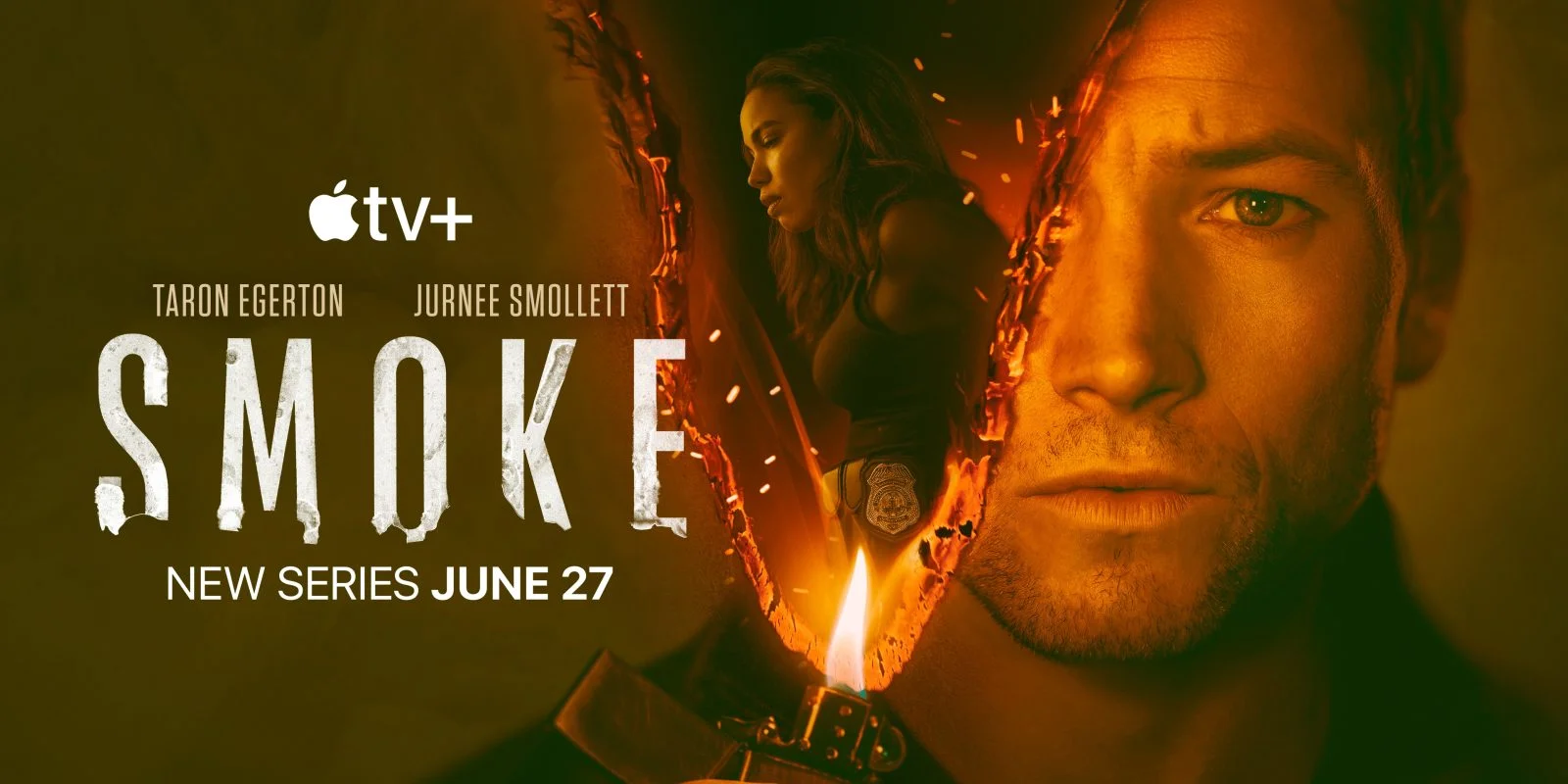
The tone of the show quickly changes in Episode 2, titled “Your Happy Makes Me Sad.” After a heated argument at home involving Dave’s wife, Ashley (played by Hannah Emily Anderson), and her son, viewers catch a glimpse of Dave’s turmoil. The narrative shifts to a suspenseful scene viewed through the eyes of a limping figure in a green jacket—the very clue that has captivated the investigation team. In a stunning reveal, the audience learns that Dave himself is the arsonist. This revelation marks a significant departure from the procedural expectations set in the premiere episode, redefining the central mystery into one concerned with motivation, psychology, and duality.
Suddenly, Smoke becomes less about piecing together evidence and more about unraveling the depth of Dave’s concealed life. Viewers are left to wonder how long he can keep this secret and what drives him to such self-destructive extremes. Anxiety builds as Dave’s private and public identities inch ever closer to catastrophic collision, with his coworkers and family oblivious to the tragic double life he leads.
Episode 2’s Twist Transforms Smoke Into a Psychological Character Study
The moment Dave is unveiled as the arsonist, the show takes an unexpected turn. Once a principled investigator with literary dreams and a collection of personal secrets, Dave now becomes the primary subject under scrutiny, shifting the genre away from a conventional investigation drama. Smoke aligns itself more closely with psychological explorations like Breaking Bad or The Americans rather than with standard American procedurals.
With the audience granted more insight into Dave’s hidden actions than his colleagues, the show generates a lingering, unsettling tension. Now it is not the question of “who did it?” but “why did he do it?” and “when will his world unravel?” that drives the suspense. The interplay between Dave and those around him, especially Michelle Calderon, gains new layers of dramatic irony and intensity.
This narrative choice distinguishes Smoke from the formulas of typical U.S. procedural shows, feeling more akin to the tone of many UK dramas. Shows like Broadchurch, Hidden, and Line of Duty opt to probe motive and consequence, focusing less on the act itself and more on the underlying psychology fueling it. By following this tradition, Smoke elbows its way into an echelon where the study of trauma and hidden agendas becomes the real heart of the story, using the ongoing investigation as a lens to examine personal downfall and fractured morality.
The dynamic cast further sets the series apart. Jurnee Smollett’s turn as Michelle injects a sharp, sincere energy to the quest for truth, while Greg Kinnear appears as Harvey Englehart, the unyielding chief of the Umberland Fire Department, supplying additional tension and oversight that keeps Dave under constant subtle pressure.
Smoke officially premiered on June 27 on Apple TV+, and from the outset makes it clear that it has no interest in playing it safe. The revelation of Dave’s true nature elevates the stakes, promising viewers an unpredictable and challenging narrative as the season unfolds.
How the Unmasking Reshapes Relationships and Raises the Stakes
With Dave’s secret out in the open for viewers, but hidden from his colleagues, every interaction becomes fraught with new danger. Michelle Calderon is convinced the police have not yet caught the right person, and she becomes even more committed to finding the arsonist behind the latest crime spree. As she and Dave continue to collaborate, unaware of his guilt, dramatic irony intensifies—the audience knows what Michelle does not, and that dread is palpable with every new fire and investigation.
The involvement of characters like Harvey Englehart adds extra friction to Dave’s daily existence. As the chief of the Umberland Fire Department, Englehart keeps a close eye on both the investigation and his staff. With each new case, suspicions have the potential to surface, as the accumulating evidence may reveal inconsistencies in Dave’s story. Each meeting, every strategy session, and all shared information between Dave, Michelle, and Englehart is weighted by the underlying threat of exposure and the devastating consequences that would follow.
Smoke disrupts the conventions that have come to define shows like 9-1-1 or Chicago Fire. Unlike these series, which typically focus on rescuing innocent victims and tracking down perpetrators from a purely righteous perspective, Smoke dares to place its focus on a lead character who is both the hero and the villain. The show’s willingness to humanize Dave, presented in all his complexity and contradiction, sets it apart. Egerton’s portrayal ensures Dave Gudsen comes across as multidimensional—flawed, haunted, and desperate.
As the season continues, the looming questions remain: How long can Dave maintain the deception? Who will be the first to suspect? And what will the fallout be when the truth inevitably surfaces? All of these threads promise a suspenseful ride that goes far beyond the confines of a typical firefighter drama.
Award-Worthy Performances and a New Direction for Crime Dramas
Taron Egerton’s performance anchors the show, harnessing experience from his diverse filmography—most notably, Black Bird, Rocketman, and the Kingsman franchise. Even within just the first two episodes of Smoke, Egerton delves into the turmoil and ambiguity of Dave’s character with a new level of nuance. He exposes Dave’s inner darkness and conflicting loyalties, lending credibility to the show’s ambitious tonal shifts. Dennis Lehane’s knowledge of Egerton’s capabilities ensures that the actor is given space and material to thrive in a complex leading role, helping Smoke push beyond standard expectations for the genre.
The supporting cast, including Jurnee Smollett as Michelle and Greg Kinnear as Harvey, brings additional weight to the drama. Their roles become increasingly significant as the investigation progresses and as suspicions begin to arise. Hannah Emily Anderson’s depiction of Ashley, Dave’s wife, adds critical emotional resonance, revealing how Dave’s double life impacts those closest to him.
As a series, Smoke breaks away from formulaic storytelling and introduces riskier, more emotionally charged plots that keep audiences invested. Its willingness to abandon the season-long secret in favor of immediate, character-driven conflict feels daring and fresh—providing not just action and suspense, but a thought-provoking look into the complexities of guilt, obsession, and self-destruction.
With seven episodes remaining in the season, and Egerton at the center of a spiraling crisis, Smoke sets the stage for an ongoing exploration of morality, personal ruin, and the choices that separate hero from villain. By shifting the focus from solving crimes to understanding the motivations behind them, Apple TV+ delivers a drama that stands out from the pack and leaves viewers eager to see how far Dave Gudsen will fall—or if redemption is possible at all.
The cast at the heart of this tense tale features Taron Egerton as Dave Gudsen, Jurnee Smollett as Detective Michelle Calderon, Hannah Emily Anderson as Ashley, and Greg Kinnear as Chief Harvey Englehart. Together, they create a riveting narrative where secrets threaten to destroy not just individuals but the fragile bonds holding their community together.
Smoke tells the gripping story of an arson investigator and a police detective, united against cunning arsonists, but drawn ever deeper into a web of shifting allegiances and buried truths. As the plot unravels, viewers find themselves caught between empathy and outrage, compelled to watch a man’s inner demons blaze out of control.
For audiences and enthusiasts of intense and energetic storytelling, Taron Egerton Smoke crime drama on Apple TV+ promises a thrilling journey—one where the most dangerous threat may not be the fires tearing through the city, but the secrets burning within its lead character.
Our Reader’s Queries
Q. Is Taron Egerton LGBTQ?
A. After some people wondered about his sexuality, Egerton said that he enjoys supporting his gay friends, but he is not gay himself.
