
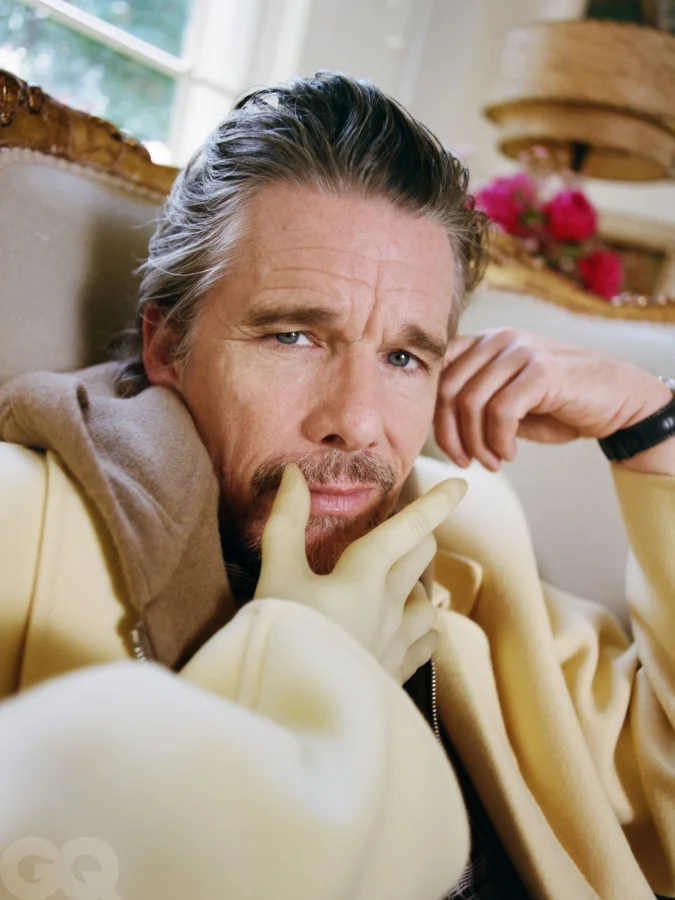
At the recent Telluride Film Festival in Colorado, Ethan Hawke emerged as a central figure, showcasing two very different films that highlight distinct facets of his talents. One film is a documentary he directed about country music legend Merle Haggard titled Highway 99: A Double Album, while the other is Blue Moon, a biopic in which he stars as the lyricist Lorenz Hart under the direction of Richard Linklater. These premieres coincided with Hawke receiving a Telluride medallion tribute, marking a noteworthy milestone amid the festival’s celebrations.
A Festival Veteran’s Unconventional Press Engagement
Hawke demonstrated his approachable nature and festival savvy by choosing to meet the press at Telluride’s casual Baked in Telluride walk-in eatery, surprising onlookers who were enjoying pizza nearby. During this informal setting, he discussed the remarkable coincidence of premiering two songwriters’ biographical films simultaneously in the mountain town, one featuring his directorial work and the other a starring role that has already attracted Oscar buzz. His presence at the festival has been consistent since his directorial debut there in 2015.
The Evolving Relationship Between Hawke and Telluride
First appearing at Telluride with Seymour: An Introduction, a documentary about pianist Seymour Bernstein, Hawke returned in various capacities over the years. He starred in Paul Schrader’s First Reformed and directed a film about Flannery O’Connor starring his daughter. Now, Telluride has hosted his fourth and fifth premieres, although Highway 99 had limited screenings due to its lengthy runtime of over three hours with an intermission, leaving some passholders unable to attend. Blue Moon is slated for release this fall while the Haggard documentary is actively seeking distribution.
Reflecting on a Special Tribute Day at Telluride
During his tribute on the festival’s opening day—playfully dubbed “Ethan Hawke Day” by Richard Linklater—Hawke admitted to a bittersweet feeling as the celebrations concluded.
“I had to wake up this morning and be like, Ethan Hawke Day’s over. So sad. But I love this festival, and to have these two different parts of my life be represented here feels really cool,”
he shared. Hawke acknowledged the rarity of having two films about American songwriters premiere simultaneously, underscoring how this was unplanned yet significant for him.
Long Journeys to Telluride’s Premieres
While Highway 99 reflects two years of focused work, the project about Lorenz Hart materialized only recently after years of intermittent development. Hawke revealed,
“Rick and I have been talking about making Blue Moon for 12 years,”
describing their gradual but deliberate process of script readings and revisions before deciding,
“I think we’re ready. Let’s make this thing.”
He described Linklater’s patience as exceptional, adding of the director,
“He will make no film before its time.”
Contrasting Creative Processes Behind the Two Films
The two projects differ sharply in style and demands on Hawke’s artistic vision. He described Blue Moon as a challenging endeavor:
“Rick and I are trying to do what we’ve done our whole lives, but trying to grow up. The level of difficulty on this was…we both felt that we kind of reached the wall of our talent.”
In contrast, the documentary format of Highway 99 offered a more balanced pace over years of archival research, providing Hawke an outlet when not acting and nourishing his passion for music. He emphasized that though both films revolve around songwriters,
“they’re total different parts of my brain.”
The Shared Pain and Humanity of Merle Haggard and Lorenz Hart
Hawke reflected on the emotional depth both musical figures embody, saying,
“They’re both in tremendous pain, and I do think the songs spring (from that).”
He noted Merle Haggard’s expression of anger, confusion, and loss overshadowed at times by addiction, while Lorenz Hart’s pride was tied closely to his songs amidst personal decline. About Hart’s character in Blue Moon, Hawke remarked,
“He almost has no dignity except in these songs… Blue Moon is a story of a human being who died of a broken heart.”
The Surprising Emergence of Highway 99 at Telluride
Unlike Blue Moon, which has been in public conversation for years, Highway 99 was a relatively secret project until shortly before its Telluride debut. Hawke spoke of the documentary’s long gestation and last-minute editing breakthroughs with editor Barry Poltermann, who also worked on Hawke’s previous projects.
“I thought I found the movie…and then it kind of quickly (accelerated),”
he said. Despite having more material, Hawke felt the film was complete and submitted it to Telluride, which quickly accepted it into the lineup.
The Influence of Jason Fine and the Rolling Stone Connection
Hawke credited Jason Fine, an editor from Rolling Stone who transitioned into documentary production, as a pivotal figure in initiating the Haggard project. Their mutual passion for country music and Fine’s belief in Merle’s overlooked importance in American culture spurred conversations that grew into the film. Hawke noted the timely nature of the documentary, saying the 2020 election’s divisiveness made Merle—a non-dualistic thinker—an especially relevant subject to encourage unity beyond partisan divides.
Exploring Merle Haggard’s Complex Legacy
Hawke acknowledged the challenges in addressing Haggard’s complicated public image, especially the controversy surrounding “Okie from Muskogee.” He explained that the song’s meaning shifted in Merle’s own retellings, suggesting it reflected his father’s viewpoint rather than a fixed political stance. This ambiguity captured Hawke’s interest in portraying Merle not simply as a political figure but as a multifaceted artist. Hawke emphasized Merle’s extraordinary skill as a songwriter and musician, quoting Dolly Parton’s praise and pointing out Haggard’s unwillingness to embrace typical country star branding.
Merle Haggard’s Reluctance to Embrace “Outlaw” Branding
Unlike many country stars who capitalized on outlaw images regardless of their personal histories, Merle avoided such labels. Hawke recounted,
“He didn’t want a brand. He thought that was corny, that it was a lie.”
Highlighting Johnny Cash’s admiration, he shared the quote,
“Merle Haggard is the person I’m pretending to be,”
exemplifying Merle’s profound influence on his peers.
The Dynamic Soundtrack Featuring Contemporary Covers
A prominent element of Highway 99 is its incorporation of approximately 30 contemporary acoustic covers by artists such as Dwight Yoakam, Norah Jones, Los Lobos, Taj Mahal, Sierra Ferrell, Jason Isbell, Sturgill Simpson, and Tyler Childers. These performances deepen the film’s exploration of songwriting by allowing audiences to hear familiar songs through new interpretations, bridging past and present musical landscapes. Hawke explained,
“When you listen to somebody cover a song, you kind of listen to the writing of the song in a different way.”
Distribution Plans for the Documentary and Soundtrack Ambitions
Having premiered Highway 99 for the first time in Telluride, Hawke is optimistic about securing a distributor. He also expressed enthusiasm for producing a soundtrack album, envisioning collaboration with producer Shooter Jennings and reuniting with artists like Norah Jones to craft studio-quality versions of the covers. Hawke hopes this will extend the film’s reach and draw further attention to Merle’s songwriting legacy.
The Significance of Reviving Merle Haggard’s Story
Hawke believes that Highway 99 fills a crucial gap in American cultural storytelling by reintroducing Merle Haggard to new audiences. Quoting Bob Dylan’s high praise,
“He’s too big for Mount Rushmore,”
Hawke highlighted Merle’s sustained songwriting brilliance, which persisted across decades without fading. Hawke also revealed that Dylan’s dedication inspired Merle’s own ongoing creativity, quoting him:
“Everybody in the world knows Bob Dylan’s busting his ass to write another great song. Why aren’t I?”
Physical and Vocal Transformation for Blue Moon
Regarding his role as Lorenz Hart, Hawke described how it marked a departure from his previous acting choices. He revealed that earlier in his career he avoided roles requiring major physical or vocal alterations, wanting to stay close to his natural self. However, with Blue Moon, which required shaving his head, a large combover, and adopting an East Coast accent, he embraced stretching his boundaries. Hawke compared this to the earlier transformative role of John Brown in the miniseries The Good Lord Bird, calling both efforts expansions of his definition of naturalistic acting.
Perfecting the Character’s Voice and Period Authenticity
To capture Lorenz Hart’s voice and mannerisms accurately, Hawke recorded himself and shared these sessions with Linklater to adjust the tone and ensure authenticity. He emphasized how crucial it was to maintain period accuracy without making the voice sound cute or anachronistic, as breaking the audience’s immersion would weaken the film’s impact. Quoting director Peter Weir, he noted,
“You know, self pity plays for exactly a fraction of a second. No, that’s too long.”
Hawke found dramatizing self-pity challenging but integral to the role.
The Complex Humor and Tragedy of Lorenz Hart’s Story
While portraying Hart’s tragic decline, Hawke found humor in the script’s numerous witty lines, estimating about 200 such moments. He connected this balance to Hart’s own lyrics, which blend humor with heartbreak, exemplified by the famous song “My Funny Valentine,” a piece Hawke first played on trumpet portraying Chet Baker in 2015. The screenplay provided a compelling portrait of Hart during the backdrop of America’s shifting culture amid World War II and the rising prominence of Rodgers and Hammerstein.
Navigating the Dynamics of Rodgers and Hart
Hawke acknowledged Richard Rodgers as a genius who skillfully adapted his compositions to partner with two distinct lyricists. While some may prefer Hammerstein’s sentimental style over Hart’s humor, Hawke stressed that each had its place, noting that the film includes critiques of Rodgers and Hammerstein but doesn’t force viewers to choose between those works and Rodgers & Hart’s collaborations.
Exploring Hart’s Vulnerability and Isolation
Within the film, Hart’s desperation and self-pity emerge as he seeks approval from Rodgers and other characters, embodying a “nebbish” figure, which is a new type of role for Hawke. He credits his longstanding relationship with Linklater for this casting choice, admitting that
“I don’t think anybody else in the world would have cast me in this part.”
The trust built over years allowed Linklater to see the complex emotional recesses Hawke could portray.
