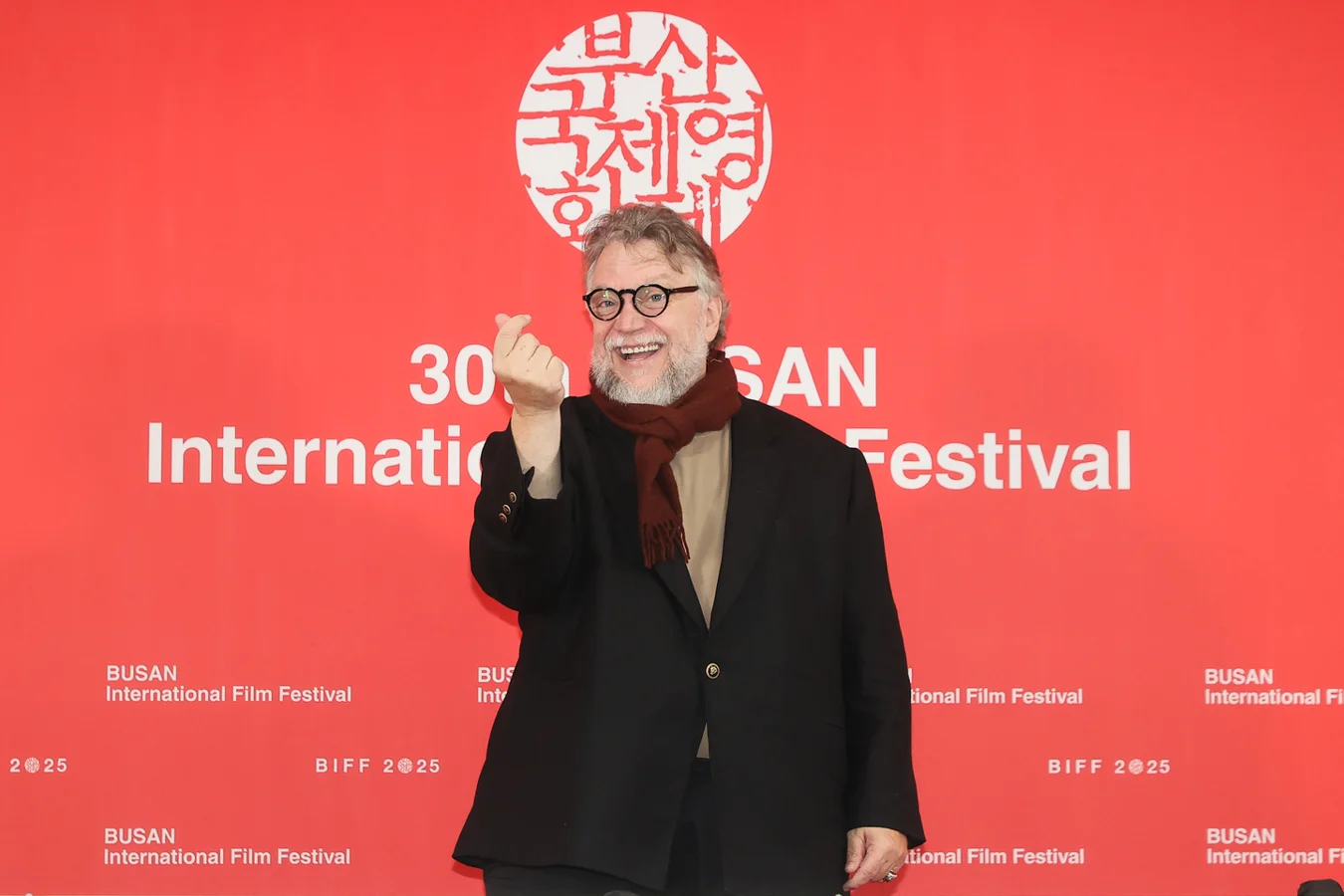
Guillermo del Toro’s creativity blends fantasy with deep humanity. [Image Source: LESLIBRAIRES]
At the Busan International Film Festival, two visionary filmmakers, Guillermo del Toro and Yeon Sang-ho, explored the depths of their creative journeys, highlighting unexpected parallels in their storytelling despite cultural differences. Their discussion, held during Netflix’s Creative Asiaconference, illuminated the essence of Guillermo del Toro creativity and revealed how monsters and human emotion intertwine in their art.
Shared Inspirations Rooted in Childhood Fascination with Monsters and Animation
Both del Toro and Yeon credited their early experiences with monsters and Japanese animation as foundational to their artistic paths. Del Toro described himself as someone who preferred indoor exploration through stories rather than outdoor activities.
“I’m not a good outdoorsy guy. I’m an indoor observer, reader, consumer of audiovisual media, storyteller. You know, if there was no movies, they would throw me out of a cliff to die.”
—Guillermo del Toro
He detailed how Japanese tokusatsu series like Ultraman and the works of Osamu Tezuka shaped his imaginative world:
“So we watched all the series, not only Osamu Tezuka, but we watched all the Tsuburaya series, Ultraman, Ultraseven, Ultra Q. So I grew up like a Japanese kid.”
Yeon shared comparable inspirations from the same era. He reflected on his connection to Japanese animation throughout his youth, admitting that sports were not his strength and that his inspirations came from the wide-ranging world around him:
“Actually, I think it’s right to say that I get inspiration from everything in life. But when I was young, at that time in Korea, Japanese animation was on TV, and I’m not a good sportsman.”
Approaches to Adaptations and Cross-Cultural Storytelling
The conversation shifted as del Toro discussed his long, intimate relationship with Mary Shelley’s Frankenstein, which he adapted and presented at Busan. He traced his engagement with the source material back to childhood, emphasizing the deep study of the Romantic writers who influenced the story:
Image of: Guillermo del Toro
“I saw the movie when I was seven, I read the book when I was 11, and since that time until now, I have made it a point to study… the lives of the Romantics. Percy B. Shelley, Mary Shelley, Lord Byron.”
He described adaptation as a personal expression:
“You study all of that through decades and decades and decades and it becomes part of you. And then what you do is like you sing the same song with your own voice with different arrangements and it feels new because it matters to you.”
Meanwhile, Yeon, currently working on an adaptation of the Japanese manga The Human Vapor, was struck by del Toro’s knowledge of lesser-known Japanese works, including the original 1960 film.
Transitioning Between Animation and Live-Action Films
Del Toro praised Yeon’s rare achievement in moving smoothly from animation into live-action film:
“Very rare that an animation director transitions so beautifully to live action.”
He regards animation, especially stop-motion, as a pure art form that remains a vital part of his creative life alongside his live-action projects.
Yeon explained the distinctive strengths of animation and live-action, noting that animation offers a broad emotional range through variations in drawing and movement, while live-action contains a palpable authenticity derived from actors’ performances:
“Animation and live-action have somewhat different appeals. In animation, almost all drawing styles exist. You can convey something just through the shape of appearance, which is a really big appeal, and depending on how you make it move, the way emotions are expressed changes a lot, so it has a broader range for conveying emotions. Live-action films definitely have authenticity that comes from the talents that actors possess, so there’s definitely a different kind of delivery power from that.”
He also expressed a personal aspiration:
“Since I’m doing a lot of live-action film series now, I have a desire in one corner of my heart to someday make some legendary animation like Osamu Tezuka or works like those I loved so much when I was young. When I work on projects with creatures, there’s somewhat the joy I had when doing animation.”
Embracing Serendipity During the Filmmaking Process
Both filmmakers recounted moments where spontaneity and accidents enhanced their movies. Yeon described an instance during the production of Train to Busan where a scene with zombies being dragged away was added after shooting had already started. To clarify his vision, he spent a day drawing the scene for the crew, resulting in a sequence almost exactly as depicted in the film:
“Originally, since I did animation, I try not to draw as much as possible. But when some explanation is needed, I do draw. The most representative case was when filming ‘Train to Busan’ – there was a scene where zombies were being dragged away in the ending, but that scene didn’t exist originally. We said we should add such a scene, but the staff couldn’t accurately understand what kind of scene it was, so I spent about a day drawing that scene. Amazingly, it’s almost identical to the image that appears in the movie now.”
He also recalled how unexpected weather affected set design:
“We had a past scene, so we worked quite hard to do the set dressing. We came after setting it up, but the night before, there was an incredibly heavy rain. It rained and all the mud was washed away, and the floor we had set up became completely muddy. At first, we thought we were unlucky and tried to clean it up, but as we tried to clean it, the look itself matched so well with the past. When such accidents happen, the accident isn’t really an accident but makes the film really special.”
Del Toro expanded on this philosophy, highlighting the importance of adapting to what a film reveals during production:
“As you age, you learn to, when you’re a young director, you talk a lot. When you are older, you listen a lot. And you know who’s talking all the time? The movie… And if you learn to listen, you make a better movie by realizing that accident is telling you this is what the movie wants to be.”
Balancing Spectacle and Emotional Depth in Filmmaking
Asked how to preserve humanity within large-scale scenes, del Toro stated that every element of a film constitutes drama, describing filmmaking as “poetry with hardware.” He explained:
“You have a dolly track, you have a lens, you have a camera… you’re using hard things to produce symphonic movement.”
The interplay of visual elements also reflects this holistic vision. Del Toro emphasized the inseparability of departments:
“Wardrobe is set design. Set design is cinematography. Cinematography is wardrobe. There’s no difference. You’re creating a single image.”
He recalled advice from makeup effects legend Dick Smith, citing Laurence Olivier’s words:
“When you’re an actor in a rain scene, let the rain do some of the acting for you.”
This mindset asserts that every production detail plays a role in storytelling, as “everything is acting.”
Perspectives on Criticism and Artistic Focus
When discussing responses to criticism, Yeon acknowledged awareness of critics’ viewpoints while maintaining distance:
“Actually… I feel what kind of thoughts critics have about certain works. I feel it, and sometimes there might be a gap between that person and me. When there’s a gap, I try to respect and understand it enough, but it doesn’t have a big influence on my work.”
Del Toro adopts a stricter stance, avoiding reviews altogether:
“If you believe the good ones, you have to believe the bad ones. And I don’t want to.”
The Mexican director highlighted the power of profound personal impact over popularity, citing the transformative effect of Terry Gilliam’s Brazil despite its commercial failure:
“It doesn’t matter how many people liked it or not. It changed my life.”
New Media, Industry Shifts, and the Future of Storytelling
Yeon connected today’s streaming landscape to past innovations in animation distribution, likening current global simultaneous releases to the emergence of Original Video Animation (OVA) in Japan during the rise of videodecks. Although streaming offers uniform release worldwide, theatrical films still differ by country in timing and experience, providing unique depth:
“I think this way. Since I did animation, those who really like animation will know, but there used to be something called videodeck. When videodeck first started to emerge, a genre called OVA (Original Video Animation) began to appear in Japan.”
Del Toro noted that filmmakers need to focus on the magnitude of ideas rather than screen dimensions, ensuring that content resonates equally in theaters and home settings.
Guidance for Emerging Filmmakers on Commitment and Collaboration
Wrapping up their discussion, del Toro offered a metaphor emphasizing the long-term dedication required in filmmaking:
“Making a movie is not a date, it’s a marriage. So don’t marry that easy. Marry people you really give a fuck about.”
Their conversation underscored the necessity of deep creative commitment and harmonious teamwork when bringing stories to life, highlighting how Guillermo del Toro creativity thrives in collaboration and thoughtful attention to detail.