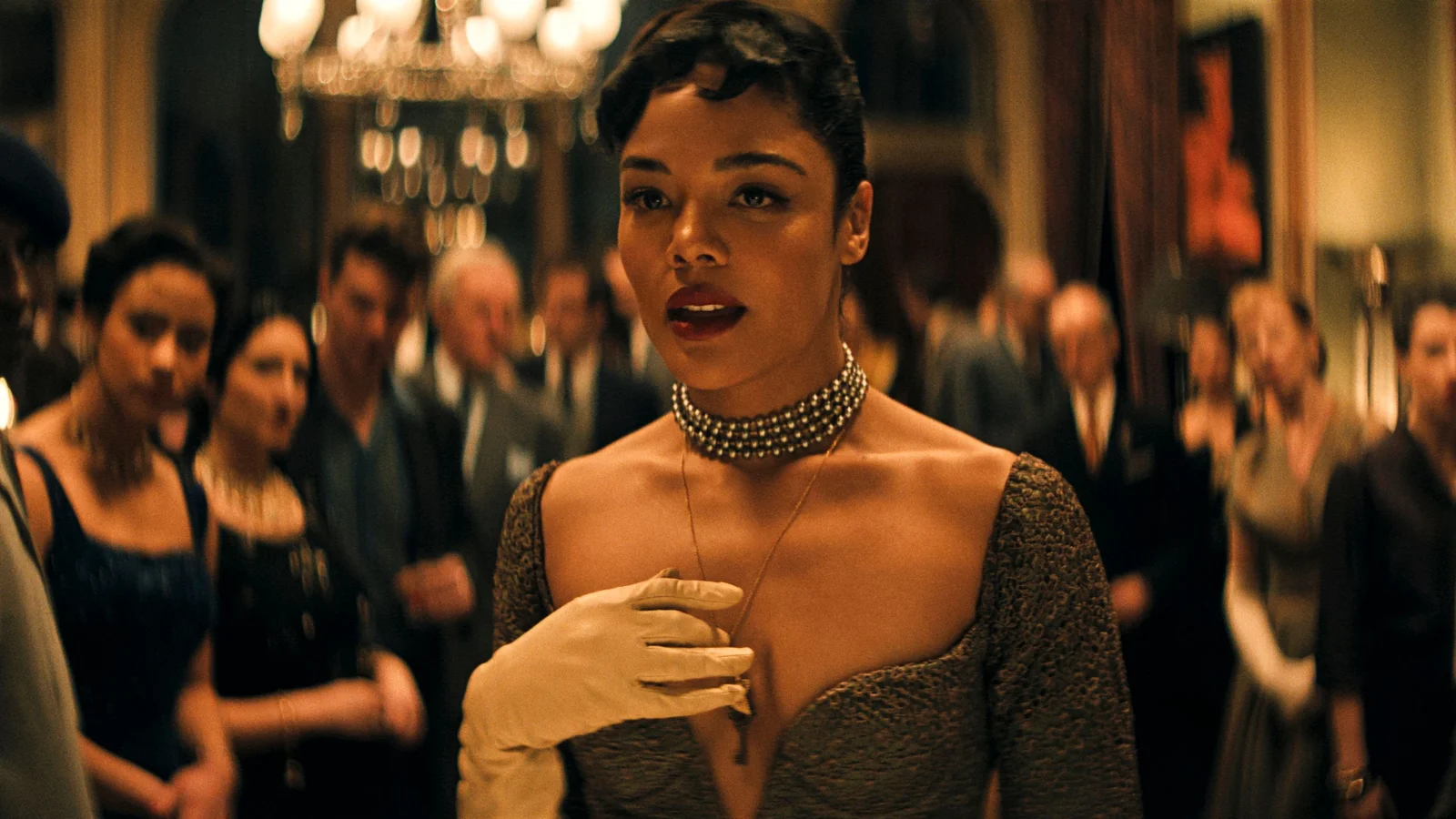
Nia DaCosta’s Hedda Reboot breathes new life into Henrik Ibsen’s classic play by relocating the story from 1890s Scandinavia to 1950s England, where old social norms are questioned through a lens of female ambition and identity. Released on Prime Video on October 29, the adaptation centers on Hedda Tesman, portrayed by Tessa Thompson, whose complex character challenges stereotypes about women’s roles and desires.
A Bold Reimagining of a Classic Tale
The film opens with a detective acknowledging Hedda, signaling her strong presence from the start. Hedda herself dismisses traditional identities imposed on her, including her maiden name Gabler, emphasizing a refusal to be defined by men, a key theme throughout Nia DaCosta’s adaptation. The story shifts from Ibsen’s original setting to post-war England in the 1950s, following Hedda and her new husband George Tesman (Tom Bateman) as they prepare a housewarming for their recently acquired mansion. George’s motivations partly involve impressing academic peers to secure a professorship and manage the mortgage, while Hedda’s lavish lifestyle displays a subtle resistance to societal expectations.
Unlike the play where George’s rival is Eilert Lovborg, DaCosta introduces Eileen, a female character who was Hedda’s former lover and George’s academic competitor. This change drives the narrative toward an exploration of female ambition and desire, shifting the story’s focus from male rivalry to women’s complex relationships. Nina Hoss, who plays Eileen, highlights this shift:
Image of: Nia DaCosta
“It changed everything. It challenges George in a different way; it challenges [Nicholas Pinnock’s cynical Judge] Brack. It challenges the men, in the sense they have to take these three women seriously,”
she explains.
Breaking Down Gender and Ambition Stereotypes
The film confronts stereotypes about female ambition and ego, traditionally explored in male contexts. Co-star Imogen Poots describes Eileen’s character as embodying a “female version” of traits often labeled narcissistic when exhibited by men, such as strong ambition, a trait still stigmatized in women. She notes,
“We do have examples of [the female ego], but probably not enough…We’ve spent a lot of time ruminating on the male ego. Not to call [Nina’s] character a narcissist, but she’s sort of ‘the female narcissist,’ or like a female version of all of these male traits. It’s not necessarily artist traits or human traits. I think there’s something very, very interesting about all of that. It’s still seen as such an ugly word, ambition, which is a real problem.”
On set, the atmosphere contrasted with the intense on-screen dynamics between Hedda and Eileen, as the actors stayed engaged collaboratively rather than isolating themselves between scenes. Nina Hoss reflects on the experience, emphasizing the camaraderie between women:
“Whenever I work with women, it’s always an amazing collaboration…We’re all human beings with flaws and preferences or whatever, but when you work together as women, there’s this collaborative feeling – not pitting against each other or whatnot. What these three women feel they have to do is the sad bit but how they fight their way through and how they try to come into their own is, I hope, interesting to watch.”
The Historical Context of Female and Queer Identity
DaCosta’s relocation of the story to 1950s England adds unspoken layers about the invisibility and repression of female and queer identities during that period. The film subtly acknowledges the harsh realities of the era, including the rise in arrests under laws criminalizing homosexuality, which heavily affected gay men but left female same-sex attraction largely unrecognized. This historical backdrop enhances the meaning behind Eileen’s struggles and Thea’s (Imogen Poots) decisions. Hedda’s movements through physical and social shadows—the smuggled manuscripts, secret kisses, and overheard conversations—reflect this invisibility and her incomplete self-awareness.
During the pivotal housewarming night, tensions erupt both inside Hedda and among the guests. Hedda battles with regrets over not embracing her true feelings for Eileen years earlier, while Eileen encourages Hedda to break free from societal constraints. Eileen and Thea plan to co-author a book on female sexuality, intensifying the film’s focus on marginalized voices and female empowerment. DaCosta comments on the symbolism of these characters:
“You can really see Thea and Eileen as different parts of Hedda…I thought that was really interesting, because for a character that is quite opaque and doesn’t let people in and doesn’t understand herself, I thought having these two other women who are, in some ways, parts of Hedda psyche would illuminate her in a way that was really helpful.”
The Challenge and Freedom of Portraying Hedda
For Tessa Thompson, embodying Hedda Gabler is both daunting and exhilarating given the character’s legendary status in theatre. She immersed herself in historic Hedda performances by actresses such as Cate Blanchett and Fiona Shaw before connecting with Shaw in person and engaging deeply with the film’s cast. Thompson embraced the creative freedom afforded by DaCosta’s vision, remarking:
“I decided not to worry too much about how to make my Hedda individual, because I knew she would be. Anytime you funnel things through your lens, it’s different and Nia made so many fundamental changes to the source material that we really were making our own offering…As soon as I really understood that, I worried less about the pressure. No one’s ever played this Hedda before; I am the first and only, and I felt so supported by Nia and our incredible cast.”
Nina Hoss, whose prior experience with Hedda on stage in Germany was different from this film version, found the process liberating and refreshing. She reflects,
“I had a completely new experience with this, and found it very liberating. I forgot completely about what I had done [as Hedda]…I knew this production would be so different and was its own beast from the script, but I was just so curious to see what Tessa does with it, you know? To see every day the choices she made with the material I knew very well. She’s such a strong actress, I completely forgot about it all. I always say, ‘No one owns Hedda’. You can’t explain her. You have to make up your own mind what her motives are and that’s very personal, and why I think she will always stay fascinating.”
The Lasting Impact of Hedda Gabler
Despite being a character celebrated and dissected by actors like Ingrid Bergman and Maggie Smith, Hedda Gabler continues to captivate audiences as an enigmatic figure. DaCosta attributes Hedda’s enduring appeal to her complex reflection of human flaws and impulses, particularly those rarely assigned to women on screen. Tessa Thompson suggests this double standard in audience reception:
“It’s so gendered, right? No one says they don’t like Silence of the Lambs because Anthony Hopkins’ Hannibal Lecter isn’t likeable.”
This comparison underscores Hedda’s unique role as a “bad” woman who defies traditional sympathy but commands fascination.
The film’s release on Prime Video this fall invites a new generation to reconsider Hedda’s story through the nuances of gender, power, and societal expectations. DaCosta’s interpretation reframes a classic work to engage with contemporary conversations about identity, female agency, and the complexities of ambition.