
Tom Cruise‘s reputation for performing his own daring stunts has sparked a significant “Tom Cruise stunt controversy” within Hollywood, especially as fellow actor Ethan Hawke shares his frustrations about the pressure it creates for others. During the Sundance Film Festival, Hawke discussed his experience doing stunts for his upcoming film and questioned the industry’s evolving expectations surrounding stunt work.
Ethan Hawke’s Perspective on Performing Stunts
Ethan Hawke, known for his role in Blue Moon, spoke candidly about the pressure actors face to emulate Tom Cruise’s extreme stunt performances, particularly in his new historical action drama, The Weight. Hawke, 55, performed his own stunts but emphasized that not all films require death-defying acts to be authentic.
He said,
Tom Cruise has totally changed what’s expected for actors,
before expressing his frustration:
Some part of me is getting angry over the years because everyone somehow feels like they’re less if they use a stunt team.
Hawke highlighted a simpler approach in his film, stating,
What I liked about our movie is there were no ridiculous stunts,
adding,
It’s human. It’s not about things blowing up, so most of the stunts were things we could do. They weren’t superhero things.
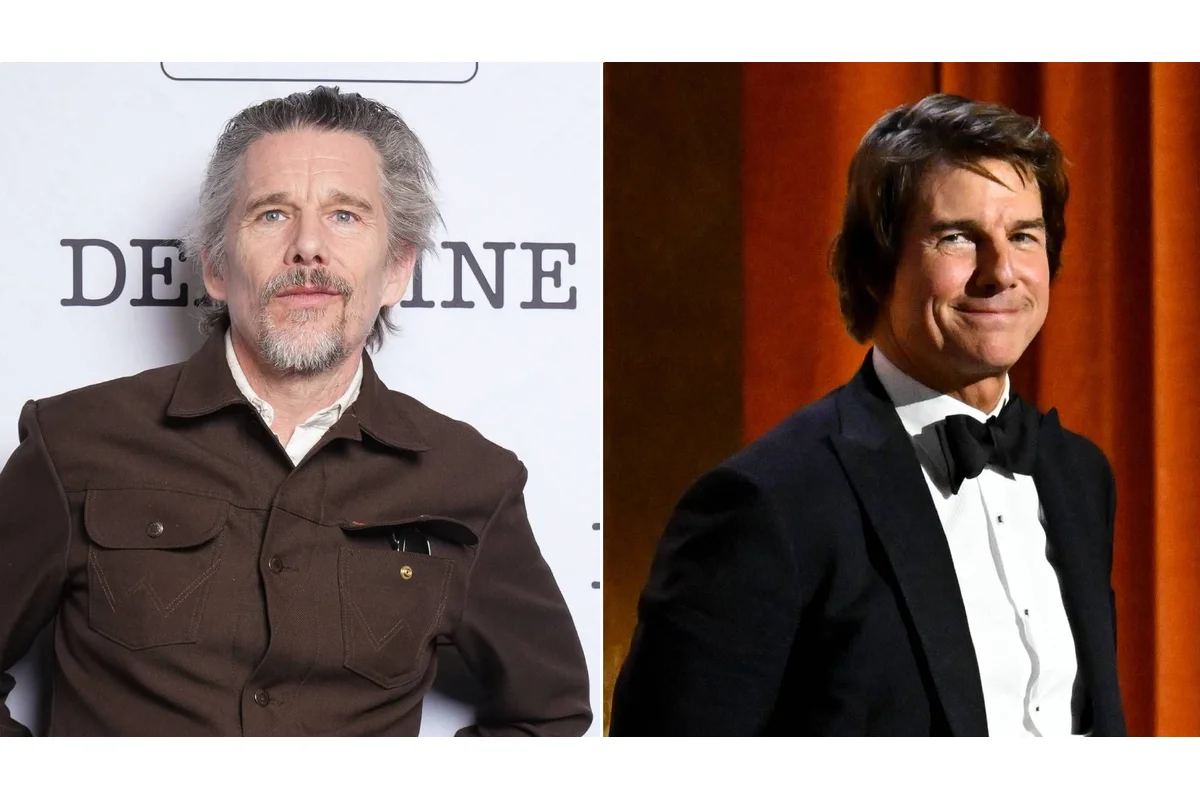
The Weight is set during the Great Depression and follows a widower, played by Hawke, who is separated from his daughter and sent to a brutal work camp. The story intensifies as his character is tempted by the camp’s warden, portrayed by Russell Crowe, to smuggle gold through harsh wilderness in exchange for early release. This mission pushes Hawke’s character to attempt dangerous feats, providing the film’s physical challenges without resorting to Hollywood spectacle.
The Intense Demands of Tom Cruise’s Stunts
While Tom Cruise, now 63, is widely regarded as a master of his craft and continues to push stunt boundaries, some of his feats have taken a serious toll on his health. Wade Eastwood, Cruise’s longtime stunt coordinator and second unit director, revealed details about the physical strain from filming a particularly hazardous stunt for the latest Mission: Impossible movie.
In a challenging scene, Cruise walked along the wing of a small biplane mid-flight, a stunt so taxing that he often had to be physically carried off the aircraft. Wade described it to The Times of London, explaining,
The audience will never really appreciate how dangerous that plane chase is,
and added,
I have to do what I can to eliminate as much risk as possible, but there is still a lot of risk.
Wade further illustrated the ordeal:
It beat the hell out of him. The wind hitting him, and the blast of the propeller, particles hitting him,
continuing,
It was the hardest workout you could ever do, it was very dangerous and very exhausting for him … Many times we were carrying him off the wing because he was so tired. And he was flying all day.
In addition to aerial stunts, Cruise’s underwater sequences have become increasingly infamous. For the recent film, he wore a diving suit weighing over 125 pounds while performing underwater scenes described as chaotic and difficult to control. Wade recounted the challenges, saying,
It was absolutely hectic and chaotic underwater,
further explaining,
We rehearsed as much as we could, but it’s like having an animal on set: they always react slightly differently, no matter how much you rehearse, and filming underwater was the same.
Despite the risks and exhaustion, Wade praised Cruise’s mindset, stating,
Tom doesn’t show fear, Tom shows competence,
and added,
He had fun during all his stunts, even when it was exhausting. He’s always positive, he’ll always put on a smile, and he genuinely enjoys it.
Balancing Safety and Spectacle in Modern Stunt Work
The ongoing debate over Tom Cruise’s stunt choices underscores the tension in the entertainment industry between pushing the limits for authenticity and prioritizing safety and practicality. Hawke’s remarks highlight the reality that many actors rely on stunt doubles without losing credibility, while Cruise’s commitment to doing daring stunts himself has undoubtedly set a new standard.
The introduction of the Best Stunt Design category at the upcoming 100th Academy Awards in 2028 reflects increasing recognition of stunt work as a vital creative element in filmmaking. Yet, the conversation remains complex, as actors and crews grapple with the physical demands and risks posed by such stunts.
Hawke’s grounded approach in The Weight offers an alternative to extreme spectacle, focusing on human drama and manageable physical challenges. Meanwhile, Cruise’s career continues to push the boundaries of what is possible in action films, inspiring admiration but also scrutiny.
As both actors contribute their unique perspectives, the industry may see evolving attitudes towards stunt work, emphasizing not just daring feats but also safety, storytelling, and the diverse needs of different film genres.
