
Jacob Elordi, who is nominated for Best Supporting Actor at the upcoming Oscars, revealed that his acclaimed role in Guillermo del Toro’s Frankenstein nearly did not happen due to his mother’s early warnings. Before Elordi became a recognized actor, his mother Melissa expressed concern about working with del Toro after seeing the eerie DVD cover for Pan’s Labyrinth, a 2006 film by the director.
Early Horror Fascination and Childhood Memories of Pan’s Labyrinth
Elordi recounted that as a 10-year-old, he frequently explored the horror section at Blockbuster, where he first discovered Pan’s Labyrinth. He vividly remembered the unsettling imagery on the DVD case.
“And I saw the tree and the little girl, and I turned it around, the DVD case, and I saw the Pale Man. And I remember thinking, what is that?”
Mother’s Condition for Renting the Movie and Del Toro’s Reaction
Although Pan’s Labyrinth was rated M in Australia, Elordi’s mother allowed him to rent it only on one strict condition:
You must never work with this man.
Speaking during a BFI IMAX screening of the film in London alongside Guillermo del Toro, Elordi laughed while recalling the moment, adding, And lo and behold. Del Toro responded with humor, saying,
It’s good to disobey one’s mother.
Elordi’s Unexpected Casting and Confidence in the Project
Elordi’s eventual casting as a lead in Frankenstein happened through a stroke of luck after the originally intended actor withdrew just nine weeks before filming began. With only four weeks to prepare, Elordi felt a mix of excitement and certainty about the project, stating,
so excited and so sure when I read the screenplay for the first time, that I had no fear… there’s no other filmmaker on this planet that could make a truly great ‘Frankenstein’ film.
Del Toro’s Longstanding Vision for Frankenstein and Personal Connection
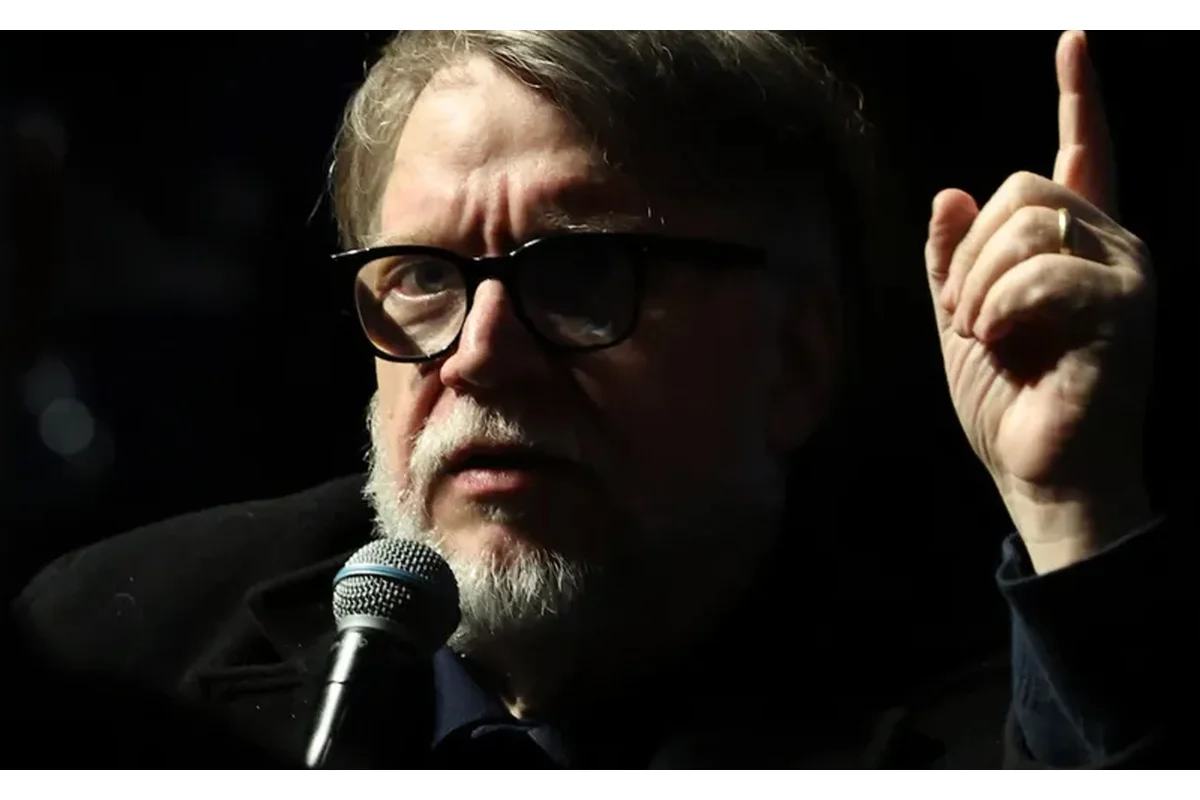
The film’s development spanned over 30 years, tracing back to when del Toro first read Mary Shelley’s Frankenstein at age 11. At the event, del Toro described his emotional and spiritual attachment to the story, explaining,
I just felt this book should exist, because [Frankenstein’s] Creature is me. You know, I identify entirely with the Creature. And I wanted to tell the story the way Mary Shelley wanted to tell it, which is, it becomes every human. It is the origin of humanity and understanding as paradise lost … I know this sounds exaggerated, but it’s my religion. I was born and raised Catholic, and then at 11, I became a Frankensteinist.
The Film’s Release on Netflix and the Importance of the Theatrical Experience
Although Frankenstein was produced for Netflix, del Toro emphasized his enthusiasm for experiencing the film in a cinema setting. Highlighting the massive 85 by 65-foot screen at the BFI IMAX, he said,
This is the best way to experience any story: collectively, and it is the best way to see movies,
and continued to stress the communal nature of cinema, adding,
I mean, it takes 35,000 iPhones to make that screen… but it also is the communal [aspect]. I think that movies — the way I see them — whether it’s “The Shape of Water” or Pan’s Labyrinth or this [Frankenstein], you know, they bring a sacramental beauty to them. If we commune with them, we can gain a spiritual tendency for empathy, for humanity, for forgiveness, for something that we need. If we experience it as a community, all the better, because we have never been so connected and so alone as we are right now.”
Del Toro’s Reflection on Modern Life and the Power of Shared Storytelling
Pointing to his phone during the event, del Toro remarked on the contradictory nature of contemporary human connection, saying,
So we are the loneliest humans that have ever walked the earth, and yet we never can stop looking at this fucking thing,
before gesturing at the giant screen behind him and urging viewers,
I urge you to look at that fucking thing. Have a good time.
