
Director Gore Verbinski’s latest film,
“Good Luck, Have Fun, Don’t Die,”
starring Sam Rockwell, Juno Temple, and Haley Lu Richards, investigates the dangerous impact of artificial intelligence on society. Set for release in 2025, the US/Germany co-production portrays a near-apocalyptic world threatened by AI, where a mysterious man from the future embarks on a perilous mission to stop the impending disaster.
Plot Summary: A Stranger’s Warning at a Los Angeles Diner
In a late-night Los Angeles diner, an unidentified man, played by Sam Rockwell, arrives with a bomb strapped to his chest, declaring himself a time traveler. He warns that artificial intelligence, smartphones, and social media are causing human intelligence to erode. Claiming to have returned to this exact moment 117 times before, his goal is to find the perfect group of individuals to join him in preventing a young boy from launching a catastrophic AI program. Among those who accept his call are Mark (Michael Pena) and Janet (Zazie Beetz), a couple at a crossroads, and Ingrid (Haley Lu Richardson), a woman inexplicably dressed as a princess.
Character Backstories Highlight Societal Struggles with Technology
Screenwriter Matthew Robinson intersperses the thriller’s main narrative with brief flashbacks explaining the backgrounds of the team members. Mark’s story reveals his horror as a substitute teacher witnessing his students’ zombified dependence on smartphones. Ingrid’s princess costume relates to her severe allergy to technology and Wi-Fi. These vignettes emphasize the overwhelming presence of AI and digital devices in everyday lives, hinting at a deeper underlying menace. Susan (Juno Temple), another key character, brings intense emotion as a grieving mother desperate to clone her son, who was a victim of a school shooting—this subplot critiques America’s gun violence epidemic and cultural acceptance of such tragedies.
Sam Rockwell Delivers a High-Energy Yet One-Dimensional Performance
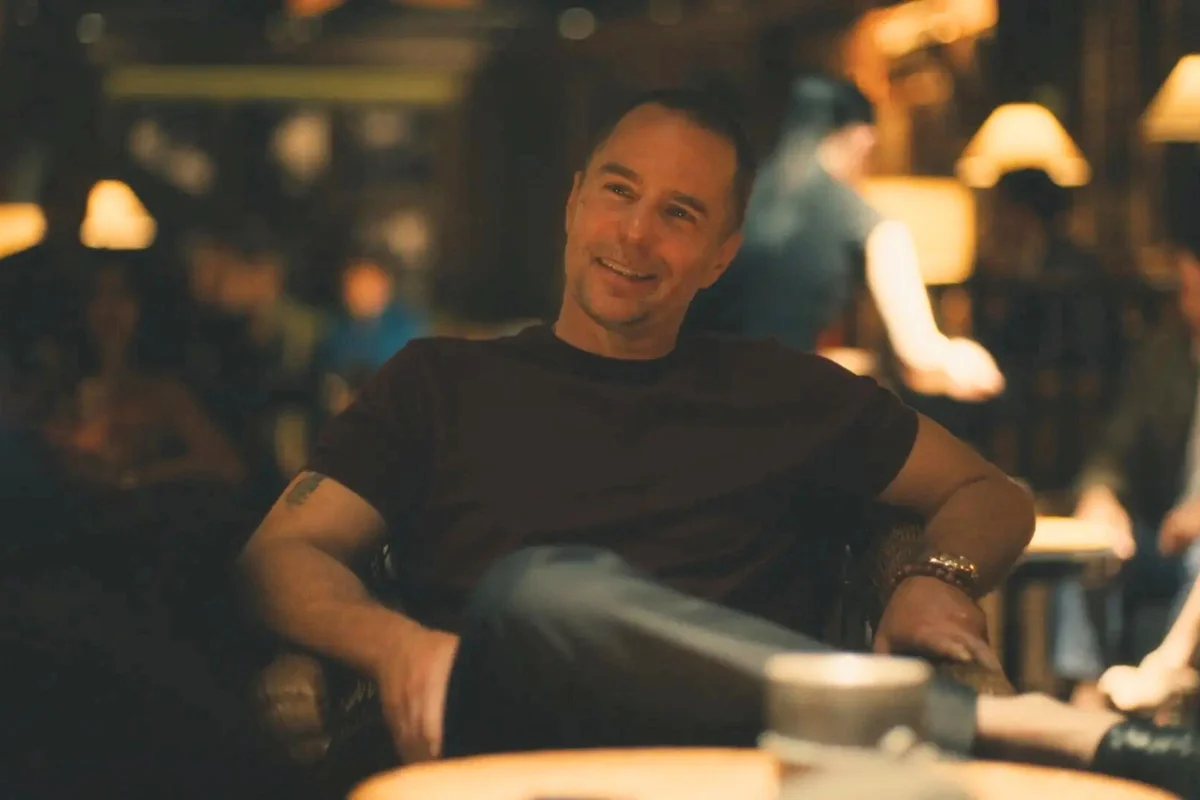
Sam Rockwell embodies the frantic, possibly unhinged man from the future, infusing the role with kinetic energy and snarky commentary. However, the character lacks depth and humor, limiting Rockwell’s usual range. His companions, portrayed by a strong supporting cast including Haley Lu Richardson and Zazie Beetz, offer steadiness but are similarly underwritten with few memorable lines. This results in characters who feel more like conduits for satire than fully formed individuals.
Visually Striking Action Mixes Sci-Fi, Horror, and Social Commentary
Gore Verbinski’s direction ensures a visually vibrant experience, blending science fiction and horror elements with sharp social critique. The team faces threats ranging from masked assassins and heavily armed homeless individuals to bizarre AI-generated challenges. Still, despite this colorful chaos, the film struggles to muster genuine emotional engagement, opting instead for cynicism and sarcasm as it critiques modern society’s obsession with technology and the decline of real-world interaction.
Film’s Underlying Message and Public Reception Prospects
“Good Luck, Have Fun, Don’t Die”
attempts to expose how technology and artificial intelligence may be diminishing human qualities and social connections. Although Verbinski’s reputation and an energetic cast could attract attention, early screenings suggest the film may resonate more as a cult favorite than a commercial success. Its nihilistic tone and uneven storytelling leave the audience uneasy, as it raises important questions about AI’s role without fully humanizing its characters or providing hopeful solutions.
“Doesn’t have enough of a human element” – unnamed reviewer
