
Tom Hiddleston’s return in The Night Manager’s second season culminates in a finale that shocks and isolates both his character, Jonathan Pine, and the audience. The Emmy-winning spy thriller, co-produced by BBC and Prime Video, follows Pine’s perilous mission against arms dealer Richard Roper, a narrative that grips viewers with tension and emotional intensity.
Nearly a decade after his initial success in the series, which earned him a Golden Globe and multiple Emmy nominations, Hiddleston reunites with writer David Farr to continue the saga. This season, along with the upcoming third chapter, deepens the high-stakes cat-and-mouse game between Pine, an MI6 agent, and the cunning antagonist played by Hugh Laurie.
Journey into the Depths of Espionage: Pine’s Mission in Colombia
The six-episode second season, penned by David Farr and directed by Georgi Banks-Davies, tracks Pine’s undercover journey in Colombia, where he investigates a burgeoning arms operation. Adopting the alias Matthew Ellis, Pine infiltrates the shadowy world of Teddy Dos Santos, a young and ambitious businessman entangled in an illicit arms trade network.
During his mission, Pine reconnects with Roxana Bolaños, a Miami-based shipping broker linked to Teddy’s criminal dealings. Early in the season, Pine suspects Roxana’s involvement in the suspicious death of MI6 superior Rex Mayhew, who was killed after probing a high-level leak. Despite mutual blackmail, Pine leverages Roxana’s position to get closer to Teddy’s network.
As Pine delves deeper, he discovers Teddy is a front for the real mastermind: Richard Roper, who faked his death years earlier and now orchestrates a huge arms-smuggling ring from the Colombian shadows. Roper aims to rebuild his empire and fund a private guerrilla army to overthrow the local government.
Complex Alliances and Betrayals Shape the Climactic Finale
Following the unmasking of Pine’s cover, he secretly confronts Teddy, playing recordings exposing Roper’s intent to disown him, revealing the true heir is Roper’s English son Danny, secluded at boarding school. Exploiting Teddy’s feelings of betrayal, Pine persuades him to betray his father.
In the finale, Teddy collaborates with Pine to redirect a final weapons shipment, supplying authorities with incriminating proof against Roper. However, tipped off by Roxana, Roper outmaneuvers them by switching cargo planes, sending an empty plane to law enforcement while delivering actual arms to Colombian militants. After fulfilling his deal, Roper cruelly murders Teddy in Pine’s presence.
Reflecting on the devastating moment, Hiddleston says,
The way it felt like playing [Pine’s reaction to Teddy’s death] was almost like being enveloped or engulfed in an explosion of pain and trauma and vulnerability,
underscoring the emotional collapse his character endures. He adds,
It’s an impact of enormous grief and loss that engulfs him or washes over him and renders him completely incapacitated for 10 or 20 seconds.
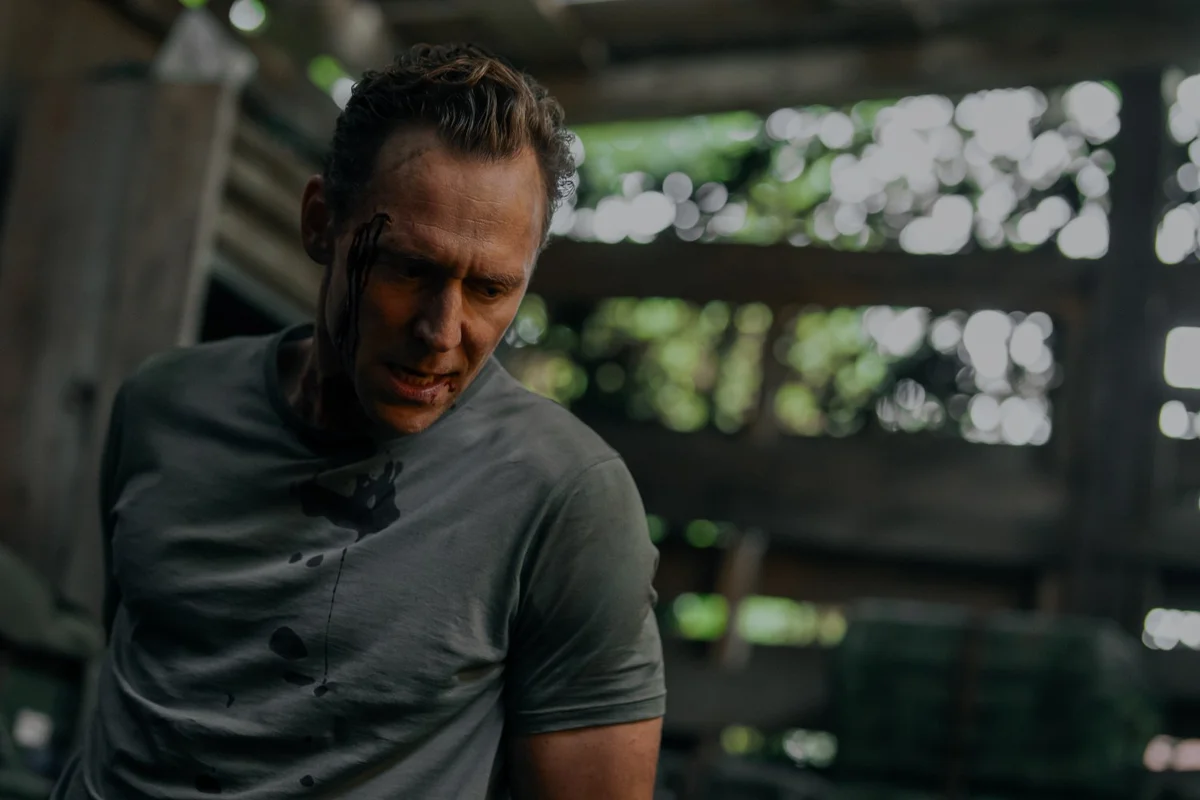
Reacting instinctively to further gunfire, Pine narrowly escapes a deadly shootout, but after wandering through a dense forest for hours, he collapses in exhaustion, hinting at a fragile state as the season closes.
Hiddleston Explores Jonathan Pine’s Psychological Turmoil
In a detailed discussion, Hiddleston, also an executive producer, delves into the psychological complexity of Jonathan Pine following such a shattering conclusion. He describes Pine as
a man alone, a man cut adrift, a man completely abandoned. And, dramatically, that’s an extraordinary place to leave someone.
This loneliness is intensified by the physical and emotional trauma Pine faces, compounded by the loss of allies and loved ones.
Looking back to his collaboration with Farr, Hiddleston explains that their initial conversations accounted for the decade that has passed since the first season, marking an evolution in Pine’s character shaped by the global turmoil of the last ten years. He emphasizes Pine’s vigilance, skill, and enduring moral courage, traits that have defined him as a British officer turned undercover intelligence agent.
Hiddleston notes,
“He was a British officer in Iraq and Afghanistan before he was a hotel manager, but he was comfortable in uniform.”
This past embedded in Pine’s identity contrasts with his role as a collector of languages and personas—traits inspired by le Carré’s original work. Unlike before, Pine now speaks Spanish and assumes various identities, yet he struggles to express his own truth beneath layers of disguise.
Jonathan Pine’s Unyielding Battle with Richard Roper’s Shadow
The ongoing rivalry between Pine and Roper remains the story’s core, as emphasized by the return of Hugh Laurie’s character. Hiddleston compares their dynamic to the legendary tale of St. George and the dragon, underscoring the philosophical and moral confrontations they embody. He explains how Pine’s belief in human goodness starkly contrasts with Roper’s cynical worldview, encapsulated by a line from Roper:
The world is rotten. Might as well celebrate that rottenness.
This season, themes of paternal relationships dominate the narrative. Teddy craves his father’s approval, Roper worries over his son Danny, and Pine himself represents an unconscious heir and executioner to Roper’s legacy. A pivotal scene between Pine and Roper highlights their ideological divide, with Roper taunting,
Your father’s values are dying. Mine are in the ascendant. Wake up and smell the effing coffee.
Pine counters with heartfelt defiance:
My father loved me. What about yours?
Hiddleston interprets this as central to le Carré’s exploration of love and cynicism. While Pine is driven by a transformative belief in love’s power, Roper embodies a dark skepticism, complicating the audience’s allegiance despite his charm.
The Enigma of Pine’s Relationships with Teddy and Roxana
The show introduces a provocative dynamic between Pine, Teddy, and Roxana, with writer David Farr initially teasing a love triangle. Roxana later admits to Roper that it was not she, but Teddy who developed feelings for Pine, deepening the emotional stakes.
Hiddleston describes Pine’s vulnerability in these relationships, shaped by past trauma involving women who suffered due to his actions or inactions. Acknowledging Pine’s self-diagnosed pathology, he shares Pine’s fear that intimacy brings harm, noting,
I have a bad record with people I get close to.
Roxana’s role is complex; motivated by personal loss linked to her family’s tragedy, she exhibits strength and agency rather than vulnerability. Teddy, presented initially as a dangerous villain, reveals himself as a lost youth searching for belonging, paralleling Pine’s own fractured identity. Hiddleston sees both men as
“lost boys trying to find a center,”
bound by a shared loneliness and haunted pasts.
The Power Play of Seduction and Betrayal Among Espionage Players
Interpersonal relationships in the spy world are intricately laced with seduction and deception. According to Hiddleston, Pine’s interactions with Teddy and Roxana are imbued with an element of psychological and spiritual seduction. He reflects on Pine’s ability to seduce key figures, like Roper in the first season, to gain trust and access.
One standout moment illustrating this tension is the suggestive three-way dancing scene in episode three, which encapsulates the characters’ layered connections. Hiddleston emphasizes how these interactions feel authentic, revealing the brokenness and fragmentation of all involved.
The Ambiguity of Pine and Teddy’s Relationship Charge
Addressing the nature of Pine and Teddy’s relationship, often described as homoerotic or romantic, Hiddleston observes that much depends on personal interpretation. He acknowledges the deliberate provocative choreography of their dancing scene, where Pine pushes boundaries to extract information.
He describes the palpable charge between the characters as rooted in mutual vulnerability and reliance amid danger, rather than explicit sexuality. Hiddleston praises Diego Calva’s portrayal of Teddy as richly complex, highlighting the evolving dynamics across their shared screen time without imposing labels for audience perception.
The Tragic Consequences of Pine and Teddy’s Alliance
Their alliance ultimately costs Teddy his life in a tense confrontation with Roper. Despite having the chance to kill Roper, Teddy hesitates, torn by their father-son connection. Pine’s internal struggle during these moments reflects desperation compounded by powerlessness, as he cannot intervene due to being restrained.
Hiddleston describes the layers of tension, stating,
I think the stakes are almost unimaginably high, and Pine has put all his chips on Teddy and on the unlikely brotherhood that they have forged together.
He explains Roper’s preemptive deception by switching planes to outwit them, and adds,
I know they’re going to try and pull the wool over my eyes, so I’m going to pull the wool over theirs before it happens.
In their final exchange, Pine urges Teddy to keep his faith, a message that symbolizes Pine’s own will to survive as the hostile jungle closes in. The rich backdrop amplifies Pine’s isolation and vulnerability in the face of insurmountable odds.
The Impact of Angela Burr’s Death on Pine’s Isolation
The season’s closing moments also foreshadow the profound effect of Angela Burr’s death on Pine. Olivia Colman’s character, an invaluable ally and figure of guidance, is lost, leaving Pine further alienated. Hiddleston reflects on the consequences:
It completely isolates him. He is alone. Anybody who ever cared about him is gone.
With the deaths of his parents, the absence of the MI6 agent runners like Rex and Angela, and the hazardous security service overseen by Mayra Cavendish, Pine stands abandoned at the story’s end. Hiddleston portrays this as an extraordinary dramatic place to leave a character, setting the stage for a gripping continuation.
Where the Story Goes Next: Anticipation for the Final Chapter
Hiddleston and Farr have made it clear that The Night Manager is envisioned as a trilogy, with a third and likely final season on the horizon. The series concludes season two with Pine both physically compromised and emotionally fractured, poised on a precipice following traumatic losses and uncertain alliances.
This setting promises a powerful narrative escalation as Pine confronts the fallout from his choices, pursues his mission, and grapples with the ghosts that have shaped his fractured path. Viewers are left with intense suspense about how Pine will endure and what sacrifices lie ahead in the culminating chapter.
