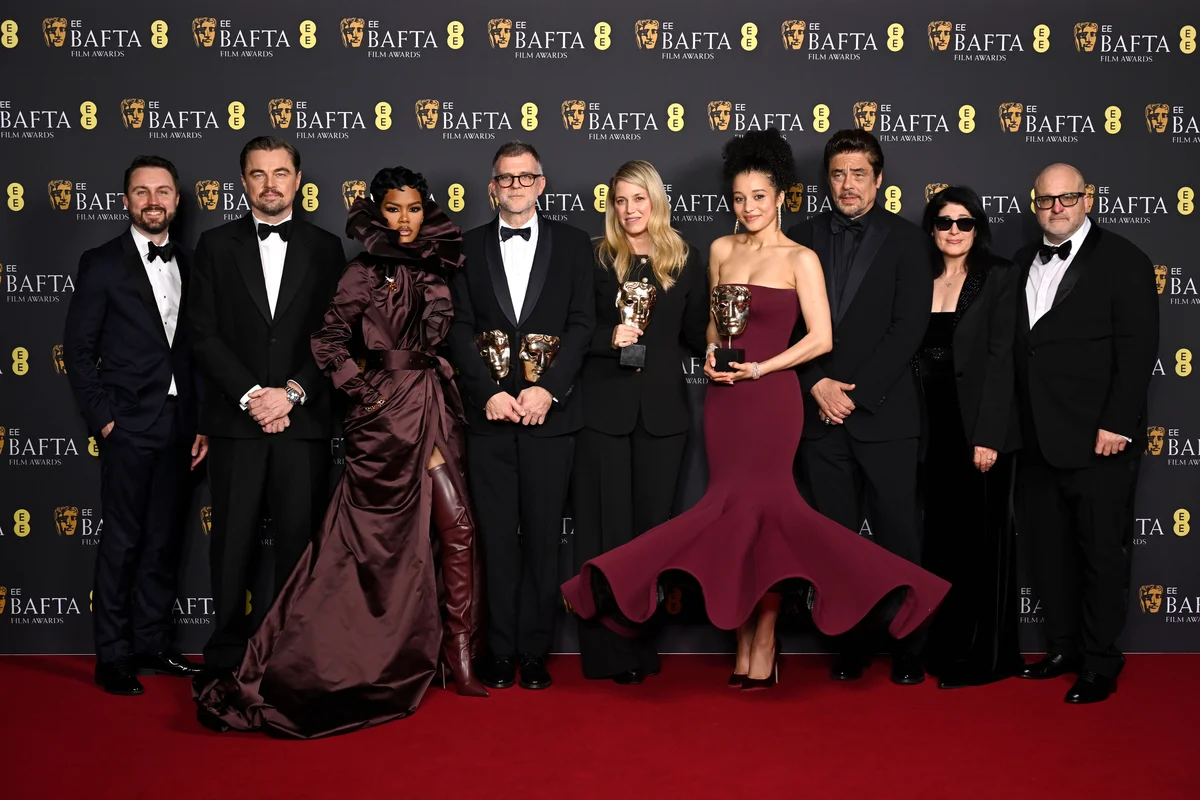
Paul Thomas Anderson discusses film’s role in politics at Baftas. [Image Source: YIMG]
At the 2026 Bafta Film Awards, Paul Thomas Anderson, alongside filmmakers Jafar Panahi, Kaouther Ben Hania, and producer Jim Wilson, addressed the complex relationship between film and politics. Anderson, who won best adapted screenplay, best director, and best film for his political thriller One Battle After Another, avoided discussing his personal political views but emphasized expressing ideas through his art.
Anderson’s Approach to Politics Through Cinema
Paul Thomas Anderson spoke about his confidence in conveying his perspectives on the world via his films rather than direct political statements. He described the story of One Battle After Another, centered on a former revolutionary pursued by an old adversary, as a way to share feelings about society without being overtly political. Anderson stated,
“I’ll ultimately fail in this situation. Where I have confidence I won’t fail is in the film,”
reflecting his belief in storytelling over explicit political commentary. He also said,
“I have significantly more confidence in communicating my feelings about the world through my film, and I think that’s what we’ve done,”
adding,
“I’m not a politician, but I’m a filmmaker, so I’m trying to do it through the work.”
Debate at the Berlinale Festival and Artistic Freedom
At the Berlin Film Festival, controversy arose when jury president Wim Wenders remarked that
“films are the opposite of politics.”
This sparked discussion among filmmakers and attendees about the role of politics in art. Iranian director Jafar Panahi, who has won Berlinale’s Golden Bear and faced imprisonment in Iran for alleged anti-government activities, cautiously avoided delving into the debate but showed respect for Wenders’s stature. He said,
“if he says something, there’s a reason for it,”
while stressing the importance of artistic independence. Panahi explained to Screen International via a translator,
Image of: Paul Thomas Anderson
“what I think is important in art and in cinema is that there should be no must or should or mustn’t,”
and added,
“I think art needs to be independent and free, and I think every filmmaker makes the films they believe that they feel they have to do and that they should really be free from the chains of I should, I should not, one must, one must not.”
Panahi also spoke of his difficulties obtaining a UK visa to attend the Baftas, a consequence of his history with Iranian authorities.
Separating Art from Politics: Old Notions Challenged
Jim Wilson, a UK producer involved with The Voice Of Hind Rajab and The Zone Of Interest, offered a critical perspective on Wenders’s claim, suggesting it may have been a misstatement. He argued that dismissing the political dimension in art is outdated, noting,
“Politics is the way we organise our societies, the way we live together. That’s what politics is,”
before clarifying a distinction between politics in the artistic sense and party politics. Wilson insisted,
[Separating film from politics] is not an interesting way to think about culture or any art, let alone cinema.
Calls for Celebrities to Use Their Platform for Justice
Tunisian director Kaouther Ben Hania strongly urged public figures to raise their voices on pressing global issues, such as the ongoing war in Gaza. She stated,
“Celebrities, for example, and people who have this kind of power can and should use their platform to defend justice, to ask for accountability,”
underscoring the responsibility that comes with influence. Producer Nadim Cheikhrouha echoed this urgency, observing that condemning injustices is insufficient in the current climate. He remarked,
“We’re living in a world where denouncing stuff is not enough,”
adding,
“Things are getting worse and worse, and the situation seems to be the same.”
Cheikhrouha emphasized the importance of witnessing and recognizing global crises and mentioned humanitarian efforts, saying,
[People] need to be a witness of what is happening, to recognise what is happening, and then all kinds of actions are possible. We have here a pinch from the Red Cross, and the idea is to open the humanitarian corridors. Do a real ceasefire. Anyone can do something at this level.
Memorable Highlights from the Bafta Ceremony
The Baftas this year featured several notable moments, including the introduction of a new host and an unusual apology for swearing during speeches. These events added to the event’s dynamic atmosphere, as industry professionals gathered to honor films that engage with political and social themes in meaningful ways.
The ongoing discussions involving Paul Thomas Anderson, Jafar Panahi, and others underline the tension between artistic expression and political context in contemporary cinema. Their contributions reflect a broader conversation about the role of filmmakers in engaging with societal issues, whether through direct commentary or through storytelling that challenges viewers to think critically. As global situations continue to evolve, filmmakers and cultural leaders appear poised to remain central voices in debates about justice, freedom, and responsibility.