
The Disney+ series Andor presents a darker perspective on the Star Wars universe by portraying the Galactic Empire as a methodical authoritarian regime, rather than just a villainous empire of fantastical evil. Through its two-season arc, Andor chronicles the formation of the Rebel Alliance, revealing the harsh realities of resistance within a bureaucratic dictatorship. Writer and director Tony Gilroy’s exploration of authoritarianism in Andor reveals how oppressive governments consolidate control through surveillance, corporate takeovers, and the suppression of dissent.
Set five years before the destruction of the Death Star, Andor follows Cassian Andor’s journey amid the tightening grip of the Empire. The show strips away the mystical elements common in Star Wars, instead focusing on the moral and political struggles ordinary people endure under autocratic rule. Gilroy’s vision exposes fascism not as a sudden upheaval but as a gradual suffocation carried out by ordinary officials eager to climb the ranks, demonstrating a chilling reflection of historical and contemporary regimes.
Positioning Andor Within the Star Wars Timeline and Narrative
Andor is situated immediately before the events of Rogue One and the original Star Wars film. It portrays five critical years leading to the Rebellion’s rise, chronicling Cassian Andor’s transformation from survivalist to reluctant revolutionary.
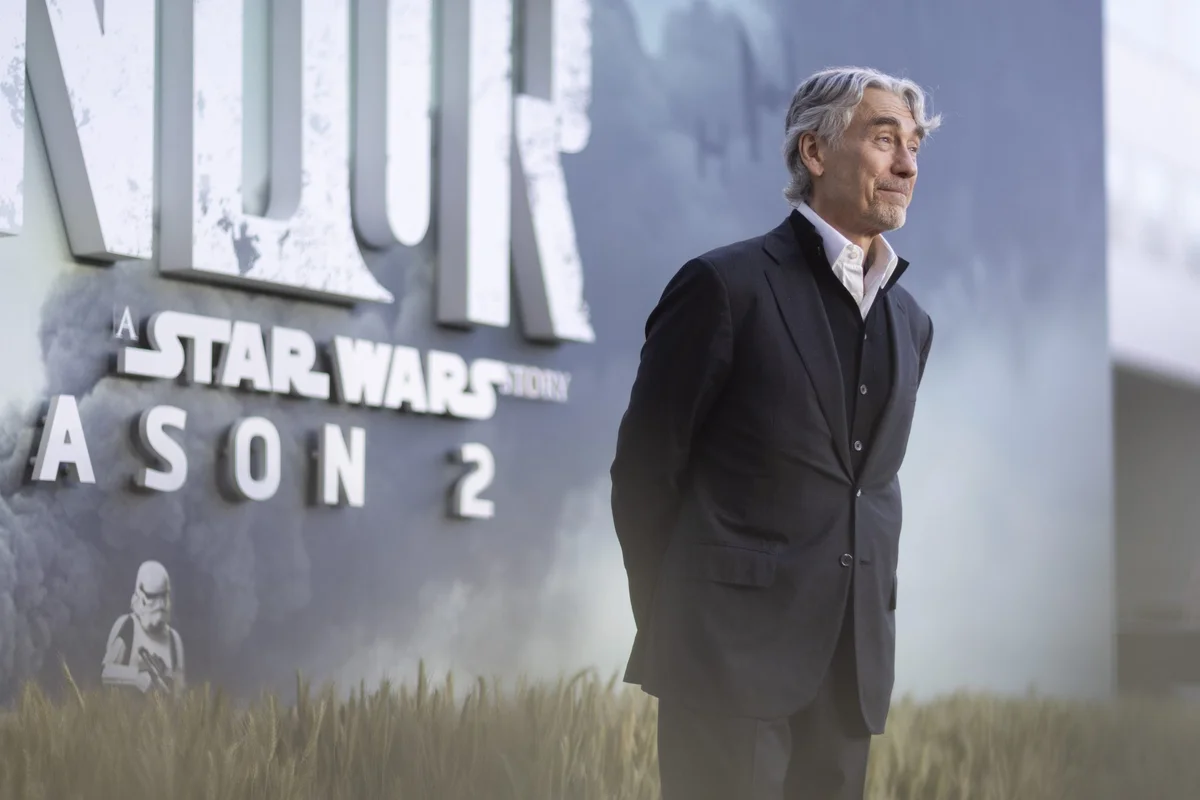
Gilroy explains,
“Our last scene in Andor is him walking into what would be the first scene of Rogue One. It’s a five-year tranche of history right before the destruction of the Death Star, and it is a five-year period where the Empire is really tightening its grip around the throat of the galaxy in the most extreme way.”
This framing grounds the series in a pivotal era, anchoring the fictional rebellion’s origins in a detailed political climate.
Deliberate Absence of Mysticism and Focus on Realism
Notably, Andor moves away from traditional Star Wars motifs such as the Force and lightsabers. Gilroy reveals the show was intentionally crafted to avoid the franchise’s mystical elements, emphasizing the gritty reality of authoritarian rule over fantastical battles. He shared,
“In this huge galaxy, how many people would have ever encountered a Jedi? How many people would ever know about the Force? How many people know about this family you keep rotating these movies on?”
Tony Gilroy, Writer/Director of Andor
The rationale was to depict a galaxy where most citizens have no interaction with legendary force users, thus focusing on human decisions and systemic oppression rather than supernatural elements. Although the second season partially incorporates the Force, it serves mainly to enhance the grounded narrative rather than dominate it.
Exploring Moral Choices in Authoritarian Settings
Andor’s story revolves around individuals forced to navigate moral complexities amid political tyranny. Gilroy distances the show from simplistic political dichotomies, describing its characters as shaped by circumstance rather than ideology. He reflected,
“I want to let them let their freak flags fly,”
emphasizing character depth over political messaging.
Gilroy resists categorizing Andor as a left-right political allegory, asserting that the show’s core concern is the erosion of communities under authoritarianism.
“What I really can stand behind as an ideology in the show is the destruction of community,”
he stated, highlighting the universal and human consequences of oppressive regimes beyond partisan lines.
Contemporary Parallels Intensify the Series’ Relevance
When the first season was made, political circumstances were relatively stable, but by the second season’s development, global events — including a Trump resurgence — brought unsettling parallels. Gilroy observed,
“Wow, are we heading for a highway collision here or not?”
Tony Gilroy, Writer/Director of Andor
The timing made promoting the show complex, especially given the diverse Star Wars audience. Nonetheless, the creative team increasingly embraced the series’ political subtext as unavoidable, mirroring real-world authoritarian tendencies and societal fractures.
Depicting the Empire’s Crushing of Communities Through Characters and Storylines
The Empire in Andor is shown systematically dismantling societal structures and freedoms. Characters like Ghorman’s people and Bix—an illegal immigrant figure—illustrate this range of suffering. The Empire’s expansion and nationalization of corporations serves as a classic fascist tactic.
Gilroy recounts the series’ inciting incident: a confrontation on a corporate-controlled pleasure planet where Cassian Andor kills two corrupt officers. This incident triggers the Empire’s takeover, demonstrating its strategy of exploiting events to justify further control.
The Menace of Bureaucratic Authoritarianism Over Iconic Villainy
In Andor, the Empire’s bureaucratic nature is portrayed as more frightening than overt villains like Darth Vader or the destructive Death Star. Gilroy explains that this grounded portrayal evokes a deeper emotional response, as
“anything real, anything that you can identify as reality, is going to be more emotionally connected and more terrifying.”
The show reveals fascists as petty, career-driven individuals—worried about parking, favors, and quotas rather than grand schemes—making them more unsettling because of their banality. This realistic depiction exposes how ordinary people enable oppressive systems by “willfully forgetting” their actions, following orders, and succumbing to social pressures.
Introducing State-Controlled Media and Propaganda as Tools of Oppression
Andor incorporates mass media manipulation for the first time within Star Wars. The destruction of Ghorman serves as a major plot point, showcasing how propaganda and state-owned media facilitate the Empire’s agenda. Gilroy compares this to historical bureaucratic evil, referencing the Wannsee Conference where Nazis systematically planned genocide.
He remarked,
“Well, this is how they do it.”
Tony Gilroy, Writer/Director of Andor
This strategy of manufacturing consent and turning the population against political targets illustrates the complexities of autocratic rule beyond brute force.
Loneliness and Social Fragmentation as Vulnerabilities to Authoritarian Influence
The series also examines isolation’s role in making individuals susceptible to authoritarian systems, encapsulated by the character Syril Karn. Gilroy noted a poignant moment where Karn, stripped of his career, retreats to his mother’s home, emphasizing loneliness as a gateway to vulnerability.
He agrees with broader societal views that social media, economic instability, and media fragmentation cultivate these vulnerabilities, contributing to political phenomena like MAGA’s rise, showing real-world influences on the narrative.
Gilroy’s Reflections on Returning to the Star Wars Universe
Gilroy acknowledges the immense creative effort involved in producing Andor and other recent Star Wars projects, describing the output as equivalent to eight feature films in five years. While hesitant about returning to Star Wars under current conditions, he leaves the possibility open.
A Small-Scale Approach to Complex Political Themes
Gilroy’s storytelling philosophy involves starting from intimate, personal moments rather than grand ideological statements. Using his film Michael Clayton as an example, he focuses on the everyday lives and struggles of characters rather than large abstract themes.
Regarding Jason Bourne, Gilroy points to memorable small scenes—like a tense fax machine confrontation—to emphasize how seemingly minor moments can carry significant narrative weight, illustrating his preference for grounded storytelling.
Prioritizing Character Depth Over Political Messaging
Gilroy stresses that his primary goal is to engage audiences with characters before the political or moral lessons become apparent. He seeks to inspire empathy and investment in his characters’ journeys, rather than use them as mere vessels for ideology.
He shared,
“I want you to care about the people before they tell you how they got there and what they believe. I really need you to be deeply invested in them, and then you can decide if you trust them or not along the way.”
Tony Gilroy, Writer/Director of Andor
Addressing Authoritarian Paranoia Through Realism, Not Fantasy
Gilroy describes the paranoia often present in his work not as irrational fear but as grounded reportage. His imagination is harnessed to anticipate threats realistically, reflecting historical truths and contemporary observations.
He clarifies,
“I don’t think I’m a fantasist… I don’t think there’s anything where I’m pushing the fantasy into the point of unreality.”
Thus, his work walks a fine line between creative fiction and plausible political scenarios.
Imagination as a Tool for Illuminating Authoritarianism
Gilroy credits his career to blending disciplined craft with an active imagination capable of constructing complex, believable worlds. He defines this imaginative capacity as essential to his work on Andor, which maximally expressed his ability to envision detailed narratives reflecting real-world authoritarian mechanisms.
This emphasis on detailed imagination combined with real political themes creates an intense and thought-provoking series, challenging viewers to reconsider the nature of power, resistance, and state control.
