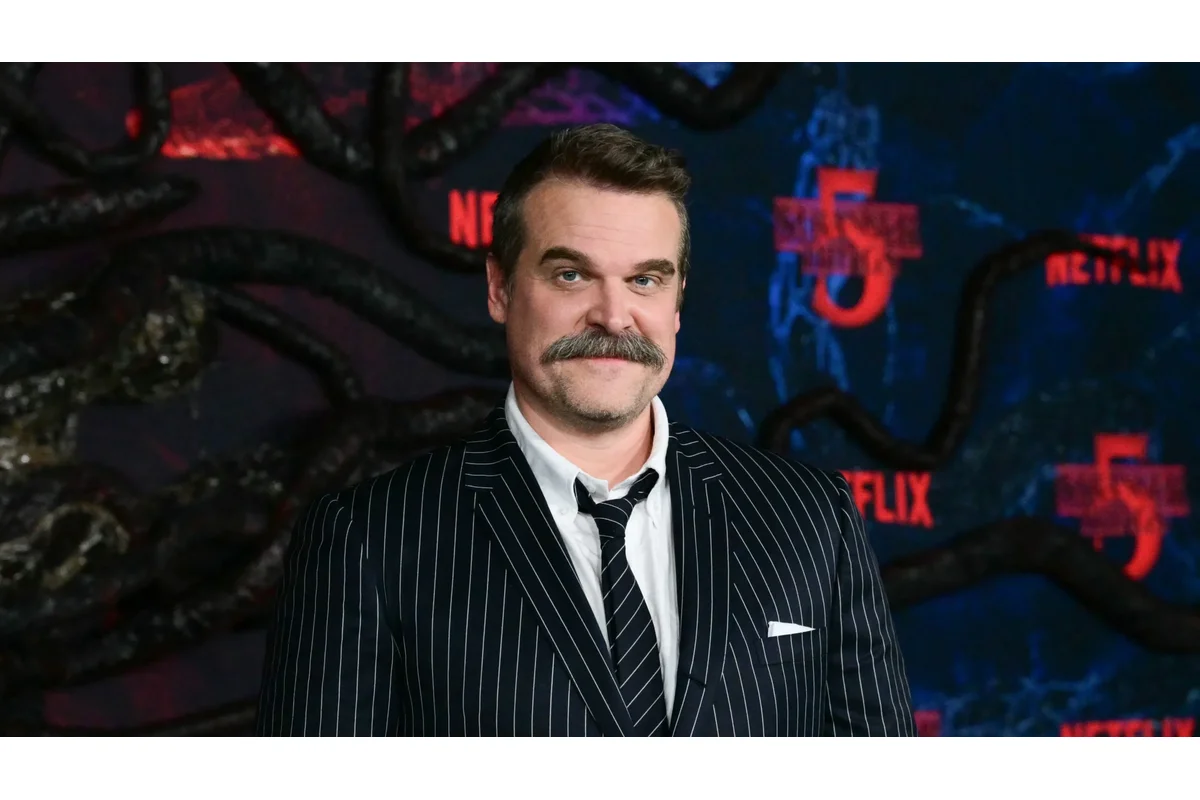
David Harbour stars as Floyd in DTF St. Louis’s complex love triangle. [Image Source: MENSJOURNAL]
David Harbour DTF St. Louis has stirred curiosity since its debut, but the series’ title only scratches the surface of a deeper narrative. The intense HBO thriller, led by Jason Bateman, David Harbour, and Linda Cardellini, explores a complex midlife love triangle set in St. Louis, where three adults entangled in dissatisfaction turn to an app designed for married individuals seeking affairs, sparking unexpected emotional turmoil.
The Complex Emotional Landscape of the DTF St. Louis Love Triangle
DTF St. Louis unfolds as a dark, twisting story about three adults trapped in lives that no longer satisfy them. Seeking escape from their routines, Floyd (David Harbour), Carol (Linda Cardellini), and Clark (Jason Bateman) take a risky step by joining a secretive digital platform. What begins as a bid to revive excitement spirals into convoluted emotional entanglements and hidden tensions, revealing more than just physical desires.
David Harbour sheds light on Floyd’s layered character, revealing that he and Carol have been married for nearly a decade. Harbour explained,
“I think a lot gets revealed later, as you see — they’ve [Floyd and Carol] been married for… How long have they been married? Is it like 10 years or something? … Eight or 10 years. And so, you get to see some backstory about the beginnings of that marriage.”
This reveals that the couple’s long history is key to understanding their present struggles.
Floyd stands at a critical point in his marriage, grappling with dissatisfaction and questioning if love alone can hold them together. Harbour describes one peculiar source of friction as Carol’s habit of wearing umpire gear around the house—a simple but emblematic detail showing Floyd’s growing discomfort and disconnect:
Image of: David Harbour
“At the time we meet him, early on, he’s talking about the umpire gear; they’re having problems because she wears this umpire gear around the house, and it really turns him off, and she won’t stop wearing it when she’s gardening and doing other tasks around the house. So, there’s a simple aspect to it as well, but the other thing is, I think Floyd is kind of a sweet guy.”
Despite the escalating events, Floyd’s tender nature complicates his choices. His difficulty in communicating and desire to maintain loyalty to Clark, the friend involved in the affair, lead to tragic consequences. Harbour elaborates on Floyd’s complex motivations:
“He’s got communication problems, but he also, I think, wants to impress his friend [Clark] and connect with him, because one of the most joyous times I think he has with DTF is when they’re making their profiles, or when Clark is excited about it. I mean, even later on, when he wants to kind of get off, I think he’s embarrassed, because it was Clark’s idea, and because he doesn’t want to hurt Clark in that way. So I think there are a lot of feelings that are going on in this that are not simply straightforwardly looking for something. And I think that’s the great thing about the series itself: you think it’s going to be DTF St. Louis, and yet we’re going to subvert your genre, and we’re going to tell you about weird, wacky, sort of intimate, secret desires for friendship that may be more powerful, or self-potency that may be more powerful than sex itself.”
Jason Bateman on the Fragile Bonds and Flaws Within the Triangle
Jason Bateman’s character Clark represents a man desperate for deeper connection beyond his marriage. Bateman elucidates that Clark’s quest for intimacy has deteriorated into frustration and poor decisions:
“Well, my character is desperately searching for a more significant connection with someone in his life than he’s able to establish or maintain with his wife. That sort of atrophied into a place of desperation for himself. And so he makes this decision, and that decision, and we get to see the results of his mishandling of those relationships, and this idea of growth is sort of misguided. So fortunately, he doesn’t have the skills to manage that, and we get seven episodes of nonsense.”
The unfolding narrative layers reveal the multifaceted dynamics between these characters, highlighting their flawed attempts at connection. When asked about their own major questions regarding their characters, both Harbour and Bateman shared intimate curiosities. Harbour confessed,
“Yeah, I got a simple one. I wanted to know if my guy was gay. I mean, there’s a lot of stuff — you’ve begun to see things — but there’s a lot of stuff where he’s using this site for male hookups, as Richard Jenkins’ character says, and it’s a much more complicated answer, but it was a simple question going in.”
Bateman added,
“Mine’s not too dissimilar from that. I think both of these characters are dealing with some of those questions, and just wondering what sort of label to put on these efforts of connection. And it’s an interesting journey as a viewer, I found, watching the episodes, to see these sweet guys just kind of put it all out there. It’s really interesting how Steve’s crafted that.”
Linda Cardellini Reflects on Carol’s Journey and the Affair’s End
Linda Cardellini, portraying Carol, grappled with understanding what happens to her character following the pivotal events. She expressed a pressing question about the affair’s conclusion:
“I had a question about what happened after he passed. When did we end it for real, was sort of my question going in, and how did that thing come to a sputtering halt? We have this affair, that you see happening, and then it turns into this other kind of thing, and then at some point it goes away before the event happens. And that was my question. So, I have my answers.”
Joy Sunday Discusses Bringing Jodie to Life in DTF St. Louis
newcomer Joy Sunday opened up about her experience playing Jodie, a character who brings a unique perspective within the story. She connected deeply with the creator Steve’s vision, appreciating the show’s dry humor and heartfelt approach. Sunday shared,
“I really just fell in love with Steve’s universe, and I love dry humor. I mean, one of my favorite comedy shows is King of the Hill, and I think this was just the dark version of it, where you see people living out and being themselves in their private lives. And it was so special and heartfelt the way he approached it. For my character specifically, it was interesting because on paper and on screen, she seems like someone who would have a very blunt assumption of everyone around her, but she doesn’t at all. And I think that just demonstrates Steve’s expansive perception of everyone and the space he allows people to be human.”
Sunday further explained how her involvement influenced Jodie’s evolution, saying,
“I mean, gosh, I think once I knew I had it, I just felt so privileged to have his trust. And I think because of that, I just fell really deep into it. I did a lot of character work on the back end because, obviously, I don’t get to see her at home, but it was important for me to map out the pieces of information she had and how she felt about it, because I felt those were informing her emotional beats. Well, firstly, thank you, Steve, that’s coo, but again, the rhythm of his work and his words is just so beautiful and so human. And also, even just as you see it in the show, he really dwells in the silences. You couldn’t guess, as an actor, that the director’s going to stay with you on that, but he does for everyone across the board. And I think that kind of shows in the work — especially for me. So I think she kind of has three different versions: the script version, the set version, and then the screen version. And I think there are different versions throughout for her, but I’m really happy with where she arrives.”
She also expressed curiosity about Jodie’s backstory:
“For sure. I really was interested in her past life — who she was before we met her. Especially since she’s such a blank slate in terms of expression, or what she says, I wanted to know what she was feeling about everyone, why she has this very generous view of everyone around her, and how that is then packed into somebody who dresses so modestly, and is such a laid-back person. She was just a privilege to kind of unfold, and to then be a vehicle for kind of understanding everybody else. I just wanted to be intimately familiar with her.”
Discussing the overlap between her role on DTF St. Louis and her work on the mystery series Wednesday, Sunday affirmed that both projects enriched her craft. She remarked,
“There’s definitely both ways. I think Wednesday prepped me to work alongside such legends like Richard, Jason, and Linda. I think DTF completely changed the course of my life — not to be dramatic — but it was just such a beautiful production to be a part of, from top to bottom. Every single person on that set respected, admired, and appreciated what everyone was bringing to it. And I think it kind of just reinvigorated me as an actor, as a performer, as an artist, and just brought so much hope back into my life, in a way. And yeah, as we’re shooting season three, I’m definitely carrying that in my heart.”
What to Expect Next from DTF St. Louis
DTF St. Louis challenges expectations with its intense and emotional portrayal of strained relationships, pushing beyond typical genre offerings to explore the hidden desires and loyalties that define its main characters. With a star-studded cast including David Harbour, Jason Bateman, and Linda Cardellini, the series offers a raw look at friendship, betrayal, and the search for identity amid mounting pressures.
The show’s narrative unfolds episodically on HBO, with new episodes airing Sundays at 9 p.m. EST, promising deeper revelations and escalating conflict. As audiences delve into Floyd’s past and the tangled relationships within the love triangle, the series underscores the fragile balance between connection and self-destruction in midlife crises, making it a compelling drama with lasting impact for fans of intense psychological storytelling.