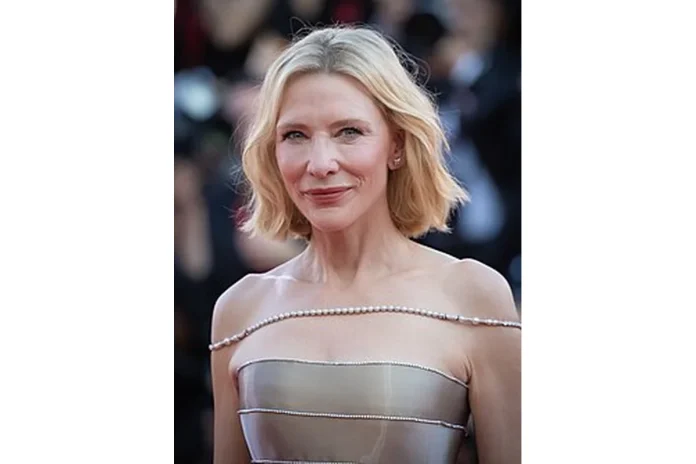
Cate Blanchett Bio
Catherine Élise Blanchett is an Australian actor and producer regarded as one of the finest performers of her generation. Recognised for her versatile work across stage and screen, she first drew international attention in the late 1990s and has since built a career spanning independent film, large-scale blockbusters, and classical theatre. Blanchett has received numerous accolades, including two Academy Awards, four British Academy Film Awards, four Golden Globe Awards, and three Screen Actors Guild Awards, along with nominations for three Primetime Emmy Awards and a Tony Award.
A graduate of the National Institute of Dramatic Art, Blanchett has appeared in more than seventy films and over twenty theatre productions. Her films have grossed over 9.8 billion dollars at the worldwide box office, making her one of the most commercially successful actresses of her era. She is also recognised for her humanitarian work with the United Nations High Commissioner for Refugees and her advocacy on environmental issues.
Early Life and Background
Catherine Élise Blanchett was born on 14 May 1969 in the Melbourne suburb of Ivanhoe, Victoria, Australia. Her Australian mother, June, was a property developer and teacher, while her American father, Robert DeWitt Blanchett Jr., was a Texan native who served as a United States Navy chief petty officer before becoming an advertising executive. The couple met in Melbourne when Robert’s ship broke down in the harbour. Blanchett is the second of three children, with an older brother and a younger sister, and has described herself as a part extrovert, part wallflower during her childhood.
When Blanchett was ten years old, her father died of a heart attack, leaving her mother to raise the family. She attended primary school at Ivanhoe East Primary School and later pursued her secondary education at Ivanhoe Girls’ Grammar School and Methodist Ladies’ College, where she developed a passion for the performing arts. In her late teens and early twenties, she worked at a nursing home in Victoria before enrolling at the University of Melbourne, where she began studying a Bachelor of business administration.
While travelling in Egypt, Blanchett was cast as an extra in the Egyptian boxing film Kaboria (1990) and accepted the job because she needed money. On returning to Australia, she moved to Sydney and enrolled at the National Institute of Dramatic Art, graduating in 1992 with a Bachelor of Fine Arts.
Path to Celebrity
Blanchett began her professional career on the Australian stage in 1992, immediately after graduating from the National Institute of Dramatic Art. Her early stage work established her reputation in Sydney, and she made her feature film debut in 1997. She soon came to international prominence for her performance as Queen Elizabeth I in the period drama Elizabeth (1998), which earned her first Academy Award nomination and signalled her arrival on the global stage.
Following this breakthrough, Blanchett took on a wide range of roles in both independent productions and major studio films. Her willingness to play unconventional characters and her command of diverse accents helped her transition smoothly from Australian theatre to international film. She co-founded her production interests alongside her husband, playwright and screenwriter Andrew Upton, and the two became co-CEOs and artistic directors of the Sydney Theatre Company in 2008.
Cate Blanchett Career
Early Career (1992–1997)
Blanchett began her career on the Australian stage in 1992, working with several theatre companies in Sydney after graduating from the National Institute of Dramatic Art. Her early stage roles helped her develop the range and discipline that would later define her screen work. She made her feature film debut in 1997 and quickly attracted the attention of international casting directors.
Her earliest film and television appearances during this period laid the foundation for her later achievements, including projects that showcased her ability to portray complex, strong-willed women. By the end of 1997, she had been cast as Queen Elizabeth I in Elizabeth, a role that would soon change the course of her career.
Breakthrough (1998–2007)
Blanchett came to international prominence with her performance as Queen Elizabeth I in Elizabeth (1998), a role that earned her first Academy Award nomination for Best Actress. She followed this with a string of acclaimed performances, including a scene-stealing turn as a legendary elf queen in Peter Jackson’s The Lord of the Rings trilogy (2001–2003), which became a global phenomenon.
In 2004, Blanchett won the Academy Award for Best Supporting Actress for her portrayal of Katharine Hepburn in the Martin Scorsese biopic The Aviator. The performance made her the only actor to win an Academy Award for portraying another Academy Award-winning actor. She received additional Oscar nominations for Notes on a Scandal (2006), I’m Not There (2007), and Elizabeth: The Golden Age (2007), the last for reprising the role that first brought her worldwide recognition.
Notable Works and Milestones
Among Blanchett’s most recognised works are Elizabeth (1998), The Aviator (2004), and Blue Jasmine (2013). Her portrayal of a neurotic former socialite in Woody Allen’s Blue Jasmine earned her a second Academy Award, this time for Best Actress. She is the only Australian to win two acting Oscars and is among only four actors to have won the Academy Award for Best Actress after previously winning Best Supporting Actress.
Continued Success (2008–2020)
Blanchett expanded her work across blockbuster franchises and auteur-driven films, appearing in Indiana Jones and the Kingdom of the Crystal Skull (2008), The Curious Case of Benjamin Button (2008), Cinderella (2015), Thor: Ragnarok (2017), and Ocean’s 8 (2018). Alongside her film work, she and Andrew Upton led the Sydney Theatre Company from 2008 to 2013, where her performance as Blanche DuBois in A Streetcar Named Desire was hailed as one of the great stage performances of the era.
She made her Broadway debut in 2017 in The Present, earning a Tony Award nomination for Best Actress in a Play. In 2020, she portrayed Phyllis Schlafly in the FX on Hulu miniseries Mrs. America, which brought her a Primetime Emmy nomination. She also became a UNHCR Goodwill Ambassador in 2016, using her platform to advocate for refugees worldwide.
2021–Present: Tár and Further Acclaim
In 2022, Blanchett starred as fictional conductor Lydia Tár in Tár, directed by Todd Field, a performance that drew widespread critical acclaim. She won her fourth Golden Globe Award, fourth BAFTA Award, and second Volpi Cup for Best Actress, along with her eighth Oscar nomination. That same year, she voiced Spazzatura in Guillermo del Toro’s Pinocchio and co-produced the Apple TV+ film Fingernails.
In 2023, she co-starred in the Australian drama The New Boy and reprised her role as Hela in the Marvel animated series What If…?. The following year, she headlined the Apple TV+ miniseries Disclaimer, written and directed by Alfonso Cuarón, earning another Primetime Emmy nomination. In 2025, she is scheduled to star at the Barbican Theater in London in a reimagining of Anton Chekhov’s The Seagull.
Cate Blanchett Award Nominations
Cate Blanchett has accumulated a remarkable number of award nominations across her career, reflecting her standing in both film and theatre. She has received eight Academy Award nominations, including recognition for Elizabeth, The Aviator, Notes on a Scandal, I’m Not There, Elizabeth: The Golden Age, Blue Jasmine, Carol, and Tár. She has also received nominations for a Tony Award, three Primetime Emmy Awards, and a Drama Desk Award, among other honours from major international film institutions.
Cate Blanchett Awards Won
Cate Blanchett has won two Academy Awards, four British Academy Film Awards, four Golden Globe Awards, and three Screen Actors Guild Awards, in addition to numerous critics’ prizes. Her Academy Award wins came for Best Supporting Actress in The Aviator (2005) and Best Actress in Blue Jasmine (2014). She has also received the Centenary Medal from the Australian government, the Companion of the Order of Australia, the French Chevalier of the Order of Arts and Letters, and the Honorary César award.
| Award | Wins | Year |
|---|---|---|
| Academy Award for Best Supporting Actress (The Aviator) | 1 | 2005 |
| Academy Award for Best Actress (Blue Jasmine) | 1 | 2014 |
Cate Blanchett Family
Cate Blanchett is married to playwright and screenwriter Andrew Upton, whom she met in Australia in the mid-1990s. The couple married on 21 June 1997 and have three sons and a daughter, with the daughter adopted in 2015. After making Brighton, England their main home for nearly ten years, Blanchett and Upton returned to Australia in 2006 to be closer to family, before relocating back to England in 2016.
Personal Life
Blanchett has spoken publicly about feminism and the pressures women in Hollywood face, and she has long been recognised as a style icon, frequently appearing on lists of the best-dressed women in the world. She has served as a UNHCR Goodwill Ambassador since 2016, undertaking missions to Jordan, Lebanon, and Bangladesh to highlight the plight of refugees. She also co-created and produced the Australian miniseries Stateless, which premiered on Netflix in 2020 and focuses on the lives of people in an immigration detention centre.