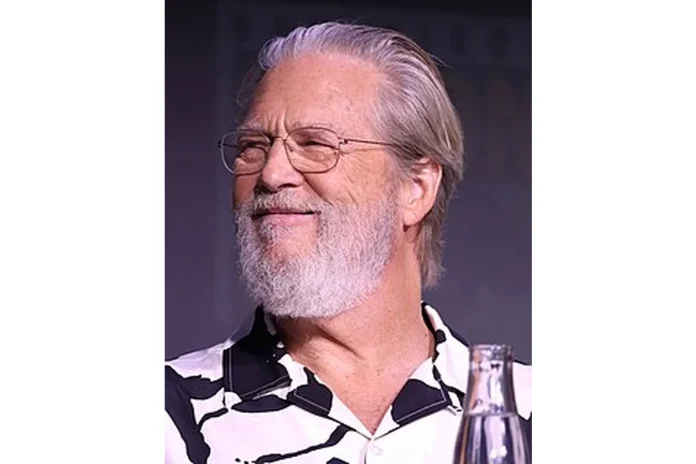
Jeff Bridges Bio
Jeffrey Leon Bridges (born December 4, 1949) is an American actor. He is best known for his leading man roles in film and television. In a career spanning more than seven decades, he has received various accolades, including an Academy Award and a Golden Globe Award, in addition to nominations for three BAFTA Awards and two Primetime Emmy Awards. In 2019, he was awarded the Cecil B. DeMille Award. Born into a prominent acting family, Bridges appeared on the television series Sea Hunt (1958–1960) alongside his father, Lloyd, and brother, Beau. He made his feature film debut in the drama Halls of Anger (1970), and starred in The Last Picture Show (1971), which earned him his first Academy Award nomination. As a leading man, he starred in the adventure film King Kong (1976); neo-noir Cutter’s Way (1981); science fiction film Tron (1982); thrillers Jagged Edge (1985) and The Morning After (1986); dramas The Fabulous Baker Boys (1989), The Fisher King (1991), and The Mirror Has Two Faces (1996); and crime comedy The Big Lebowski (1998). Bridges received further Oscar nominations for his roles in Thunderbolt and Lightfoot (1974), Starman (1984), The Contender (2000), True Grit (2010), and Hell or High Water (2016); and won the Academy Award for Best Actor for his role as an alcoholic singer in Crazy Heart (2009). He has also starred in big-budget films, such as Seabiscuit (2003), Iron Man (2008), and Tron: Legacy (2010). On television, he earned Primetime Emmy Award nominations for his performances in the HBO film A Dog Year (2009), and the Hulu series The Old Man (2022–2024).
Early Life and Background
Bridges was born on December 4, 1949, in Los Angeles, California, the son of actor Lloyd Bridges and actress and writer Dorothy Bridges. He is one of four children: older brother Beau Bridges, who is also an actor; a younger sister Lucinda; and a brother named Garrett, who died of sudden infant death syndrome in 1948. His maternal grandfather was an immigrant from Liverpool, England. Bridges and his siblings were raised in the Holmby Hills section of Los Angeles. He shared a close relationship with his brother Beau, who acted as a surrogate father when their father was working. He graduated from University High School in 1967. At age 17, he toured with his father in a stage production of Anniversary Waltz, and then moved to New York City, where he studied acting at the Herbert Berghof Studio. He also served in the United States Coast Guard Reserve as a boatswain’s mate from 1967 to 1975 in San Luis Obispo, California, with a terminal rating of Boatswain’s Mate Second Class.
Path to Hollywood
Bridges made his first screen appearance in an uncredited role in The Company She Keeps (1951); the film was released shortly after his first birthday. In his youth, Bridges and his brother Beau made occasional appearances on their father’s show Sea Hunt and the CBS anthology series The Lloyd Bridges Show. In 1965, he played a supporting role alongside his father in an episode of The Loner. In 1969, he played Job Corps crew member Cal Baker in the Lassie episode “Success Story.” In 1971, he played the lead role Mike in the television film In Search of America. His first major role came in the 1971 film The Last Picture Show, for which he garnered a nomination for the Academy Award for Best Supporting Actor. He next co-starred in the 1972 gritty boxing film Fat City, directed by John Huston.
Jeff Bridges Career
Early Career (1951–1970)
Bridges made his first screen appearance in an uncredited role in The Company She Keeps (1951); the film was released shortly after his first birthday. In his youth, Bridges and his brother Beau made occasional appearances on their father’s show Sea Hunt (1958–1961) and the CBS anthology series The Lloyd Bridges Show (1962–1963). In 1965, he played a supporting role alongside his father in an episode of The Loner. In 1969, he played Job Corps crew member Cal Baker in the Lassie episode “Success Story.”
Breakthrough (1971–1989)
In 1971, he played the lead role Mike in the television film In Search of America. His first major role came in the 1971 film The Last Picture Show, for which he garnered a nomination for the Academy Award for Best Supporting Actor. He next co-starred in the 1972 gritty boxing film Fat City, directed by John Huston. In 1973, he starred as Junior Jackson in The Last American Hero, a film based on the true story of NASCAR driver Junior Johnson. He was again nominated for Best Supporting Actor for his performance opposite Clint Eastwood in the 1974 film Thunderbolt and Lightfoot. In 1976, he starred as the protagonist Jack Prescott in the first remake of King Kong, opposite Jessica Lange. This film was a commercial success, earning $90 million worldwide, more than triple its $23 million budget, and also winning an Academy Award for Best Visual Effects. Towards the end of the decade, he acted in mystery Somebody Killed Her Husband (1978) opposite Farrah Fawcett, the satirical black comedy Winter Kills (1979) alongside John Huston, and the comedy-drama The American Success Company (1979). In 1980, he acted in Michael Cimino’s large Western ensemble film Heaven’s Gate acting opposite Kris Kristofferson, Christopher Walken, John Hurt, Sam Waterston, and Isabelle Huppert. The film was a public critical and commercial failure and was blamed for the downfall of the studio, United Artists.
Notable Works and Milestones
Bridges starred in the science fiction film Tron (1982), in which he played Kevin Flynn, a video game programmer. Critic Roger Ebert described the film as “brilliant” and compared it to The Empire Strikes Back, writing, “This movie is a machine to dazzle and delight us…and in a technical way maybe it’s breaking ground for a generation of movies in which computer-generated universes will be the background for mind-generated stories about emotion-generated personalities.” He also starred in the romantic comedy Kiss Me Goodbye directed by Robert Mulligan, acting alongside Sally Field. In 1984, he starred in the John Carpenter-directed science fiction romance Starman playing an alien opposite Karen Allen. For his performance, he was nominated for the Academy Award for Best Actor. During this period, he also performed in the neo-noir Against All Odds (1984) with James Woods and Rachel Ward, the thrillers Jagged Edge (1985) opposite Glenn Close and The Morning After (1986) with Jane Fonda, and the crime comedy Nadine (1987) alongside Kim Basinger. In 1988, he portrayed automobile entrepreneur Preston Tucker in the Francis Ford Coppola directed biographical film Tucker: The Man and His Dream which earned positive reviews.
Jeff Bridges Award Nominations
Throughout his career, Jeff Bridges has received numerous nominations for prestigious awards, including three BAFTA Awards and two Primetime Emmy Awards. His performances have earned him critical acclaim and recognition across the film industry.
Jeff Bridges Awards Won
Jeff Bridges has won various awards, including an Academy Award for Best Actor for his role in Crazy Heart (2009) and a Golden Globe Award for Best Actor in a Drama. In 2019, he was honored with the Cecil B. DeMille Award for his contributions to the film industry.
Jeff Bridges Family
Jeff Bridges married Susan Geston in 1977. They met while filming Rancho Deluxe in 1975, on a ranch where Geston had been working as a waitress. They have three daughters, born in 1981, 1983, and 1985.
Personal Life
Bridges has studied Buddhism and has described himself as “a Buddhistly bent guy.” He has co-written a book with Zen master Bernie Glassman on the subject but doesn’t consider himself a Buddhist in terms of formal affiliation, saying he enjoys the meditation part. On October 19, 2020, Bridges announced that he had been diagnosed with Non-Hodgkin lymphoma and has gone through chemotherapy. On September 12, 2021, he announced that his cancer was in remission. Bridges also announced he contracted COVID-19 while in treatment and fought for almost five weeks. He described the long process of recovery from both diseases, relating how large his tumor had grown, yet being unaware it was there. After five weeks in the hospital with COVID, he had months of recuperation at home before he could function again.