Robert Lee Zemeckis Bio
Robert Lee Zemeckis, sometimes referred to as Bob Zemeckis, is an American filmmaker recognized for directing and producing some of the most commercially successful and visually innovative films in modern cinema history. His body of work spans comedies, science fiction, dramas, and animated features, consistently blending cutting-edge visual effects technology with compelling character-driven storytelling. He has earned two Academy Awards and a Golden Globe Award, alongside nominations for five British Academy Film Awards and a Daytime Emmy Award.
Born on May 14, 1952, in Chicago, Illinois, Zemeckis grew up on the city’s South Side in a working-class household, the son of Italian-American mother Rosa Nespeca and Lithuanian-American father Alphonse Zemeckis. Television and his father’s 8 mm film camera became his earliest creative outlets, sparking a lifelong fascination with visual storytelling that eventually led him to pursue formal film training at the University of Southern California’s School of Cinematic Arts.
Early Life and Background
Robert Lee Zemeckis was born in Chicago on May 14, 1952, the son of Italian-American mother Rosa and Lithuanian-American father Alphonse Zemeckis. He grew up in a working-class family on Chicago’s South Side, attending a Catholic grade school and then Fenger Academy High School. His childhood environment held little in the way of formal artistic exposure, and he has described his upbringing as lacking music, books, or theater. Television became his primary window to a wider world, and an episode of The Tonight Show Starring Johnny Carson introduced him to the existence of film schools, setting him on his career path.
Seeing the 1967 film Bonnie and Clyde with his father confirmed his desire to become a director, though his parents expressed concern that such a dream was unrealistic for someone from his background. Undeterred, he enrolled at Northern Illinois University in DeKalb, spending a summer working as a film cutter for NBC News in Chicago and editing commercials. He applied to transfer to the University of Southern California’s School of Cinematic Arts, winning admission after an impassioned phone call in which he promised to improve his studies through summer school.
At USC, Zemeckis met fellow student and writer Bob Gale, with whom he shared a straightforward ambition to make mainstream Hollywood movies rather than pursue more academic or experimental filmmaking. Zemeckis graduated from USC in 1973, and his short film A Field of Honor earned him a Student Academy Award for Special Jury Prize, drawing the attention of Steven Spielberg, who would become his mentor and executive producer.
Path to Director
Winning the Student Academy Award at USC for his short film A Field of Honor put Zemeckis on Steven Spielberg’s radar. Spielberg was so impressed by the student work that he personally arranged to meet with Zemeckis and became his mentor, eventually executive producing his first two feature films. Zemeckis and Gale co-wrote the screenplays for those early films, and their collaboration proved foundational to his artistic development.
Zemeckis made his feature directorial debut in 1978 with I Wanna Hold Your Hand, a comedy about Beatles fans, followed by Used Cars in 1980. Both films were praised by critics but found limited commercial audiences, and the pair developed a reputation within Hollywood for writing scripts that studios admired yet struggled to turn into box office successes. Years of difficulty finding directing work followed until Michael Douglas hired him in 1984 to direct Romancing the Stone, a romantic adventure that became an unexpected sleeper hit and restored his standing in the industry.
Robert Lee Zemeckis Career
Early Career (1978–1984)
Zemeckis began his directing career in 1978 with I Wanna Hold Your Hand, a comedy set during the Beatles’ 1964 appearance on The Ed Sullivan Show that pioneered his use of archival footage and doubles to incorporate real historical figures. His follow-up, Used Cars (1980), starred Kurt Russell and was another critical favorite that underperformed commercially. Romancing the Stone (1984), starring Michael Douglas and Kathleen Turner, became his first major commercial success and proved he could deliver a crowd-pleasing hit, earning enough momentum to get the long-gestating Back to the Future greenlit.
Breakthrough (1985–1999)
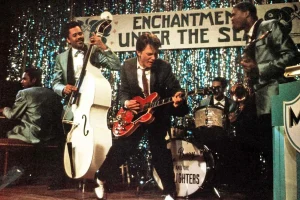
Back to the Future, released in 1985, was a defining cultural event. Starring Michael J. Fox as Marty McFly, Christopher Lloyd as Doc Brown, and Lea Thompson and Crispin Glover in supporting roles, the film follows a teenager who accidentally travels back to 1955 in a modified DeLorean automobile. The film was a massive commercial success, and its two sequels, Back to the Future Part II (1989) and Back to the Future Part III (1990), cemented the trilogy as one of the most beloved in cinema history.
Between the first and second Back to the Future films, Zemeckis directed Who Framed Roger Rabbit (1988), a groundbreaking collaboration with Walt Disney Pictures that seamlessly integrated hand-drawn animation with live-action footage. With a then-industry-leading budget of $70 million, the film was both a critical and commercial triumph, winning three Academy Awards and demonstrating Zemeckis’s facility with technically demanding filmmaking.
In 1994, Zemeckis directed Forrest Gump, starring Tom Hanks as a man with a low I.Q. who unwittingly intersects with many of the defining events of twentieth-century American life. The film grossed $677 million worldwide and became the highest-grossing American film of the year, sweeping the Academy Awards with wins for Best Picture, Best Actor for Hanks, and Best Director for Zemeckis. The win for Best Director made Zemeckis one of the few filmmakers to have earned Academy Awards for both student and competitive work. His collaboration with Hanks would continue across multiple subsequent films, and he also formed a long-running partnership with composer Alan Silvestri, who has scored every Zemeckis film since Romancing the Stone.
In 1997, Zemeckis directed Contact, an adaptation of Carl Sagan’s novel starring Jodie Foster as a scientist who discovers evidence of extraterrestrial intelligence. Around the same time, he founded South Side Amusement Company, which later became ImageMovers. By 1999, he had donated five million dollars to establish the Robert Zemeckis Center for Digital Arts at USC. In 2000, Zemeckis released two films shot back-to-back: What Lies Beneath, a thriller starring Harrison Ford and Michelle Pfeiffer that grossed over $155 million domestically, and Cast Away, starring Hanks as a man stranded on a deserted island, which grossed $233 million domestically and earned Hanks a Best Actor Academy Award nomination.
2004–Present
In 2004, Zemeckis directed The Polar Express, a motion-capture animated adaptation of Chris Van Allsburg’s children’s book starring Tom Hanks. The film was the first feature to use motion-capture technology on a large scale, prompting The New York Times to note its potential significance in the transition from analog to digital cinema. He followed it with Beowulf in 2007, using motion capture to retell the Anglo-Saxon epic poem, and A Christmas Carol in 2009, an adaptation of Charles Dickens’s novella starring Jim Carrey in multiple roles.
Zemeckis founded ImageMovers Digital in 2007 in partnership with Walt Disney Studios, but the company closed in 2010 after its final film, Mars Needs Moms, became a notable box office disappointment. He returned to live-action filmmaking with Flight in 2012, a drama starring Denzel Washington as an airline pilot, followed by The Walk in 2015, about Philippe Petit’s tightrope walk between the World Trade Center towers, and Allied in 2016, a romantic thriller starring Brad Pitt set during World War II. In 2018, he directed Welcome to Marwen, starring Steve Carell, followed by The Witches, an adaptation of the Roald Dahl novel released on HBO Max in 2020, and Pinocchio, a live-action Disney+ film released in 2022 that received highly negative critical reception despite earning a Visual Effects Society Award nomination. In 2024, he released Here, an adaptation of Richard McGuire’s graphic novel starring Tom Hanks and Robin Wright, and has expressed interest in a potential film adaptation of the Back to the Future stage musical.
Robert Lee Zemeckis Award Nominations
Over the course of his career, Robert Lee Zemeckis has received nominations for five British Academy Film Awards and a Daytime Emmy Award, in addition to the Academy Award and Golden Globe wins noted elsewhere. Under his direction, actors including Tom Hanks have earned Academy Award nominations for performances in his films, and several of his projects have been recognized across international awards bodies for their technical and artistic achievements.
Robert Lee Zemeckis Awards Won
Robert Lee Zemeckis’s awards include two Academy Awards and a Golden Globe Award. He won the Academy Award for Best Director for Forrest Gump and earlier received a Student Academy Award for Special Jury Prize for his short film A Field of Honor during his time at USC, making him one of a small group of filmmakers to win Academy Awards in both categories. Forrest Gump also won the Academy Award for Best Picture and Best Actor for Tom Hanks, with additional Academy Awards for the film’s editing, visual effects, and adapted screenplay.
| Award | Wins | Year |
|---|---|---|
| Academy Award for Best Director | 1 | 1994 |
| Student Academy Award for Special Jury Prize | 1 | 1973 |
Robert Lee Zemeckis Family
Robert Lee Zemeckis was born to Rosa and Alphonse Zemeckis, an Italian-American mother and a Lithuanian-American father who raised him on Chicago’s South Side. He was married to actress Mary Ellen Trainor from 1980 until their divorce in 2000, and they have a son named Alexander Francis. In 2001, he married actress Leslie Harter in Venice, and the couple has three children together. The family resides in Santa Barbara, California, and also owns a villa in Tuscany situated on the ruins of a 10th-century castle.
Personal Life
Outside of filmmaking, Robert Lee Zemeckis is a licensed private pilot who has logged approximately 1,600 hours of flight time as of October 2012, flying a Cirrus SR22. He has described sacrificing his personal life extensively during his early career, noting that his twenties were consumed entirely by work and that he won his first Academy Award at age 42 at significant personal cost. He has also been an active supporter of Democratic political candidates and causes, with campaign donation records indicating contributions related to aviation interests, family planning, and organizations advocating for women in Hollywood.