Robin Williams Bio
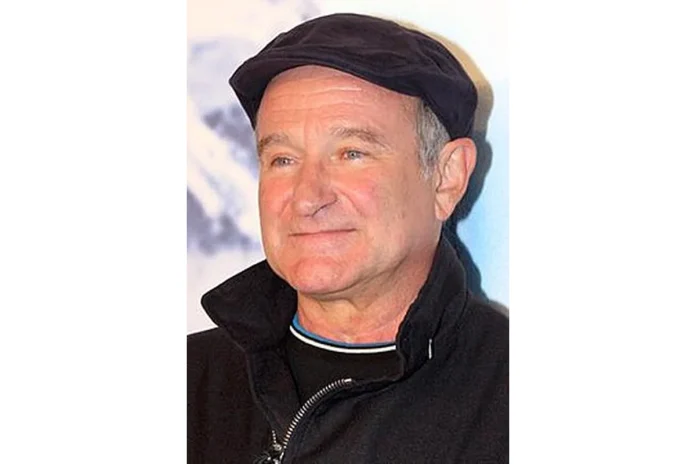
Robin McLaurin Williams (July 21, 1951 – August 11, 2014) was an American actor and comedian known for his improvisational skills and the wide variety of characters he created spontaneously. He is regarded as one of the greatest comedians of all time and received numerous accolades including an Academy Award, two Primetime Emmy Awards, and six Golden Globe Awards. Williams rose to fame playing the alien Mork in the sitcom Mork & Mindy and won an Academy Award for Best Supporting Actor for his role in Good Will Hunting. His dynamic performances in both comedies and dramas left a lasting impact on the world of entertainment.
Early Life and Background
Robin McLaurin Williams was born at St. Luke’s Hospital in Chicago, Illinois, on July 21, 1951. His father, Robert Fitzgerald Williams, was a senior executive in Ford’s Lincoln-Mercury Division, while his mother, Laurie McLaurin, was a former model from Jackson, Mississippi. Williams had two older half-brothers and was raised in a household where his mother practiced Christian Science and his father was an Episcopalian. His early exposure to humor came from his mother, who he credited as an important influence on his comedic style. Williams attended public elementary school and later transferred to private all-boys Detroit Country Day School, where he excelled academically and served as class president. However, he also faced bullying for his weight, which led him to seek solace in performing arts.
After moving to Tiburon, California, Williams attended Redwood High School, where he joined the drama club and developed a passion for acting. He graduated in 1969 and initially enrolled at Claremont Men’s College to study political science, but he dropped out to pursue acting. He later studied theater at the College of Marin and received a full scholarship to the Juilliard School in New York City, where he honed his craft alongside fellow actor Christopher Reeve.
Path to Hollywood
Williams began performing stand-up comedy in the San Francisco Bay Area in 1976, quickly gaining recognition for his unique style. His first credited film role was a minor part in the 1977 comedy Can I Do It… ‘Til I Need Glasses?, but his breakthrough came when he was cast as the alien Mork in the television series Mork & Mindy, which premiered in 1978. The show became a massive hit, turning Williams into a household name and showcasing his improvisational talents.
Following the success of Mork & Mindy, Williams starred in his first leading film role in Popeye (1980). Although the film did not perform well at the box office, it established him as a leading actor in Hollywood. His career continued to flourish with notable performances in films such as Good Morning, Vietnam (1987), Dead Poets Society (1989), and Mrs. Doubtfire (1993), which showcased his ability to blend comedy with serious themes.
Robin Williams Career
Early Career (1976–1982)
Williams’s early career was marked by his stand-up comedy performances, which gained him a loyal following. He became a regular at comedy clubs in San Francisco and Los Angeles, where he developed his improvisational style. His television debut came in 1977 with a revival of Laugh-In, followed by appearances on The Richard Pryor Show. Williams’s role as Mork in Happy Days led to the spin-off series Mork & Mindy, which solidified his status as a comedic star.
During this period, Williams also released several successful comedy albums, including Reality… What a Concept, which won him a Grammy Award for Best Comedy Album. His energetic performances and unique comedic voice set him apart from his contemporaries and laid the groundwork for his future success in film.
Breakthrough (1987–1999)
Williams’s breakthrough in film came with his role in Good Morning, Vietnam (1987), where he played a radio DJ entertaining troops during the Vietnam War. His performance earned him an Academy Award nomination for Best Actor and showcased his ability to blend humor with poignant social commentary. He continued to receive critical acclaim for his roles in Dead Poets Society (1989), where he played an inspiring English teacher, and Good Will Hunting (1997), for which he won the Academy Award for Best Supporting Actor.
His performances in these films demonstrated his range as an actor, transitioning seamlessly between comedy and drama. Williams also starred in beloved family films such as Mrs. Doubtfire (1993) and Aladdin (1992), where he voiced the iconic Genie, further cementing his status as a versatile performer.
Notable Works and Milestones
Williams’s signature works include Good Will Hunting, Mrs. Doubtfire, and Aladdin. He received numerous awards throughout his career, including six Golden Globe Awards and two Primetime Emmy Awards. His ability to connect with audiences through humor and heartfelt performances left a lasting legacy in the entertainment industry.
Robin Williams Award Nominations
Throughout his career, Robin Williams received numerous nominations for his work in film and television, reflecting his impact on the industry.
Robin Williams Awards Won
Robin Williams won several prestigious awards, including an Academy Award for Best Supporting Actor for Good Will Hunting, two Primetime Emmy Awards, and five Grammy Awards. His accolades highlight his exceptional talent and contributions to the world of entertainment.
Robin Williams Family
Robin Williams was married three times. His first marriage was to Valerie Velardi from 1978 to 1988, with whom he had one son, Zachary Pym. He then married Marsha Garces in 1989, with whom he had two children, Zelda Rae and Cody Alan. Williams’s third marriage was to Susan Schneider in 2011, and they remained together until his death in 2014.
Personal Life
Williams faced personal struggles throughout his life, including battles with substance abuse and depression. He was open about his challenges and sought help multiple times. His death in 2014 was ruled a suicide, and it was later revealed that he had been suffering from Lewy body dementia, which contributed to his mental health struggles. Williams’s legacy continues to be celebrated through tributes and memorials honoring his contributions to comedy and film.