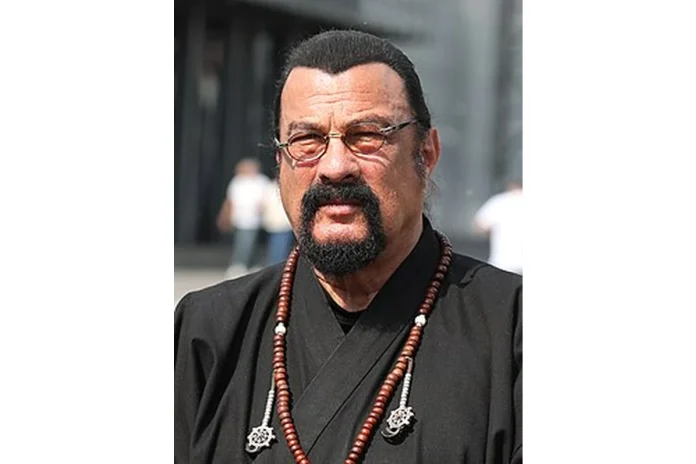
Steven Frederic Seagal Bio
Steven Frederic Seagal is an American actor, producer, screenwriter, martial artist, and musician whose career has spanned more than three decades. A 7th-dan black belt and shihan in Aikikai aikido, he made history as the first non-Japanese and American person to operate an aikido dojo. He made his acting debut in Above the Law in 1988, a film regarded as the first American production to feature aikido in fight sequences. He later achieved widespread fame in the early 1990s with action films such as Under Siege, becoming one of the most recognizable action stars of that era.
Beyond acting, Seagal has worked as a producer and screenwriter, and has built a parallel career as a recording artist with two studio albums to his credit. His public persona extends into environmental activism, law enforcement reality television, and international political engagement. At 193 centimeters tall with an imposing physical presence shaped by decades of aikido practice, he has cultivated an enduring image rooted in martial discipline and action cinema.
Early Life and Background
Steven Frederic Seagal was born on April 10, 1952, in Lansing, Michigan, the son of Patricia Anne Fisher, a medical technician, and Samuel Seagal, a mathematics teacher. His mother was of Irish descent, while his father was Jewish, with paternal grandparents who were Russian Jewish immigrants. When Seagal was five years old, his family relocated to Fullerton, California. His mother later recalled that before the move, Seagal was a frail child who suffered from asthma, but that he significantly improved after settling in California.
Seagal attended Buena Park High School in Buena Park, California, and enrolled at Fullerton College between 1970 and 1971. From an early age, he demonstrated a strong interest in martial arts, a pursuit that would come to define both his personal identity and his professional trajectory in the years to come.
Path to Actor
In 1974, Seagal traveled to Japan, where he married Miyako Fujitani, the daughter of an aikido instructor and a second-degree black belt in her own right. He taught at the dojo owned by her family and earned his aikido black belt in 1978. During his years in Japan, Seagal became the first non-Japanese person to operate an aikido dojo, a milestone that contributed significantly to his reputation within the martial arts community. He also worked as a fight coordinator on The Challenge in 1982 and Never Say Never Again in 1983, gaining his first professional experience in the film industry.
Seagal returned to the United States in 1983 with senior student Haruo Matsuoka. The two opened an aikido dojo in North Hollywood, which later relocated to West Hollywood. Seagal left Matsuoka in charge of the dojo in 1997 when their partnership ended. During this period, Seagal began working toward a film career, leveraging his martial arts credentials and distinctive presence to attract the attention of Hollywood agents.
Steven Frederic Seagal Career
Early Career (1982-1991)
In the early 1980s, Seagal’s first forays into film were as a fight coordinator on productions shot in Japan and Europe. Agent Michael Ovitz became convinced that Seagal possessed genuine movie star potential after observing his martial arts abilities and screen presence, and asked him to develop a film project. The result was Above the Law, released in 1988 and directed by Andrew Davis. The film is regarded as the first American motion picture to feature aikido choreography in its fight sequences, and Seagal’s performance received praise from critics including Roger Ebert.
By 1991, Seagal had starred in three commercially successful action films, rapidly establishing himself as a viable leading man in Hollywood’s action genre. His films consistently drew strong box office returns and positioned him alongside contemporaries such as Jean-Claude Van Damme as one of the era’s most prominent martial arts actors.
Breakthrough (1992-1995)
In 1992, Seagal achieved a major career milestone with Under Siege, in which he played Navy SEAL counter-terrorism expert Casey Ryback, a role that became one of the most iconic of his career. The film cast Seagal as the sole defender of a hijacked U.S. Navy battleship, and its commercial success cemented his status as a top-tier Hollywood action star. He reprised the Casey Ryback role in the sequel Under Siege 2: Dark Territory in 1995.
In 1994, Seagal made his directorial debut with On Deadly Ground, starring alongside Michael Caine, R. Lee Ermey, and Billy Bob Thornton. The film departed from his typical urban action formula by foregrounding environmental and spiritual themes, though it received negative reviews from critics, particularly for its extended environmental speech. Seagal himself has described it as one of the most meaningful projects of his career.
Notable Works and Milestones
Seagal is widely credited with popularizing aikido in Western cinema, and is considered an important figure in the development and spread of East Asian martial arts in film. His characters frequently reflect aspects of his own life, including his aikido background, fluency in Japanese, and Buddhist faith. In 1996, he appeared in Executive Decision alongside Kurt Russell, in a rare role where his character was killed before the film’s midpoint. In 2001, Exit Wounds marked what was regarded at the time as a commercial comeback, earning nearly $80 million worldwide. In 2010, he took on the main villain in Robert Rodriguez’s Machete, a rare departure from his typical heroic roles. Between 2009 and 2014, he starred in the reality series Steven Seagal: Lawman on A&E, which documented his duties as a reserve deputy sheriff with the Jefferson Parish Sheriff’s Office in Louisiana.
Steven Frederic Seagal Family
Seagal has six children from four relationships. While living in Japan, he married Miyako Fujitani, with whom he had two children: Kentaro Seagal, an actor and model, and Ayako Fujitani, a writer and actress. Seagal and Fujitani divorced in 1986. During his relationship with actress Kelly LeBrock, which began while he was still married to Fujitani, Seagal had three more children: daughter Annaliza, born in 1987; son Dominic, born in 1990; and daughter Arissa, born in 1993. Seagal and LeBrock married in September 1987 and divorced in 1996. He also has a son, Kunzang, with his current wife, Erdenetuya Batsukh, whom he married in 2009. Seagal is additionally the guardian of Yabshi Pan Rinzinwangmo, the only child of the 10th Panchen Lama of Tibet. He is a grandfather to two grandchildren through his eldest son Kentaro and two granddaughters through his daughter Ayako Fujitani.
Personal Life
Seagal has been married four times. His first marriage, to Miyako Fujitani, lasted from 1975 to 1986 and ended in divorce. He was briefly married to actress Adrienne La Russa in 1984, though the marriage was annulled the same year over concerns that his divorce from Fujitani had not yet been finalized. He married actress and model Kelly LeBrock in 1987, and the couple had three children before their divorce in 1996. Since 2009, Seagal has been married to Erdenetuya Batsukh, a former professional dancer from Mongolia who was considered the top female ballroom dancer in her country before their marriage.
Seagal holds citizenship in three countries: the United States, Russia, and Serbia. He was granted Serbian citizenship in January 2016 and Russian citizenship in November 2016. He is an environmentalist and animal rights advocate, and was awarded a PETA Humanitarian Award in 1999. He is also a supporter of the 14th Dalai Lama, Tenzin Gyatso, and in 1997 was identified by Lama Penor Rinpoche as the reincarnation of Chungdrag Dorje, a 17th-century terton of the Nyingma tradition of Tibetan Buddhism. Outside of film, Seagal is an accomplished guitarist and has released two studio albums: Songs from the Crystal Cave in 2004 and Mojo Priest in 2006.