
Rian Johnson’s creative vision behind Poker Face and its feminist impact are on full display as the show‘s second season wraps up in the studio with Natasha Lyonne by his side. As the dynamic duo finalizes the finale, they can’t help but joke about the editorial process, reflecting the offbeat and fearless spirit that’s made their show such a standout.
An Unconventional Detective Series Rises
Poker Face, Johnson’s Peacock series, redefines the detective genre by following the journey of Charlie Cale, portrayed by Natasha Lyonne, an unorthodox investigator with a natural ability to sniff out deception. This road-trip narrative sees Charlie crisscrossing America, always evading the mob and stumbling into danger, each episode unraveling within a precise structure that deliberately avoids the bloat common in the streaming age.
The structure of Poker Face adheres to its “howcatchem” roots rather than the classic “whodunit,” beginning each episode with a murder that draws Charlie into an unfamiliar world, connecting her fate to the victims she encounters. Season two pushes these boundaries, moving Charlie into backdrops like funeral homes and big box stores, with the tension palpable—yet notably, even as Charlie visits an elementary school, the show carefully sidesteps harm to children, maintaining a thread of empathy amid its high-stakes plots. As Johnson dryly states,
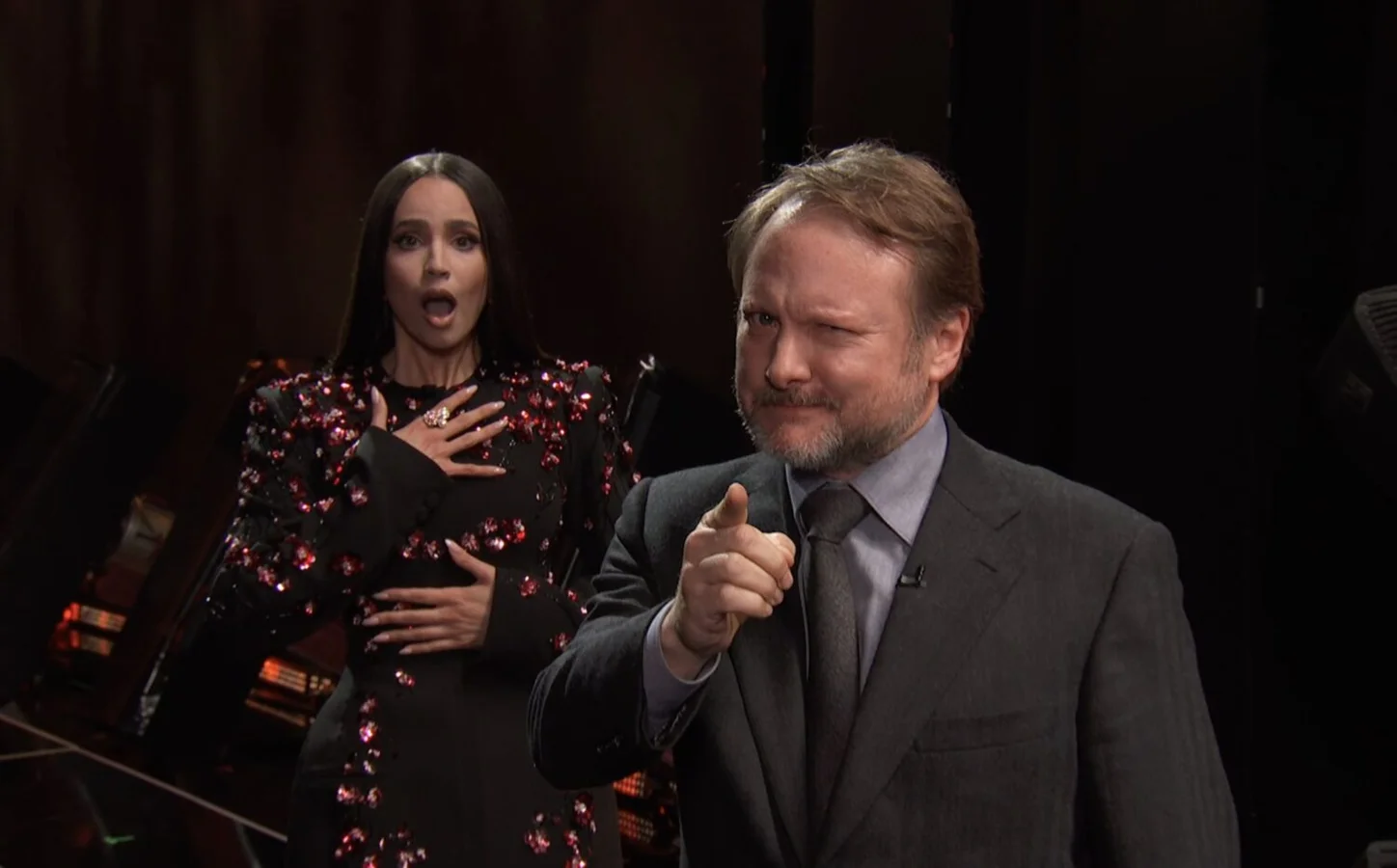
“I feel like you can kill a kid before you can kill a dog.”
—Rian Johnson, Creator-Director
Behind the Scenes: Rapid Shoots and Bold Ideas
Each episode unfolds over a tight 10-day shooting schedule, with a mix of soundstage work in New York City and location shots transforming rural New York into anywhere from Florida to the American heartland. Showrunner Tony Tost orchestrates these transformations, though not every idea—like staging a
“shitty ‘Murder on the Orient Express’”
—proves feasible. Johnson shares,
“It would have been a train mystery set on an Amtrak. It was a great script, but … trains are tough, man.”
—Rian Johnson, Creator-Director
The show’s format has succeeded in part by luring an ever-growing roster of acclaimed guest stars. This season features Cynthia Erivo in multiple roles, John Mulaney playing a corrupt FBI agent, and Kumail Nanjiani portraying a flamboyant gator wrangler reminiscent of Joe Exotic. As Johnson admits,
“The fun thing about these guest roles is they’re relatively low stakes,”
and
“so, Kumail feels fine showing up and playing a character he can take a big, wild swing with and not worry about doing it for 10 more episodes.”
—Rian Johnson, Creator-Director
Sidestepping the Usual Tropes
Poker Face distances itself from typical courtroom and police procedurals, focusing instead on its lead and her unique journey. Lyonne expresses relief at avoiding these standard trappings, a sentiment Johnson echoes, insisting,
“This isn’t a procedural show. It’s a hangout show with Charlie,”
and,
“We lean much more into the humor this season. Maybe it has something to do with the state of the world right now, but we just wanted to have a good time.”
—Rian Johnson, Creator-Director
This tightly structured series paradoxically offers creative flexibility for directors and actors, with each installment functioning almost as a standalone mini-movie. Directors are encouraged to take charge of their episodes, and with Charlie’s character background largely a blank slate, every case becomes the center of its own world. As Johnson notes,
“You can watch them in any order, and it’ll give the illusion Charlie is growing over the course of the season.”
—Rian Johnson, Creator-Director
Grappling with Network Doubts and the Power of Episodic Storytelling
Despite its firm commitment to episodic storytelling, Johnson admits this was a hard sell during development.
“It was very difficult to sell the show. The episodic nature was a scary thing to everybody.”
—Rian Johnson, Creator-Director. Lyonne recalls her reaction on reading the pilot, saying,
“I was doing backflips when I read it,”
and
“I expected all the networks to feel the same, but a lot of people were scared by the idea that it wouldn’t be a completely serialized storyline. You know, Charlie Cale goes back into her childhood and tries to find a husband while she’s solving cases.”
—Natasha Lyonne, Actress-Executive Producer
Charlie’s disinterest in traditional plots about romance or settling down sets Poker Face apart, further cementing its reputation as a radical television experiment. While men have long played wandering protagonists, Lyonne points out the novelty in allowing a female lead to forgo these constraints.
“You weren’t allowed to be a female character with an inner monologue that was not related to finding the guy.”
—Natasha Lyonne, Actress-Executive Producer
This liberation to be led by philosophy, rather than romance, is acknowledged as a rare creative decision.
“For a female character to be led by a philosophical concept, or an ethical soul journey, is a really bold act by one of our greatest living auteurs, who happens to be a guy,”
Lyonne says, motioning toward Johnson. She continues,
“It opens me up to doing so much shit that James Cagney or Humphrey Bogart are allowed to do, and that’s fucking awesome.”
—Natasha Lyonne, Actress-Executive Producer
Poker Face’s Feminist Underpinning
Johnson crafted the premise of Poker Face after rewatching classic TV like Columbo and Quantum Leap during the pandemic. Embracing the notion of an untethered, big-hearted drifter as a lead character, Johnson made the pivotal decision to cast a woman—specifically, Lyonne. Lyonne reflects,
“The idea that he’s seeing all of those dudes and then thinking, ‘God, Natasha would be perfect for this’ is really an act of feminism,”
and
“In a weird way, it’s like saying, ‘OK it’s either Daniel Craig or Emma Thompson, but they’re sort of the same to me.’ That’s a rare gift for me to then be able to embody.”
—Natasha Lyonne, Actress-Executive Producer
Creativity Under Scrutiny: Facing Public Backlash and Standing Strong
As Poker Face’s second season hits audiences, Lyonne is simultaneously embarking on her feature directorial debut, Uncanny Valley, a film blending traditional methods with artificial intelligence in a manner she describes as ethical.
“It’s all about protecting artists and confronting this oncoming wave,”
she says, underlining that the film uses AI only for certain technical enhancements, not as a generative engine.—Natasha Lyonne, Actress-Executive Producer
However, announcement of the project brought swift—and often uninformed—criticism online, exposing Lyonne to public misunderstanding and online vitriol.
“It’s comedic that people misunderstand headlines so readily because of our bizarro culture of not having reading comprehension,”
she explains,
“Suddenly I became some weird Darth Vader character or something. That’s crazy talk, but God bless!”
—Natasha Lyonne, Actress-Executive Producer. Lyonne continues,
“I’ve never been inside of one of those before,”
she says of the backlash.
“It’s scary in there, if anyone’s wondering. It’s not fun when people say not nice things to you. It grows you up a bit.”
—Natasha Lyonne, Actress-Executive Producer
Rian Johnson, no stranger to divisive fandoms after his experience with Star Wars: The Last Jedi in 2017, urges his collaborator to ignore the noise and stay focused on the work. Johnson observes,
“Any great art, during the process of making it, is going to seem like a terrible idea that will never work,”
and,
“Anything great is created in a bubble. If it weren’t, it would never make it past the gestation period.”
—Rian Johnson, Creator-Director
Lyonne’s Journey and the Value of Collaboration
Lyonne’s current success stands in stark contrast to her earlier career in Hollywood, marked by both early breakout roles and challenging stretches where good parts were hard to find.
“I’m very grateful for my success because I’ve been on the other side of the Hollywood tracks, and it’s a lot worse,”
she reflects,
“You call your agent a lot, and they say they’re not making movies right now. And you’re like, ‘I’ve seen the billboards, ma’am. It’s just not true! It’s OK to say they just don’t want me in it.’”
—Natasha Lyonne, Actress-Executive Producer
With her face now prominent on billboards and bus stops, Lyonne acknowledges that true fulfillment comes not from fame, but from the creative partnerships and the ongoing work that drive her career. Whether discussing the Met Gala, meme culture, or her own self-doubt, she remains rooted in her artistic values—and quick to celebrate her collaborators, sometimes before returning to her characteristic, topic-hopping banter.
The Lasting Significance of Poker Face
By blending classic television inspirations, deliberate creative choices, and an empowered central character, Rian Johnson’s creative vision behind Poker Face and its feminist impact have shaped one of television’s most unexpected hits. In a landscape crowded with formulaic storytelling, Poker Face stands apart for giving viewers a female lead who is defined by her integrity and curiosity, rather than romantic aspirations. As Johnson and Lyonne continue to challenge conventions and champion artistic risk-taking, Poker Face’s influence seems likely to extend well beyond the boundaries of its own genre.
