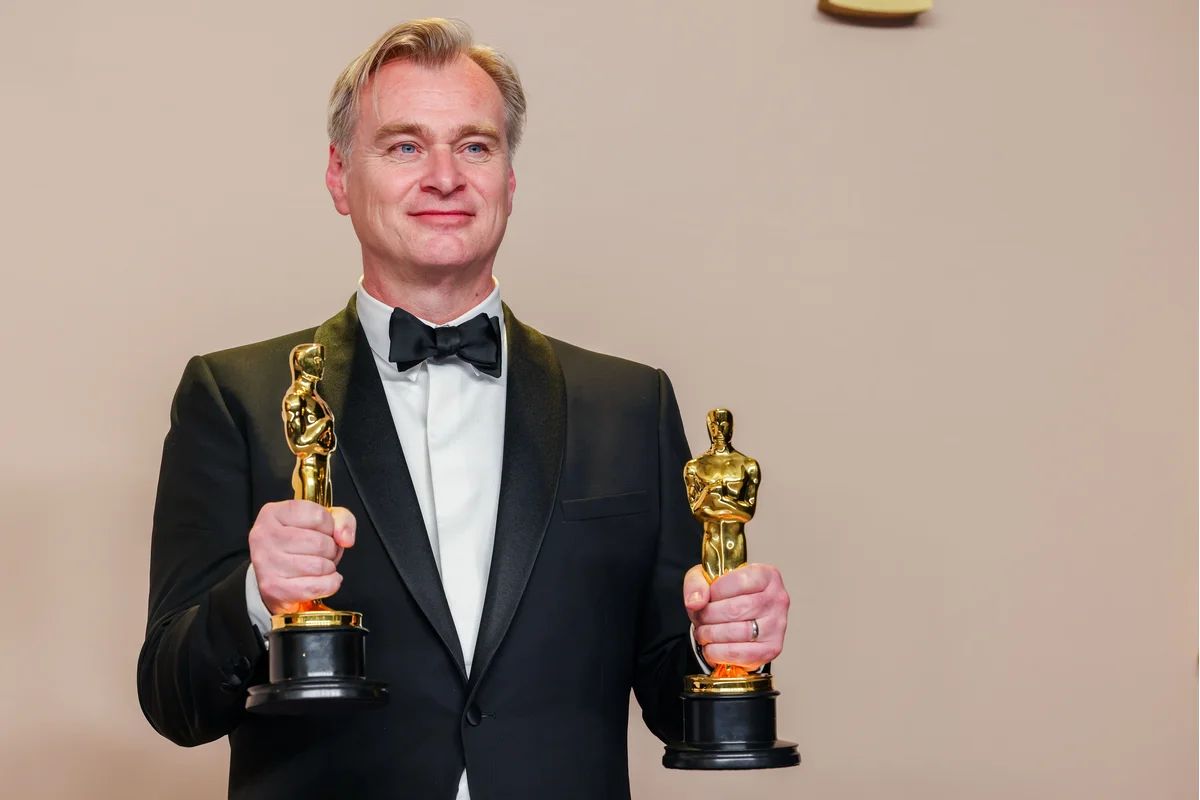
Christopher Nolan leads Hollywood directors union amid job challenges. [Image Source: COMICBOOKMOVIE]
Christopher Nolan, renowned filmmaker known for groundbreaking projects like Tenet and Oppenheimer, has recently stepped into a pivotal leadership role as president of the Directors Guild of America (DGA), representing 19,500 members. His assumption of this position in September comes during a turbulent period marked by a significant slowdown in U.S. film and television production, rising concerns over generative AI, and major corporate mergers that threaten the stability of Hollywood jobs.
Nolan’s decision to lead the union comes as the entertainment industry faces shrinking employment opportunities despite consistent consumer spending on content, raising alarms about the future of creative roles in Hollywood. As president, Nolan is committed to addressing these challenges while advocating for the preservation and growth of Christopher Nolan Hollywood jobs.
Addressing the Shrinking Job Market in Hollywood
Nolan conveyed his concern about the disparity between steady consumer investment in entertainment and the severe drop in union member employment. In 2024 alone, the DGA reported a 35 percent reduction in television jobs, along with an 8 to 12 percent decrease in film work, although employment figures for 2025 remain unavailable. This disconnect, Nolan explained, stems from evolving business models and demands a thorough investigation.
“All of these changes over the last 10 to 15 years particularly, and the last five years in particular, they pose enormous challenges,”
Nolan stated during a press gathering at the DGA headquarters in Los Angeles.
Image of: Christopher Nolan
“It seemed to me that I’d have something to bring to the table in terms of trying to help represent the members through what is a turbulent period.”
– Christopher Nolan, DGA President
Nolan emphasized the need to bridge the gap between viewer spending and industry reinvestment, questioning why employment levels fail to reflect the robust consumer demand for content.
“How do you reconcile those things? What’s happening to the investment? Why aren’t we reinvesting in the consumer? … We need to look at how the new models have created this disconnect.”
– Christopher Nolan, DGA President
Lobbying Efforts and Legislative Push to Revive Domestic Production
In response to declining job availability, the DGA is advocating for incentives to increase film and television production within the United States. The union has championed expanded production credits in key states like California and New York and is now campaigning for a federal tax incentive program offering a stackable 25 percent rebate that could be combined with existing state rebates. Lawmakers including Representative Laura Friedman and Senator Adam Schiff have become involved in promoting this initiative, signaling rising political support.
This legislative drive aims to stimulate local employment opportunities by encouraging producers to keep projects domestic, opposing the trend of outsourcing or moving productions overseas, which has contributed significantly to the current job slump.
Upcoming 2026 Contract Talks to Center on Employment and AI Regulation
The DGA’s next round of labor negotiations with major studios and streaming platforms is scheduled to begin on May 11, 2026, following negotiations by SAG-AFTRA and the Writers Guild of America. Nolan flagged employment as one of the most pressing concerns in the talks. Although specifics were withheld, he voiced deep unease over the continued loss of jobs for guild members.
This decline has forced the union to draw from its financial reserves to maintain members’ health plans, which partially rely on employer contributions that decrease alongside employment. Rising healthcare costs have further strained these resources.
“Health care costs have gone up enormously in this country, and it’s one of the reasons for the last government shutdown,”
Nolan remarked.
“Everybody’s aware of that and we’ll do our part, but the employers are going to have to step up and do theirs.”
– Christopher Nolan, DGA President
The upcoming negotiations will also grapple with the impact of generative artificial intelligence on creative work. The DGA’s 2023 contract established biannual meetings to discuss AI use and mandated directors’ consultation before incorporating AI for creative purposes. However, Nolan intends for the union to take a more active role in shaping AI regulations, especially to protect creators from unauthorized use or manipulation of their work.
For example, concerns exist around potential deals, such as one with Paramount and Showrunner, which could enable viewers to generate new content based on existing shows with AI assistance—a move that raises questions about ownership and compensation.
Nolan remains cautiously optimistic about AI-related agreements like Disney’s December 2023 licensing deal with OpenAI but stresses that unions will require clear assurances on how creators are compensated.
“When they’ve shown how creators are going to benefit from those kind of licensing opportunities, then companies will earn the support of unions in their generative AI deals,”
Nolan added. – Christopher Nolan, DGA President
Negotiation Timelines and Industry Consolidation Concerns
The Alliance of Motion Picture and Television Producers (AMPTP), representing studios and streamers, has considered proposing unusually long labor contracts of five years, compared to the traditional three-year duration. Nolan dismissed this idea as unrealistic, cautioning against locking in agreements over extended timeframes given the unpredictable nature of the industry.
“If we had agreed to a five-year contract in March of 2020, where would we be now?”
he asked, highlighting the volatility the sector has experienced during recent years.
Adding complexity, the entertainment industry is navigating a wave of corporate consolidations. Most notably, Paramount’s merger with Skydance finalized in 2025, while Netflix is attempting to acquire Warner Bros., a transaction to which the DGA has voiced opposition. Nolan revealed that the union has engaged with Netflix and Paramount to understand how these mergers might affect workers, seeking meaningful commitments regarding operations and job security.
“It’s a very worrying time for the industry,”
Nolan stated candidly.
Warner Bros. and the Future of Theatrical Distribution
Given Nolan’s deep ties to Warner Bros., which has released nine of his films, including his upcoming feature The Odyssey shot entirely in IMAX, he is particularly sensitive to the fate of theatrical distribution amid Netflix’s attempted acquisition. Notorious for its streaming-first approach, Netflix’s ownership could potentially shorten or eliminate the traditional theatrical release window, which the DGA supports at 60 days to sustain cinemas.
“I think the theatrical window becomes a sort of easily graspable symbol of whether Warner Brothers would be run as a theatrical distributor or whether it would be folded in as a streamer,”
Nolan explained.
Beyond theatrical scheduling, the union is concerned about how a merged Warner Bros. would function in its combined role as a buyer, seller, and exhibitor of content, and most critically, the impact on jobs.
“A merger is going to mean loss of jobs. It’s going to mean consolidation. I mean, we all know that, and we can all look at the history to see that,”
Nolan stated, adding,
“Our interest right now is in trying to get to grips with how can we try and ameliorate some of these concerns.”
– Christopher Nolan, DGA President
The Road Ahead for Hollywood and Its Workforce
As president of the Directors Guild of America, Christopher Nolan is confronting a complex set of challenges including job losses, technological disruption, and shifting corporate control in the entertainment industry. His leadership brings a familiar voice demanding urgent action to protect workers’ livelihoods and the creative integrity of Hollywood production at a critical juncture.
With upcoming negotiations and pending legislation, the DGA’s efforts under Nolan’s guidance aim to stabilize employment, regulate emerging technologies like generative AI, and influence how consolidation reshapes the industry. The outcomes of these efforts will significantly affect the tens of thousands of creative professionals who contribute behind the scenes, underscoring the urgency of addressing the growing crisis in Christopher Nolan Hollywood jobs.