
Emerald Fennell’s much-anticipated adaptation of Emily Brontë’s Wuthering Heights premieres in cinemas today, drawing attention for its intense emotional depth and innovative visual style. Featuring Margot Robbie and Jacob Elordi in the lead roles, this version explores the turbulent relationship between Catherine Earnshaw and Heathcliff across the Yorkshire moors, weaving themes of love, revenge, and social boundaries.
A Powerful New Take on a Classic Tale
Emerald Fennell, celebrated for her acting and acclaimed directorial work in films like Promising Young Woman and Saltburn, directs her third feature with this adaptation of Brontë’s novel. The story centers on the passionate and often destructive bond between Catherine Earnshaw, portrayed by Margot Robbie, and Heathcliff, played by Jacob Elordi, an orphan taken in by Catherine’s family. The drama spans two generations, highlighting societal tensions and the cyclical nature of vengeance and ruin.
Supporting the adaptation’s rich narrative is a remarkable cast and soundtrack, which includes contributions from pop artist Charli XCX and an evocative track titled “House” performed alongside John Cale of The Velvet Underground. These elements combine to enhance the film’s emotional intensity and atmospheric setting.
Crafting Visuals with Emotional Resonance
Fennell places great emphasis on the emotional purpose behind every cinematic choice, working closely with Swedish cinematographer Linus Sandgren to create the film’s haunting visuals. She explains that every camera movement must be justified through emotion rather than style alone.
He’s the best ever and he’s really the same as me,
Fennell says.
Everything has to have an emotional purpose. He is so talented, but he doesn’t need to be showy. So if we’re going to have a camera move, is it emotionally justified? As long as it’s felt, you can get away with a lot more and have a more expressive world. Really, it’s the same process as it is with everyone, which is to have lots of talk. It’s kind of therapy and looking at images, but they can be anything.
Emerald Fennell, writer-director
Rather than relying on period-specific cinematic references, Fennell and Sandgren drew inspiration from more obscure and unconventional sources.
They’re very often not from other films, or if they are, they’re from things like Donkey Skin, or strange ‘50s melodramas. It’s not that we’re looking at other films that depict the same period even. There is a lot of historical research that goes into it, but that’s not all it is.
Emerald Fennell, writer-director
Design Choices Rooted in Primal Emotion
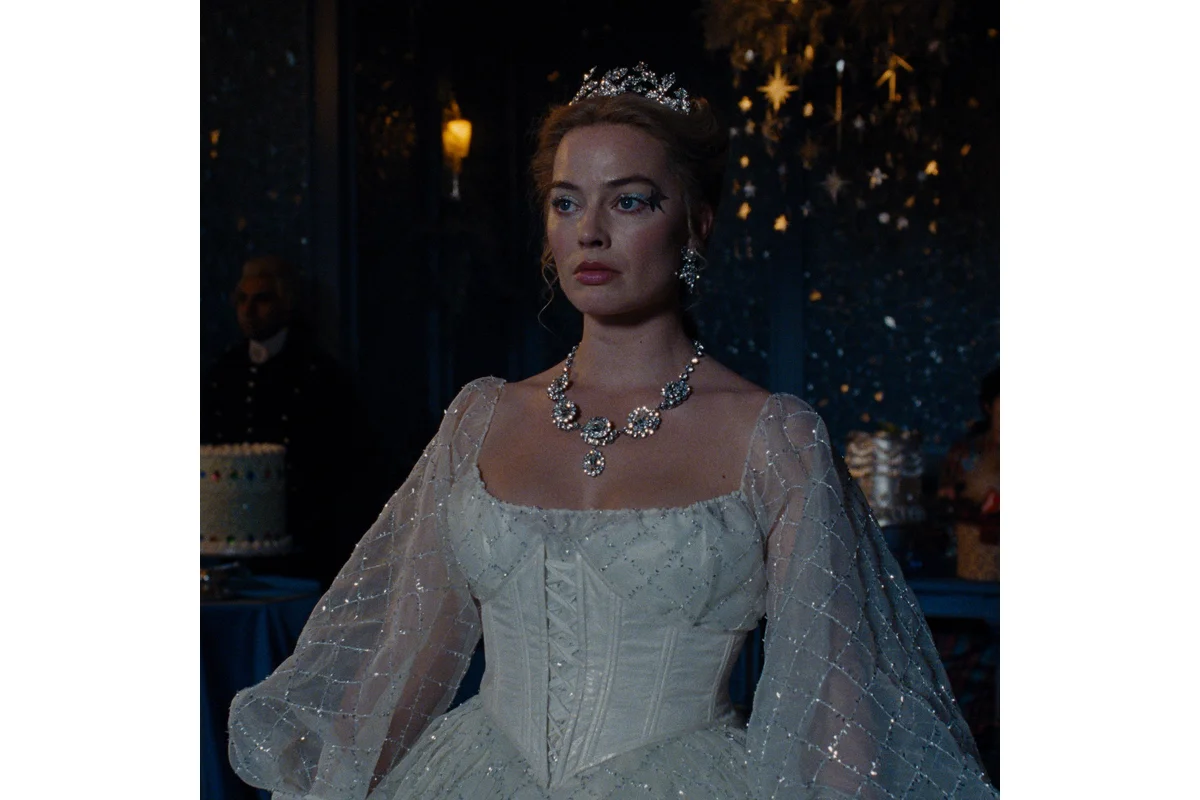
The film’s production design, led by Suzie Davies, plays a crucial role in establishing the unsettling atmosphere permeating the story. Fennell highlights their shared goal of provoking a deep, instinctual response to their environment.
We have to talk about Suzie cos she’s so chic!
Fennell chuckles.
She’s just incredible. In our early conversations, I said to her, ‘It has to have a primal, emotional subconscious response. In Wuthering Heights, everything’s based around how nature is interrupting this world. We had this concept of slate rock, and the rock was coming in and interrupting the rooms.
Emerald Fennell, writer-director
That idea also gets inverted in certain parts, so there’s a feeling of nature being suppressed – there’s taxidermy, flower pressing and walls made of skin.
Emerald Fennell, writer-director
The process to realize these unsettling design concepts, especially the concept of walls simulating human skin, involved careful experimentation.
We had Margot photograph her skin, particularly her veins and freckles,
Fennell explains.
Then it was a very long process of figuring out the best way to make it – in the end, it was padded panelling with printed crepe with her skin on it, and latex overlay. There was a kind of bulge, but it was slightly inconsistent, so each panel bulged out of the wood a little, like it does when you wear a corset. But we needed the latex cos it needed to be able to sweat, and for leeches to glide onto it.
Emerald Fennell, writer-director
The blend of Victorian-era elements and unsettling details invites viewers to look deeper, beyond surface beauty, into the gothic heart of the film.
We also had all these crazy trimmings from Victorian times. But with Suzie, the whole joy of it is you don’t want that stuff to be the first thing you see – the first thing you see is a beautiful pink room. Then you look a bit closer and there are hairs growing out of the moles – that’s what the gothic is and that’s what interests me.
Emerald Fennell, writer-director
That’s where working with Suzie, our costume designer Jacqueline Durran and everyone is so thrilling, because we’re all looking to pull a hair of out a mole in a wall! And if we’re not doing that, then we’re not doing anything purposeful or useful.
Emerald Fennell, writer-director
Subtle Symbolism Invites Audience Discovery
While the film contains layers of symbolism and coded visual cues, Fennell encourages audiences to engage with the work in a personal way, allowing each viewer to uncover meaning through their own perspective.
She emphasizes that overtly highlighting these details would detract from the experience, comparing it to the joy of a hidden picture puzzle.
There’s so much, Fennell notes. It’s so much more fun for people to find it themselves. It would be like circling Where’s Wally in a book, it would be kind of cruel – the fun is seeing it for yourself, I hope.
The interior design contributes to the eerie tone, featuring textures and elements that feel simultaneously new and disquieting.
It’s that uncanny vibe you always get because it felt so new, the whole place. We went back to those kind of materials a lot – an oil slick texture that was iridescent and sweaty.
Emerald Fennell, writer-director
Impact and Anticipation for Emerald Fennell’s Latest Film
With its release, Wuthering Heights positions itself as a unique retelling that balances emotional intensity with striking visual artistry. Emerald Fennell’s approach highlights how deep emotional connections can influence every aspect of filmmaking, from cinematography to production design. Her collaboration with talents such as Linus Sandgren, Suzie Davies, and costume designer Jacqueline Durran demonstrates a commitment to creating layered, meaningful work that challenges viewers.
As audiences experience this adaptation, the film is likely to provoke discussion about its departures from traditional interpretations and its haunting use of gothic aesthetics. Given Fennell’s track record, the film is also expected to influence contemporary approaches to classic literature adaptations in cinema.
Wuthering Heights is now showing in cinemas.
