
Netflix’s latest release, Blue Moon, showcases Ethan Hawke delivering one of the most compelling performances of 2025. Directed and written by Richard Linklater, who has worked closely with Hawke since 1995’s Before Sunrise, the film presents Hawke in the challenging role of Larry Hart, a lyricist of the legendary Rodgers and Hart duo. The movie’s unique approach to portraying Hawke’s character, including inventive techniques to make him appear physically shorter, underscores the commitment to authenticity and detail throughout the film.
Set in a single New York City bar over one night, Blue Moon captures the celebratory atmosphere surrounding the Broadway opening of Oklahoma!—a pivotal moment marking the transition from Rodgers and Hart to Rodgers and Hammerstein after a major theatrical success. With Andrew Scott portraying composer Richard Rodgers in a subdued manner, the film reflects both the personal struggles and public triumphs of its characters, especially focusing on the complex personality of Larry Hart.
Ethan Hawke’s Actual Height and Its Contrast with His Character
While playing Larry Hart, who was known for being just five feet tall, Ethan Hawke’s real height stands at 5-foot-10, as reported by Entertainment Weekly during a Q&A following a screening at the Toronto Film Festival. This significant difference required the filmmakers to employ various creative solutions to convincingly depict Hawke’s stature on screen.
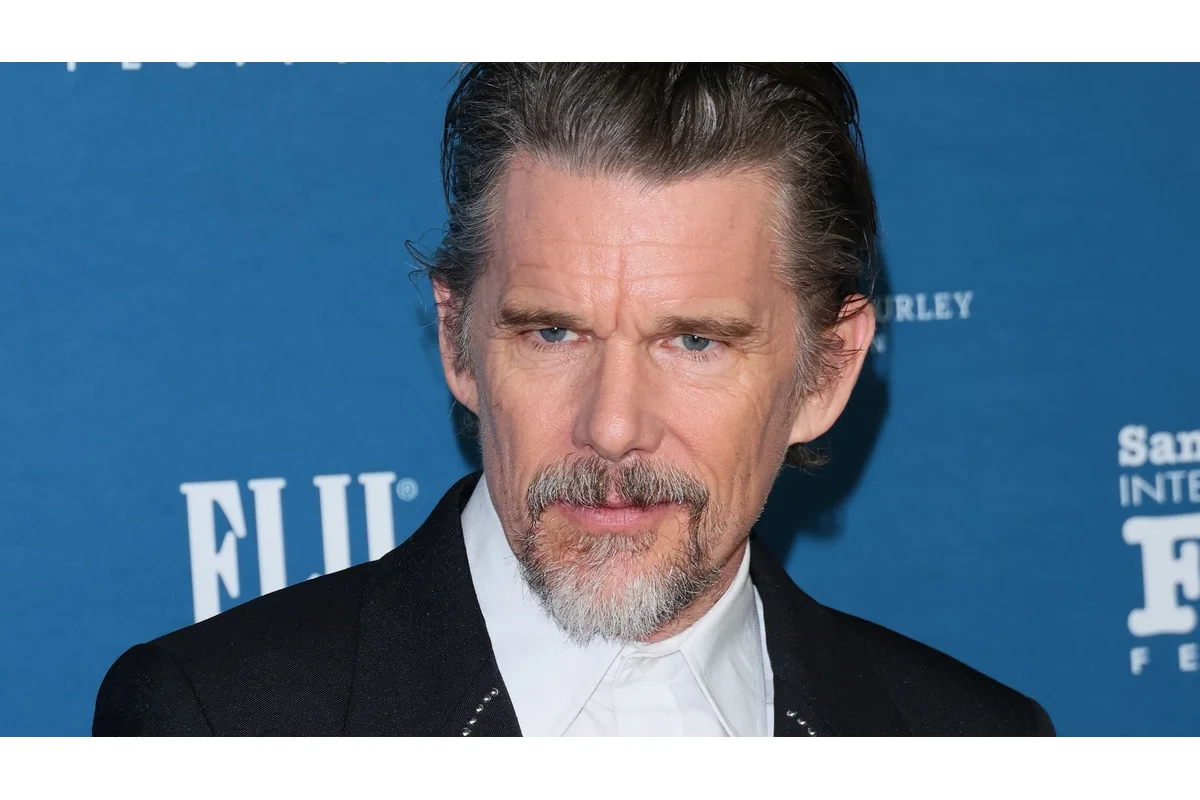
Hawke addressed the psychological burden of his character’s height during the festival talk, stating,
The challenge is understanding the way the world looks at each one of us differently, and so much of our self-esteem is rooted in how we think other people view us, which is very difficult,
Ethan Hawke said at that talk back.
People are height-ist! I mean, they really are. […] Everybody’s looking at Larry like he’s something less than, so it’s driving him mad. It has been his whole life.
Techniques Behind Transforming Ethan Hawke into a Shorter Larry Hart
Richard Linklater and his team chose to avoid digital effects, instead relying entirely on old-fashioned stagecraft to alter Hawke’s appearance. Hawke explained in an interview with Parade Magazine the complexity involved:
Rick didn’t want any digital effects, because the movie is rooted in such realism. We just used every old-school, stage craft. There wasn’t one way we did it. There was a million ways—some with perspective, some with costumes. Sometimes we dug trenches in the floor. Sometimes chairs are different heights. Sometimes the paintings are hung differently, to make it look… you know, every angle, every shot, was a different math experiment. It was extremely difficult, to do every day. But it works. It was fun.
The production’s inventive design included raising and lowering objects and constructing trenches on set so Hawke could physically appear shorter relative to others in the scene. He elaborated further on The Tonight Show with Jimmy Fallon:
I grew my hair long, and then I shaved this part,
Hawke said gesturing to his head.
And then I left this part long [he gestures to the side of his head], so I could do the comb over.
Although the haircut was unusual and not flattering outside the set, Hawke found humor in the experience, sharing,
But when you’re going to buy coffee in the morning, you know what I mean? I look like a full-blown lunatic. It was devastating to my self-esteem.
He detailed further tricks used to maintain the illusion of shortness:
We blocked the whole movie out, and we could build a trench about a foot shorter for me to walk through,
adding,
We would raise the paintings up, and the seats. My bench would be lower than your bench. Little tricks.
Hawke also reflected on the depth of Larry Hart’s character, describing the contradictions that made the role so rich:
He was the smallest person in every room, and he was the biggest person in every room,
he said, continuing,
He was the bravest, and he was the most nervous and insecure. He was gay, and in love with a woman. He was full of contradictions. Everything about him was complicated.
The Film’s Setting and Historical Context
The entirety of Blue Moon unfolds in one location—a New York City bar where Richard Rodgers and his collaborators celebrate the opening night of Oklahoma! This confined setting provided the filmmaking team with the opportunity to creatively manipulate spatial elements to alter perception and highlight the emotional intensity of the story. The shift in Broadway history, from Rodgers’ work with lyricist Larry Hart to the partnership with Oscar Hammerstein, offers a backdrop of innovation and transition within theater.
Andrew Scott’s measured portrayal of Rodgers complements Hawke’s intense characterization of Hart, enriching the depiction of this important moment in the performing arts. This collaboration between the actors and director Richard Linklater brings a level of intimacy and realism that has been praised by viewers and critics alike.
Why ‘Blue Moon’ Matters and What’s Next for Ethan Hawke
Blue Moon stands out as a testament to Ethan Hawke’s dedication to fully embodying challenging roles, especially when paired with Linklater’s nuanced direction. Despite stiff competition from stars like Leonardo DiCaprio and Timothée Chalamet for the Best Actor category at the Oscars, Hawke’s performance is being recognized as remarkable and worthy of serious consideration.
Linklater’s decision to use practical effects and stagecraft rather than relying on digital technology not only enhances the film’s authenticity but also underscores a respect for storytelling tradition. This approach complements the film’s thematic exploration of self-image, vulnerability, and artistry. For audiences interested in theater history, character-driven dramas, or Ethan Hawke’s evolving career, Blue Moon is an essential viewing experience on Netflix this year.
