
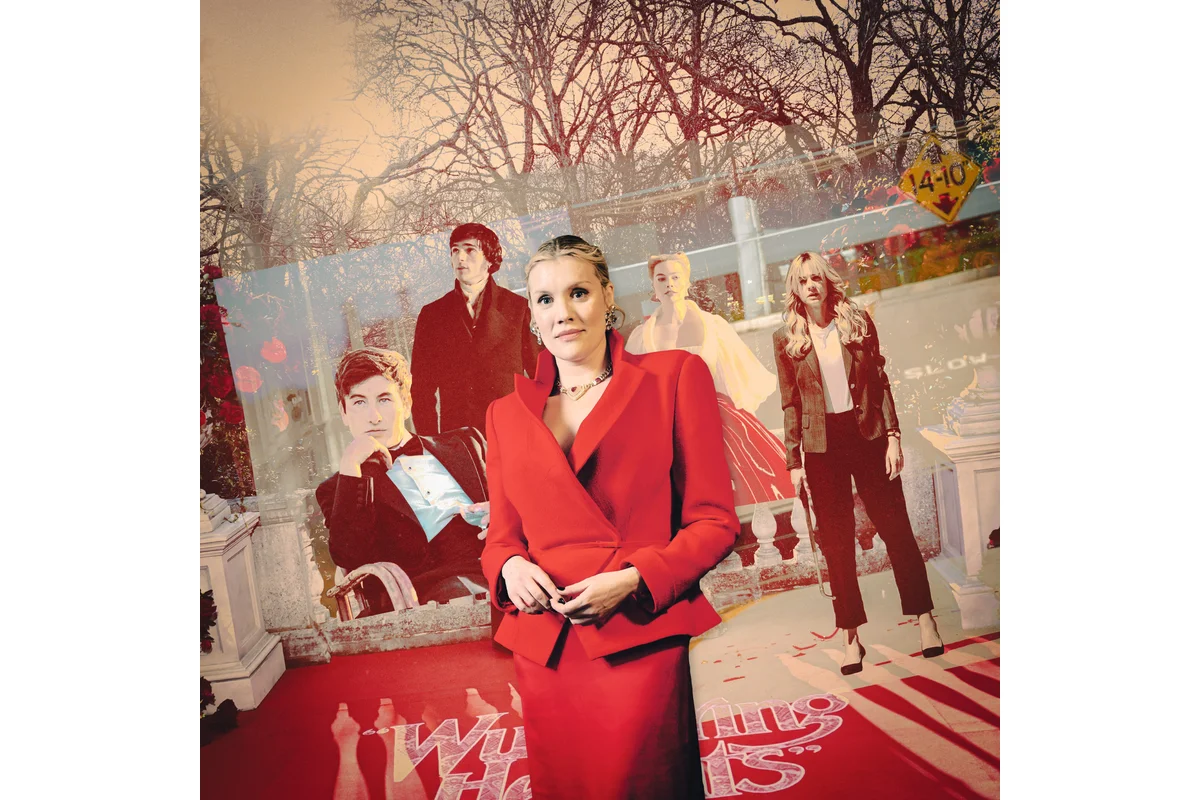
Emerald Fennell’s new film Wuthering Heights, featuring Margot Robbie and Jacob Elordi, premiered recently, offering a radical reinterpretation of the classic story set in the Yorkshire Dales. Rather than a faithful adaptation, this version presents a dolls’-house fantasy that challenges traditional expectations of the novel’s themes and setting, provoking both intrigue and frustration.
An Atmosphere of a Child’s Imaginative Fantasy
The film’s mise-en-scène lends itself to the concept of a child’s imagined world, with dim, minimal lighting enhancing a sense of bleakness. The farmstead, styled like a neglected Edwardian washroom with dank tiles and desolation, reinforces a surreal, abstract environment far removed from the raw naturalism typically associated with Wuthering Heights. The iconic scene where Heathcliff rides away is staged as though through the eyes of a child’s simplistic fantasy.
Emerald Fennell articulated this vision in an interview, stating:
I wanted to make something that was the book that I experienced when I was 14.
— Emerald Fennell, Director and Writer
The Thrushcross Grange set continues this theme: extravagant and distorted as if a living dolls’ house, filled with odd details like randomly placed stuffed sheep, heightening the uncanny and camp atmosphere. Symbolism abounds, including Isabella’s gift of a dolls’-house doll to Cathy, and Heathcliff’s portrayal as Cathy’s plaything. The unsettling power dynamics—such as Isabella made to wear a dog collar and forced to bark—are simultaneously disturbing and, at moments, unintentionally humorous.
The Film as an Adolescent’s Fevered Dream
This adaptation repeatedly falls short of fully capturing its audacious ambitions, evoking the charged symbolism and sexual imagery of a 1970s Ken Russell production, but lacking its visceral impact. The film flirts with an adolescent’s fever dream of romance but never fully commits.
The costume design has sparked online criticism for appearing plastic and inauthentic, yet it reflects the dolls’-house motif. Cathy’s ridiculous plastic crinolines upon arrival at Thrushcross Grange suggest a doll dressed by a child’s hand. However, this concept’s potential fails to blossom, as earlier costumes lack similar thematic coherence. The film’s promising elements—dolls’ house aesthetics paired with “Barbie” actress Margot Robbie—never materialize into the emphatic style they might have.
Jacob Elordi’s casting was influenced by his appearance, which Fennell noted:
looked exactly like the illustration of Heathcliff on the first book that I read.
— Emerald Fennell, Director and Writer
While Elordi delivers a credible West Riding accent, echoing James Howson’s portrayal in the 2011 Andrea Arnold adaptation, the film’s handling of casting and character dynamics raises questions about racial representation and whitewashing. Notably, actors of diverse backgrounds appear chiefly as antagonists obstructing Cathy and Heathcliff’s turbulent relationship.
Overemphasized Symbolism and Prolonged Scenes
The film is laden with symbolism that often feels heavy-handed or ill-fitting. Unusual visual motifs such as wallpaper featuring scans of Robbie’s skin, a finger inserted into a fish’s mouth, and a gelatinous slug crawling on a windowpane defy subtlety. Heathcliff’s licking of the skin-wall and extensive sex montages, which barely advance the storyline, contribute to a sense of indulgence without purpose.
Victorian constraints are symbolized through clichéd scenes like the tightening of a corset and close-ups of stays, alongside numerous dolls’ house references that ultimately fail to resonate as intended. The skin wallpaper might unconsciously allude to a haunting line from the original novel where Heathcliff fantasizes about
Painting the house-front with Hindley’s blood!
— Heathcliff, Chapter six
However, any thematic connections remain ambiguous, underscoring the director’s choice to prioritize mood and metaphor over narrative clarity.
Strong Performances Amidst a Missed Narrative
The strengths of Wuthering Heights lie in its cast, particularly the remarkable Owen Cooper as young Heathcliff, whose acting shines despite the film’s structural flaws. Yet, even Cooper cannot salvage the uneven pacing and lack of emotional depth that hinder the storytelling.
The movie maintains an atmospheric tone but eschews the novel’s signature supernatural elements entirely, leading to a noticeably ghost-free interpretation. Edgar Linton’s portrayal steals focus for the wrong reasons; the character, intended to be a youthful romantic rival, instead feels fatherly, undercutting the adolescent fantasy angle that the film attempts to present. This dissonance weakens the dynamic central to the story’s emotional core.
Fennell’s concept of reimagining the Brontë tale as juvenilia—akin to the Brontës’ own early created worlds of Gondal and Angria—is promising. However, the film ultimately lands closer to anger and frustration than fantasy and playfulness. With talented actors and rich source material at its disposal, it feels like a squandered opportunity missed by indecision and excessive stylization rather than confident storytelling.
Audience reactions ranged from laughter at unintended moments to genuine intrigue, though rarely did the film evoke the profound engagement typically expected from adaptations of this literary classic. While entertaining on some levels, it appears unlikely this version will fulfill the expectations of most fans seeking the dark passion or haunting mystery of the original Wuthering Heights.
