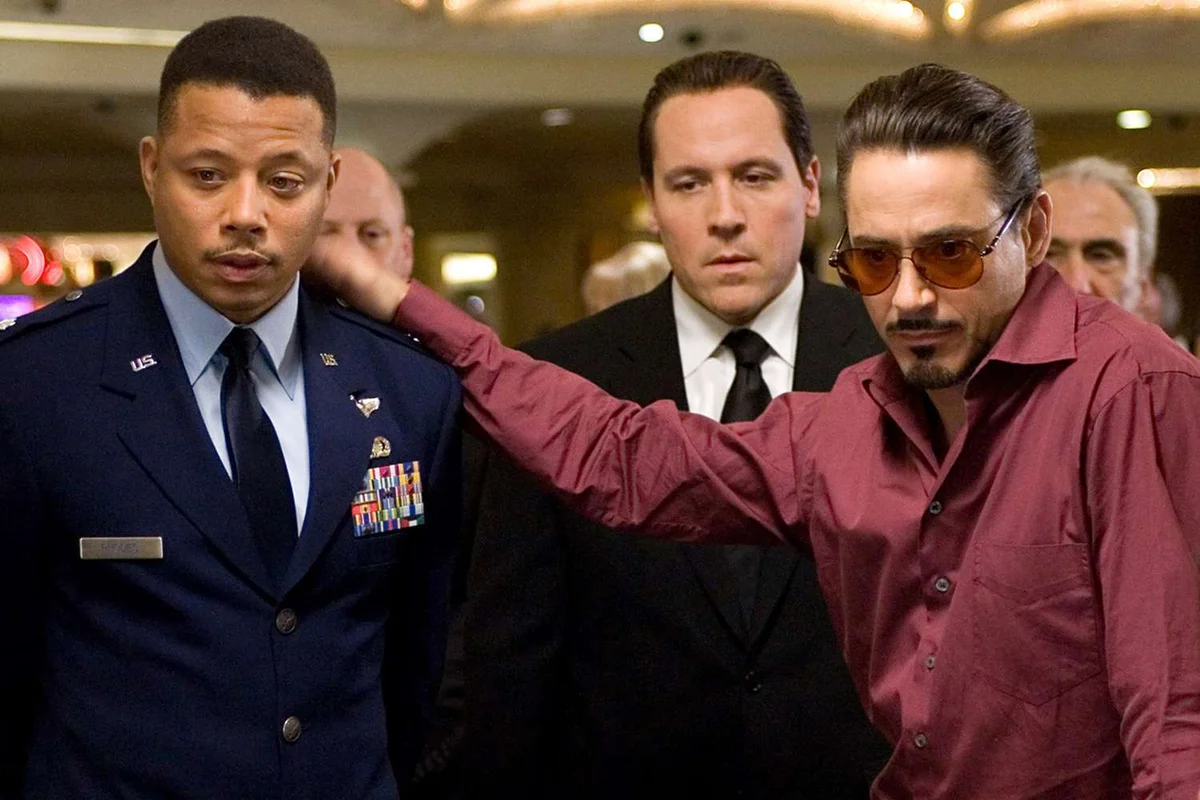
Terrence Howard as Rhodey firing in original Iron Man scene. [Image Source: PEOPLE]
Terrence Howard revealed that his departure from Marvel’s Iron Man stemmed from his reputation as an angry man. Before Robert Downey Jr. became synonymous with the Marvel Cinematic Universe, Howard was originally cast as James Rhodes in the 2008 Iron Man film. Despite playing Tony Stark’s close ally in the debut movie, Howard was replaced by Don Cheadle for the 2010 sequel. While Howard previously attributed his exit to a salary dispute, he now suggests that an earlier confrontation with a producer influenced the decision. This revelation sheds light on the behind-the-scenes tensions that impacted the casting of a major MCU character.
The Incident at Venice Film Festival and Its Consequences
Howard recounted an incident at the 2007 Venice Film Festival during promotion for the film The Brave One, where he starred alongside Jodie Foster. After a reporter asked why Howard’s name was not receiving equal billing compared to Foster’s, Howard expressed frustration, which reportedly reached Joel Silver, the film’s producer. Howard described a heated exchange with Silver, who told him,
“The reason your name isn’t above the titles is because you’re not the star of this thing — it’s Jodie. And if you get nominated for an Oscar, it’s going to be for Supporting Actor, not Best Actor,”
Howard said.
“And I was like, ‘Thank you for telling me that, now I understand. But, you have to remember that I’m a man just like you, and if you ever talk to me in that way again, I’m going to knock your teeth out of your mouth.’”
This direct threat, Howard believes, played a role in his losing his Iron Man role eight months later.
Industry Connections and Fallout
Joel Silver’s producing partner on The Brave One was Susan Downey, wife of Robert Downey Jr., who succeeded Howard in Iron Man. Howard suspects that these connections contributed to his removal from the Marvel franchise, stating,
Image of: Terrence Howard
“Eight months later, I lose Iron Man, and I’m sure that all of those things played their part.”
While representatives for Silver and Susan Downey have not commented, these revelations highlight how personal disputes intersect with broader industry decisions.
Behind Howard’s Replacement on Iron Man
Reports from Entertainment Weekly indicate that Jon Favreau, director of Iron Man, was dissatisfied with Howard’s original performance and planned to reduce the importance of the Rhodey character in the sequel. Marvel then offered Howard a substantially lower salary to continue, which he declined. Howard called his firing“the surprise of a lifetime,” lamenting the fragility of contracts in Hollywood:
“Apparently the contracts that we write and sign aren’t worth the paper that they’re printed on sometimes.”
He also pointed fingers at Downey Jr., alleging,
“The person that I helped become Iron Man, when it was time to re-up for the second one, took the money that was supposed to go to me and pushed me out.”
Howard’s Reflection on His Career Challenges and Aggression
Throughout his career, Howard has faced numerous obstacles, which he partly attributes to his own temper and desire to assert masculinity. In a candid conversation on the PBD Podcast, he recounted advice from Denzel Washington who observed,
“Look at your hands, your fists are all balled up,”
and told him,
“All of these producers are trying to open your hand so they can put money in it, but you won’t do it; you keep your hands all tight. And you’re blowing it.”
This insight convinced Howard that his confrontational attitude limited his opportunities in Hollywood.
Rise and Setbacks After Iron Man
Howard eventually regained critical and popular success with his role on the Fox music drama Empire. However, his career took another downturn after he filed a lawsuit in 2020 against Disney-owned 20th Century Fox, claiming unpaid compensation related to Empire. He believes that this legal action led to his effective blacklisting in Hollywood. Howard declared,
“You’re no longer on their list because you’ve broken the cardinal rule: you never talk,”
adding,
“Even if you’re being screwed over, you never talk. You’re supposed to keep that quiet and keep working as a good slave —and I didn’t do that.”
Implications for Howard’s Career and Industry Dynamics
Terrence Howard’s story illustrates the complex interplay between personal conduct, industry politics, and career trajectory in Hollywood. His openness about anger affecting his chances, as well as the influence of behind-the-scenes relationships—such as those involving producers like Joel Silver and Susan Downey—reveals the challenges actors face beyond their craft. Howard’s experience raises questions about contract security, the power dynamics on big film projects, and the consequences of speaking out in an environment where silence is often demanded.