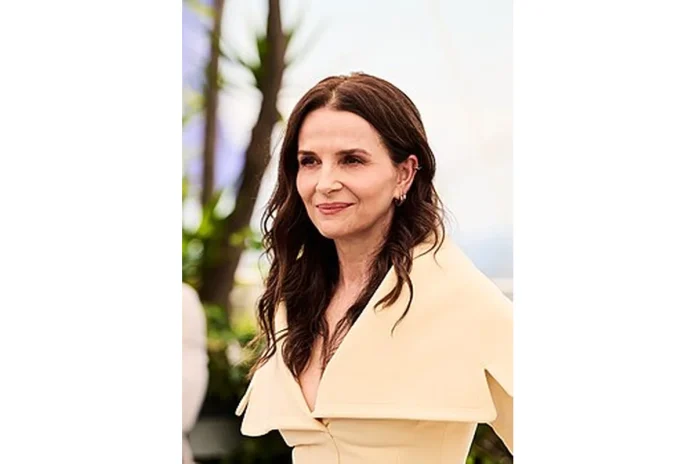
Juliette Binoche Bio
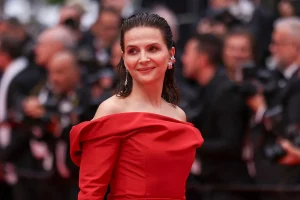
Juliette Binoche is a French actress who has appeared in more than sixty films, working primarily in French and English. She has been the recipient of numerous accolades, including an Academy Award, a BAFTA Award, a Volpi Cup, and a César Award. Binoche first gained recognition through collaborations with esteemed auteurs such as Jean-Luc Godard, Jacques Doillon, and André Téchiné, and won critical acclaim for her performances in Three Colours: Blue and The English Patient. Her career has spanned decades, showcasing her depth and versatility across both cinematic and theatrical work.
Born on 9 March 1964 in Paris, France, Binoche is the daughter of Jean-Marie Binoche, a director, actor, and sculptor of French and part Portuguese-Brazilian ancestry, and Monique Yvette Stalens, a teacher, director, and actress born in Częstochowa, Poland. Binoche’s maternal grandparents, André and Julia Helena Młynarczyk Stalens, were both actors from Częstochowa who were imprisoned at the Auschwitz concentration camp by German Nazi occupiers as intellectuals. When her parents divorced in 1968, four-year-old Juliette and her sister Marion were sent to a provincial boarding school, and during their teenage years the sisters spent their school holidays with their maternal grandmother, often going months without seeing their parents. Binoche has stated that this perceived parental abandonment had a profound effect on her.
As a teenager, Binoche discovered acting through amateur school productions and developed an early passion for the craft. At seventeen, she directed and starred in a student production of Eugène Ionesco’s Exit the King. She studied acting at the Conservatoire National Supérieur d’Art Dramatique in Paris, but quit after a short time because she disliked the curriculum. In the early 1980s, she found an agent through a friend and joined a theatre troupe, touring France, Belgium, and Switzerland under the pseudonym Juliette Adrienne, while also beginning lessons with acting coach Vera Gregh. Her first professional screen experience came as an extra in the 1983 TF1 television series Dorothée, danseuse de corde, directed by Jacques Fansten, followed by a similarly small role in the provincial television film Fort bloque directed by Pierrick Guinnard.
Path to Actress
Binoche’s first feature-film appearance came in 1983 with a minor role in Pascal Kané’s Liberty Belle, which required just two days on set. Though brief, the experience was enough to inspire her to pursue a career in film seriously. She earned her nickname La Binoche during this early period as she began appearing in a growing number of French productions. Her fortunes shifted dramatically in 1983 when she auditioned for the female lead in Jean-Luc Godard’s Hail Mary, a modern retelling of the Virgin birth; Godard had seen a photograph of Binoche taken by her then-boyfriend and requested a meeting. Though she spent six months on the film’s set in Geneva, her presence in the final cut is confined to just a few scenes.
Further supporting roles followed, including a noteworthy part in Annick Lanoë’s Les Nanas, playing opposite Marie-France Pisier and Macha Méril, and a critically acclaimed performance as the volatile teenage step-daughter in Jacques Doillon’s Family Life, which established the tone of her early career. Her breakthrough came in late 1985 with André Téchiné’s Rendez-vous, in which she was cast at short notice when Sandrine Bonnaire withdrew due to a scheduling conflict. Premiering at the 1985 Cannes Film Festival, where it won Best Director, the film made Binoche the darling of the festival and earned her first César nomination for Best Actress. Critic Armond White described her performance as career-defining. She followed this with roles in My Brother-in-Law Killed My Sister and Leos Carax’s Mauvais Sang in 1986, the latter earning her a second César nomination and marking the moment she felt she truly discovered the camera as a performer.
In 1988, Binoche took on her first English-language role in Philip Kaufman’s The Unbearable Lightness of Being, portraying Tereza opposite Daniel Day-Lewis. The film was a worldwide critical and commercial success, though Binoche later acknowledged that her English was limited at the time and she relied on a French translation to grasp her role fully. After this success, she chose to return to France rather than pursue an international career immediately. She then starred in Pierre Pradinas’s Un tour de manège, drawn to the project because Pradinas was the husband of her sister Marion, who served as set photographer and made a cameo appearance. In 1991, after a famously troubled three-year production, Les Amants du Pont-Neuf was finally released to critical acclaim, winning Binoche a European Film Award and her third César nomination. The prolonged shoot had forced her to turn down several significant international roles, and at this crossroads she made the deliberate decision to pursue an international career outside France.
Juliette Binoche Career
Early Career (1983–1991)
Binoche’s professional screen debut came with a minor role in Pascal Kané’s Liberty Belle in 1983, following her work as an extra on the TF1 series Dorothée, danseuse de corde. The two days she spent on the Liberty Belle set were enough to confirm her commitment to film acting. Her visibility increased in 1985 with a supporting role in Les Nanas and a critically noted performance in Jacques Doillon’s Family Life. That same year, André Téchiné’s Rendez-vous transformed her from a promising young actress into a major French star, earning her a César nomination and international festival attention at Cannes. She consolidated this momentum with Mauvais Sang in 1986 and then The Unbearable Lightness of Being in 1988, her first English-language role and a worldwide commercial and critical hit.
Over the remainder of the 1980s, Binoche appeared in Les Amants du Pont-Neuf, a production beset by financial and logistical difficulties that took three years to complete. When finally released in 1991, the film was a critical triumph, winning her a European Film Award and her third César nomination. By the end of this period, Binoche was recognized as one of the most significant French actresses of her generation, though the long production of Les Amants du Pont-Neuf had forced her to turn down several high-profile international opportunities, including Krzysztof Kieślowski’s The Double Life of Véronique and Jean-Paul Rappeneau’s Cyrano de Bergerac. She resolved to pursue a broader international career, setting the stage for her global breakthrough.
Breakthrough (1992–2000)
The 1990s saw Binoche cast in a series of critically and commercially successful international films that elevated her to global stardom. In 1993, she starred in Krzysztof Kieślowski’s Three Colours: Blue as a grieving music composer who loses her husband and daughter in a car accident. Her performance, marked by a restrained and deeply emotional portrayal of a woman rejecting her former life, premiered at the Venice Film Festival and won her the Best Actress Prize, along with a César Award for Best Actress and a Golden Globe nomination. Around this time, Steven Spielberg offered her roles in Jurassic Park and Schindler’s List, both of which she declined.
Her international stature was cemented in 1996 with her role in Anthony Minghella’s The English Patient, adapted from Michael Ondaatje’s novel. Playing a nurse in World War II-era North Africa alongside Ralph Fiennes, Binoche delivered what many critics consider one of her finest performances. The film won nine Academy Awards, including Best Supporting Actress for Binoche, making her only the second French actress to win an Oscar, following Simone Signoret’s victory for Room at the Top in 1960. She has described the shoot as among the happiest professional experiences of her career. In 2000, she received an Academy Award nomination for Best Actress for her role as a mysterious chocolatier in the romantic film Chocolat, directed by Lasse Hallström and based on the novel by Joanne Harris.
Notable Works and Milestones
Beyond the landmark performances in Three Colours: Blue and The English Patient, Binoche’s career is distinguished by her consistent choice of demanding and varied roles. In 1995, she starred in Jean-Paul Rappeneau’s The Horseman on the Roof, at the time the most expensive film in the history of French cinema and a worldwide box office success. In 1998, she portrayed 19th-century French proto-feminist author George Sand in Children of the Century, and later that year made her London stage debut in Luigi Pirandello’s Naked to strong reviews. In 2000, she made her Broadway debut in Harold Pinter’s Betrayal, earning a Tony Award nomination, and appeared in Patrice Leconte’s La Veuve de Saint-Pierre, which received a Golden Globe nomination for Best Foreign Language Film. In 2010, she won the Cannes Film Festival Award for Best Actress for her performance in Abbas Kiarostami’s Certified Copy, becoming the first actress to win the European best actress triple crown: Venice, Cannes, and the BAFTAs. She earned a sixth César nomination for Best Actress for her layered performance in Clouds of Sils Maria in 2014, and continued working with directors such as Claire Denis in High Life in 2018, followed by The Taste of Things and The Return in 2023 and 2024 respectively.
Juliette Binoche Award Nominations
Across her distinguished career, Juliette Binoche has received nominations for the most prestigious awards in the entertainment industry, reflecting consistent recognition from her peers and from critics worldwide. She has earned Academy Award nominations for Chocolat in the Best Actress category and for The English Patient in the Best Supporting Actress category, the latter of which she won. She has received ten César Award nominations for Best Actress across four decades, a testament to the sustained quality of her work in French cinema. Her stage work earned her a Tony Award nomination for Best Actress in a Play for her Broadway performance in Harold Pinter’s Betrayal in 2000. She has also been nominated for Golden Globe Awards for Three Colours: Blue and for La Veuve de Saint-Pierre, as well as for a BAFTA Award for Chocolat and for European Film Awards for Caché and for Chocolat.
Juliette Binoche Awards Won
Juliette Binoche has been honored with some of the most significant awards in international cinema over the course of her career. She won the Academy Award for Best Supporting Actress for The English Patient in 1997, making her only the second French actress to win an Oscar. She also won a BAFTA Award for Best Supporting Actress for the same performance. She won the Volpi Cup for Best Actress at the Venice Film Festival for Three Colours: Blue in 1993 and a César Award for Best Actress for the same film. In 2010, she won the Cannes Film Festival Award for Best Actress for Certified Copy, becoming the first actress to win the European best actress triple crown. She has also won the European Film Audience Award for Best Actress for Chocolat.
| Award | Wins | Year |
|---|---|---|
| Academy Award for Best Supporting Actress | 1 | 1997 |
| BAFTA Award for Best Supporting Actress | 1 | 1997 |
| Volpi Cup for Best Actress | 1 | 1993 |
| César Award for Best Actress | 1 | 1994 |
| Cannes Film Festival Award for Best Actress | 1 | 2010 |
| European Film Audience Award for Best Actress | 1 | 2001 |
Juliette Binoche Family
Juliette Binoche was born to Jean-Marie Binoche, a director, actor, and sculptor of French and part Portuguese-Brazilian heritage, and Monique Yvette Stalens, a teacher, director, and actress born in Częstochowa, Poland. Her maternal grandparents, André and Julia Helena Młynarczyk Stalens, were both actors who were imprisoned at the Auschwitz concentration camp during the Second World War as intellectuals. Her great-uncle Léon Binoche won a gold medal in rugby at the 1900 Paris Olympics. Binoche has a sister named Marion Stalens, who has worked as a set photographer and documentary filmmaker, and who accompanied Binoche to South Africa during the making of In My Country.
Personal Life
Juliette Binoche was married to André Halle from 1992 until their divorce in 1995. She later married actor Benoît Magimel in 1998, with whom she has a daughter named Hana, born in 1999; the couple divorced in 2003. Binoche also has a son named Raphaël, born in 1993. She is known to be a practicing Christian and has spoken publicly about her faith, stating in a 2025 interview that she reads the Bible daily and believes in a God that must be tangible and concrete rather than simply an idea. Binoche studied at the Conservatoire National Supérieur d’Art Dramatique in Paris and is also an accomplished painter; her ink portraits of her film characters and directors were published in the bilingual book Portraits in Eyes.