Kathryn Ann Bigelow Bio
Kathryn Ann Bigelow is an American film director, producer, and screenwriter born on November 27, 1951, in San Carlos, California. She made history as the first woman to win the Academy Award for Best Director for her war drama The Hurt Locker in 2008. Throughout her distinguished career, Bigelow has become renowned for directing critically acclaimed films that often explore themes of violence and gender while pushing the boundaries of cinematic storytelling. Her accolades include two Academy Awards, two BAFTA Awards, and a Primetime Emmy Award, establishing her as one of the most influential filmmakers in contemporary cinema.
Early Life and Background
Kathryn Ann Bigelow was born in San Carlos, California, as the only child of Gertrude Kathryn Larson, a librarian of Norwegian descent, and Ronald Elliot Bigelow, a paint factory manager. She attended Sunny Hills High School in Fullerton, California, where her early creative interests began to take shape. Bigelow’s parents provided a supportive environment for her artistic development, though neither worked in the entertainment industry. Her mother’s background and her father’s management role offered her exposure to different perspectives that would later inform her complex storytelling approach.
Bigelow pursued her artistic education at the San Francisco Art Institute, enrolling in the fall of 1970 as a painting student. During her time there, she was accepted into the Whitney Museum of American Art’s Independent Study Program in New York City from fall 1971 to spring 1972. Her advisers at the prestigious program included renowned artist Brice Marden and cultural critic Susan Sontag. She received her Bachelor of Fine Arts from the San Francisco Art Institute in December 1972. This period in New York also saw her living as an impoverished artist, staying with painter Julian Schnabel in performance artist Vito Acconci’s loft.
Bigelow furthered her education by entering the graduate film program at Columbia University, where she studied film theory and criticism and earned her master’s degree. Her professors included influential figures such as Vito Acconci, Sylvère Lotringer, Susan Sontag, Andrew Sarris, and Edward W. Said. While at Columbia, she worked with the Art & Language collective and Lawrence Weiner, publishing an article titled “Not on the Development of Contradiction” in their magazine The Fox. She also studied under seminal film theorist Peter Wollen, whose critical theory heavily influenced her first feature film.
Path to Directing
Bigelow’s journey into filmmaking began during her graduate studies at Columbia University, where she created her short film The Set-Up in 1978. This 20-minute deconstruction of violence in film portrayed two men fighting each other while semioticians Sylvère Lotringer and Marshall Blonsky deconstructed the images in voice-over. The film found favor with director Miloš Forman, who was teaching at Columbia at the time. Bigelow asked the actors to actually beat each other during the all-night shoot, demonstrating her early commitment to authentic and visceral filmmaking.
In 1981, Bigelow co-directed her first full-length feature film, The Loveless, with her film school classmate Monty Montgomery. This outlaw biker film featured Willem Dafoe in his first starring role and established Bigelow’s interest in manipulating movie conventions and genre. Also in 1981, she was invited by John Baldessari to teach for a single semester in the School of Art at California Institute of the Arts, further establishing her presence in the artistic community. Her early work demonstrated her unique ability to blend philosophical concepts with market demands of mainstream filmmaking.
Bigelow’s transition to the broader film industry continued with her collaboration with Eric Red on Near Dark in 1987. The film, originally conceived as a Western, was adjusted when the genre proved unpopular, inverting genre conventions while maintaining violent staples including sieges, shoot-outs, and chases. Near Dark became a cult classic within the horror genre community and featured three actors who had appeared in the film Aliens. This period solidified Bigelow’s reputation as a director willing to experiment with genre conventions while exploring complex themes of violence and gender.
Kathryn Ann Bigelow Career
Early Career (1981–1995)
Following The Loveless in 1981, Bigelow established herself in the thriller genre with a series of notable films throughout the late 1980s and early 1990s. Near Dark in 1987 marked her first major solo directing effort, co-scripted with Eric Red. The film combined Western and horror genres while exploring themes of homosexuality and America’s illusion of safety. In the same year, she directed a music video for New Order’s song “Touched by the Hand of God,” which spoofed glam metal imagery. These early projects demonstrated Bigelow’s ability to work across different media while maintaining her distinctive artistic vision.
Bigelow continued her ascent with Blue Steel in 1990, starring Jamie Lee Curtis as a rookie police officer stalked by a psychopathic killer. This film represented Bigelow’s first venture into the action genre and inverted typical conventions by placing a female protagonist at the center. The film digs deeply into feminist issues and is often studied by feminist film scholars. Her next film, Point Break in 1991, became her breakthrough mainstream success, starring Keanu Reeves as an FBI agent and Patrick Swayze as the leader of a surfing bank robber gang. The film grossed $83.5 million worldwide on a $24 million budget and marked the first time Bigelow used lengthy Steadicam tracking shots.
Breakthrough (2008–2012)
The Hurt Locker, released in 2008, represented Bigelow’s critical and commercial breakthrough into the highest echelons of filmmaking. The war drama, following members of a bomb squad serving in the Iraq War, was first shown at the Venice Film Festival in September 2008 and received universal acclaim from critics. The film stars Jeremy Renner, Brian Geraghty, and Anthony Mackie, with cameos by Guy Pearce, David Morse, and Ralph Fiennes. Bigelow filmed in Jordan in temperatures up to 130°F to achieve authenticity. The film received a 97% fresh rating from Rotten Tomatoes and marked Bigelow’s transition into political and historical filmmaking.
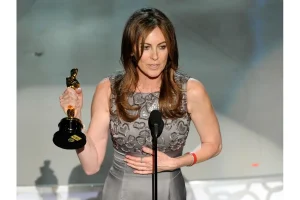
For The Hurt Locker, Bigelow made history by becoming the first woman to win the Academy Award for Best Director. She was the fourth woman in history to be nominated for the honor and only the second American woman. Her competitor in the category was her ex-husband, James Cameron, who directed Avatar. Bigelow also won the Directors Guild of America Award for Outstanding Directorial Achievement in Motion Pictures, becoming the first woman to win that award. In 2010, she won Best Director and The Hurt Locker won Best Picture at the 63rd British Academy Film Awards. Despite these groundbreaking achievements, Bigelow did not mention being the first woman to receive the Oscar in her acceptance speech.
Bigelow followed The Hurt Locker with Zero Dark Thirty in 2012, a dramatization of American efforts to find Osama bin Laden. The film served as a direct extension of The Hurt Locker, going further in-depth with historical analysis and addressing issues of geopolitics and American foreign policy. Zero Dark Thirty was acclaimed by film critics but also attracted controversy for its depiction of CIA torture practices. Bigelow won the New York Film Critics Circle Award for Best Director for the film, making her the first woman to win the award twice, having previously won for The Hurt Locker. She was also the first woman to receive the National Board of Review Award for Best Director.
Notable Works and Milestones
Throughout her career, Bigelow has developed a signature style characterized by kinetic camera movement and extensive violence. Her films often use purpose-built camera equipment to create mobile shots, particularly in works like The Hurt Locker, Point Break, and Strange Days. Bigelow describes her style as an exploration of film’s potential to be kinetic rather than simply categorizing her work within the action genre. Her films consistently satisfy and transcend the demands of formula to create cinema that is ideologically complex, viscerally thrilling, and highly personal. Social issues of gender, race, and politics are entrenched in her work across all genres.
Bigelow’s commitment to authenticity often leads her to extreme measures during filming. For Point Break, she was on the airplane with a parachute while filming Patrick Swayze skydiving. During surfing scenes, she would either paddle on a longboard or lean over a nearby boat to capture shots of Keanu Reeves. For the opening of Strange Days, she controlled a crane that dropped a camera off the edge of a tall building. These daring techniques demonstrate Bigelow’s hands-on approach to filmmaking and her dedication to achieving the most immersive and authentic visual experience possible for audiences.
Kathryn Ann Bigelow Award Nominations
Throughout her distinguished career, Kathryn Ann Bigelow has received numerous prestigious award nominations recognizing her contributions to cinema. She was nominated for the Golden Globe Award for Best Director for The Hurt Locker, losing to her ex-husband James Cameron for Avatar. Her films have garnered recognition from major industry organizations including the Academy of Motion Picture Arts and Sciences, the British Academy of Film and Television Arts, the Directors Guild of America, and various critics’ circles. These nominations reflect the critical acclaim and industry respect she has earned across multiple decades of filmmaking.
Kathryn Ann Bigelow Awards Won
Kathryn Ann Bigelow has made history with her award wins, becoming the first woman to receive the Academy Award for Best Director for The Hurt Locker. She also won the Directors Guild of America Award for Outstanding Directorial Achievement in Motion Pictures for the same film, another first for a woman director. Her accolades include two Academy Awards, two BAFTA Awards, and a Primetime Emmy Award for Exceptional Merit in Documentary Filmmaking for her work on Cartel Land. Bigelow has won the New York Film Critics Circle Award for Best Director twice, for both The Hurt Locker and Zero Dark Thirty, and was the first woman to receive the National Board of Review Award for Best Director. Time magazine named her one of the 100 most influential people in the world in 2010.
| Award | Wins | Year |
|---|---|---|
| Academy Award for Best Director | 1 | 2010 |
| Academy Award for Best Picture | 1 | 2010 |
| BAFTA Award for Best Director | 1 | 2010 |
| BAFTA Award for Best Film | 1 | 2010 |
| Directors Guild of America Award for Outstanding Directorial Achievement | 1 | 2010 |
| Primetime Emmy Award for Exceptional Merit in Documentary Filmmaking | 1 | 2015 |
| New York Film Critics Circle Award for Best Director | 2 | 2009, 2012 |
| National Board of Review Award for Best Director | 1 | 2012 |
Kathryn Ann Bigelow Family
Kathryn Ann Bigelow was born to Gertrude Kathryn Larson and Ronald Elliot Bigelow in San Carlos, California. Her mother worked as a librarian and was of Norwegian descent, while her father served as a paint factory manager. Bigelow was the only child in her family, which allowed her focused attention from both parents during her formative years. Her parents’ support for her artistic pursuits, despite their non-entertainment backgrounds, provided her with the foundation to pursue her creative ambitions from an early age.
Personal Life
Kathryn Ann Bigelow was married to director James Cameron from 1989 to 1991. The marriage ended in divorce, though both filmmakers continued to achieve significant success in their respective careers. Notably, both were nominated for the Academy Award for Best Director in 2010, with Bigelow winning for The Hurt Locker and Cameron nominated for Avatar. Despite this personal connection, Bigelow has consistently refused to identify herself as a “woman filmmaker” or a “feminist filmmaker,” preferring to let her work speak for itself. Throughout her career, she has maintained a relatively private personal life, focusing public attention primarily on her artistic output and filmmaking achievements.